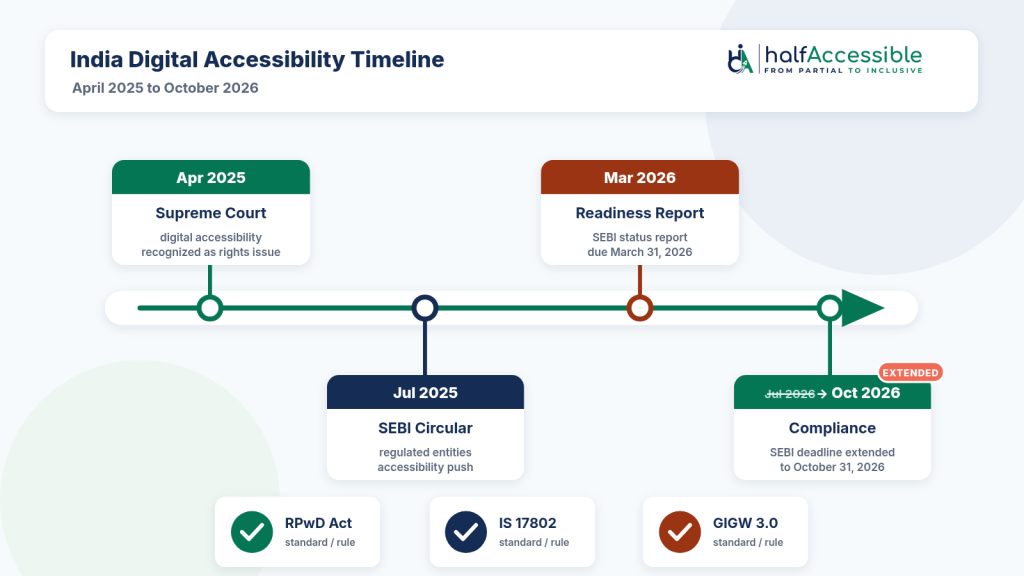
India digital accessibility compliance rests on four rules: the RPwD Act 2016, the IS 17802 standard, GIGW 3.0 for government websites and apps, and SEBI’s circulars for the securities market. On April 30, 2025, India’s Supreme Court ruled that digital access is part of the right to life and personal liberty under Article 21. SEBI issued a mandatory circular on July 31, 2025, and on August 14, 2025 the Reserve Bank of India told the banks, NBFCs and payment system providers it regulates to comply with the judgment (RBI/2025-26/74). The nearest deadline: SEBI-regulated entities must finish their accessibility audit and fix its findings by October 31, 2026.
This guide explains what each law and standard requires, who must comply and by when. HalfAccessible’s India audits are founder-led by Mohammad Shadab Saifi (IAAP CPACC, WAS and CPWA) with more than 10 years of accessibility experience, and test websites, apps and documents against WCAG 2.1 Level AA (the web baseline IS 17802 adopts) and WCAG 2.2 AA.
India Accessibility Compliance At A Glance
- Oct 31, 2026: SEBI deadline for regulated entities to finish the digital accessibility audit and fix its findings (Source: SEBI circular, July 31, 2026)
- Article 21: Supreme Court, April 30, 2025: inclusive digital access is part of the right to life and personal liberty (Source: Supreme Court judgment)
- WCAG 2.1 AA: Web baseline of IS 17802, which Rule 15 of the RPwD Rules has applied to ICT products and services since May 2023 (Source: RPwD Amendment Rules, 2023 (DEPwD))
- Rs 5 lakh: Maximum fine for later contraventions under Section 89 of the RPwD Act (up to Rs 10,000 for a first) (Source: RPwD Act, 2016 (DEPwD))
Choose Your Next Step
Not sure which of these rules apply to you? Book the free call, or answer a few questions in our free needs assessment for a recommendation. Need a fast scoped check first? Start a $500 Quick Audit. Banks, brokers and other SEBI-regulated firms can also see our banking and finance accessibility services.
India Accessibility Compliance Audit
Best for: teams that know they are in scope and need an audit report before October 31
Founder-led manual testing of your key journeys with JAWS, NVDA, VoiceOver and TalkBack, mapped to WCAG, IS 17802, GIGW 3.0 and SEBI requirements, with a fix-ready report.
Free 30-Minute Call
Best for: first conversations, scoping and quotes
Talk through which Indian rules apply to you, what to audit first and what it will cost. No technical prep needed.
Book a free 30-minute call (opens in a new tab)
$100 Technical Consultation
Best for: teams with audit findings or a developer who needs answers now
A one-hour working session to walk through audit findings, talk with your developer or review site issues live.
Key Takeaways
- On April 30, 2025, India’s Supreme Court ruled that digital access is a fundamental right under Article 21, creating an enforceable basis for accessibility mandates across sectors.
- SEBI issued a mandatory digital accessibility circular in July 2025. A July 31, 2026 SEBI circular extended the deadline for both the third-party accessibility audit and remediation of its findings to October 31, 2026 (originally April 30 and July 31, 2026).
- IS 17802 is India’s national ICT accessibility standard, published by the Bureau of Indian Standards (BIS). Part 1 (2021) adopts the European standard EN 301 549, whose web requirements match WCAG 2.1 Level AA (part of the W3C’s WCAG standards). Since May 2023, Rule 15 of the RPwD Rules requires ICT products and services to comply with it.
- GIGW 3.0 is mandatory for all Indian government websites and apps. It has 88 guidelines across quality, accessibility, cybersecurity, and lifecycle management. STQC (under MeitY) certifies conforming sites as a Certified Quality Website (CQW), valid for three years with annual surveillance audits.
- WCAG 2.1 Level AA is the technical baseline for all Indian accessibility compliance. Auditors in 2026 are expecting WCAG 2.2 alignment in practice.
- Under Section 89 of the RPwD Act, breaking the Act or its rules can lead to a fine of up to Rs 10,000 for a first contravention and Rs 50,000 to Rs 5 lakh for later ones. Regulators can add their own action, such as SEBI enforcement.
India’s Accessibility Legal Framework at a Glance
India’s digital accessibility framework is built on four interconnected pillars. Each applies to a different sector, but all of them reference the same underlying technical standard: WCAG 2.1 Level AA, adopted in India as IS 17802.
The four pillars at a glance:
| Framework | What it is | Who it covers | Technical baseline |
|---|---|---|---|
| RPwD Act 2016 (Rights of Persons with Disabilities Act) | The foundational law. It gives persons with disabilities a legal right to equal access to digital services and infrastructure, with enforceable duties. | Government bodies, public sector undertakings and private service providers (Section 46) | Rule 15 of the RPwD Rules points ICT products and services to IS 17802 |
| IS 17802 | The Bureau of Indian Standards technical standard. Part 1 is a technical adoption of EN 301 549 V3.2.1; Part 2 sets out how conformance is tested. | Websites, documents, software, mobile apps and hardware | WCAG 2.1 Level AA for web content |
| GIGW 3.0 (Guidelines for Indian Government Websites and Apps) | The operational standard published by NIC under MeitY, with 88 guidelines covering quality, accessibility, cybersecurity and lifecycle management. | All central and state government websites and apps | WCAG 2.1 Level AA |
| SEBI’s digital accessibility circulars | Extend these requirements to the regulated securities market, with audit and remediation deadlines. | Stock exchanges, clearing corporations, depositories, brokers and other intermediaries, mutual funds, portfolio managers, investment advisers and research analysts | WCAG 2.1 (or the latest version), GIGW and IS 17802 |
Banks and payment firms are covered separately by the RBI and the July 2024 banking accessibility standards.
Together, these four frameworks cover government at every level, public sector undertakings, the financial sector, healthcare platforms, and increasingly the private sector. The Supreme Court’s April 2025 ruling makes it clear that this coverage will only expand.
The RPwD Act 2016: The Legal Foundation
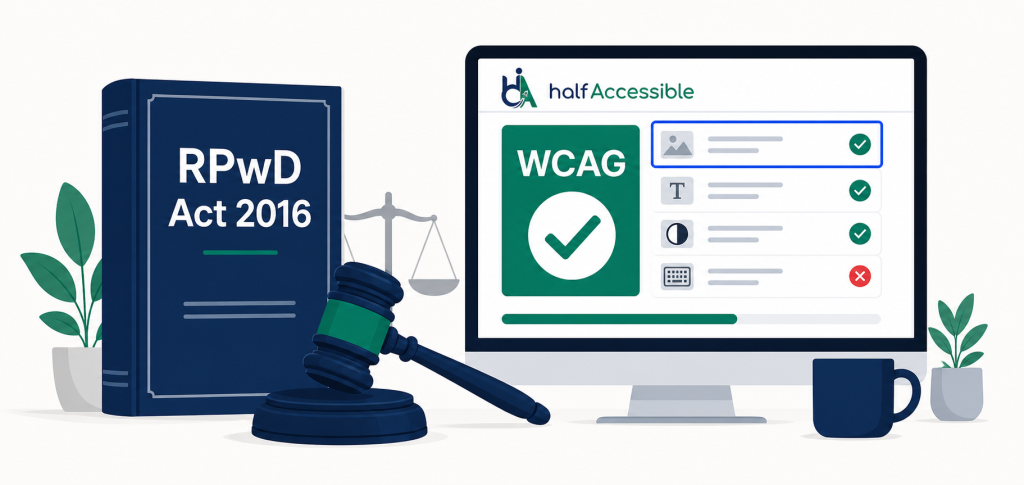
The Rights of Persons with Disabilities Act, 2016 is the primary legislation that makes accessibility a legal obligation in India. It replaced the earlier Persons with Disabilities Act of 1995 and brought India’s disability law in line with the UN Convention on the Rights of Persons with Disabilities (CRPD), which India ratified in 2007.
Section 42 of the RPwD Act covers access to information and communication technology: the appropriate government must take measures so that content in audio, print and electronic media is available in accessible formats, electronic media offer audio description, sign language and captions, and everyday electronic goods follow universal design. Section 46 then requires service providers, “whether Government or private”, to provide services in line with the accessibility rules. Those rules are Rule 15 of the RPwD Rules, 2017, which since the RPwD (Amendment) Rules, 2023 (G.S.R. 359(E), May 10, 2023) require websites, apps and other ICT products and services to comply with IS 17802. Accessibility standards for the banking sector were added to Rule 15 in July 2024.
Section 89 sets the penalty for contravening the Act or its rules: a fine of up to Rs 10,000 for a first contravention, and Rs 50,000 to Rs 5 lakh for any later contravention. The Act’s imprisonment provisions (Sections 91 and 92) deal with fraudulently claiming disability benefits and with atrocities against persons with disabilities, not with inaccessible websites. In practice, the bigger risks for an inaccessible platform are regulator action (for example by SEBI), complaints to the Chief and State Commissioners for Persons with Disabilities, and court petitions.
The Supreme Court’s April 2025 judgment elevated this further. By ruling that digital access is part of the right to life under Article 21 of the Constitution, the Court made inaccessible digital services not just a statutory violation but a constitutional one. This creates the legal foundation for challenges against any organization providing inaccessible digital services to Indian users.
According to DigitalA11Y’s overview of India’s digital accessibility laws, the RPwD Act framework, combined with the Supreme Court ruling, now creates enforceable obligations across government, financial services, healthcare, education, and telecommunications.
IS 17802: India’s National Accessibility Standard
IS 17802 is the Bureau of Indian Standards (BIS) standard for accessibility of information and communication technology (ICT) products and services, published as IS 17802 (Part 1): 2021, Requirements and IS 17802 (Part 2): 2022, which covers how conformance is determined. It is India’s formal national standard for web and digital accessibility.
Part 1 is a technical adoption of the European standard EN 301 549 V3.2.1, with references changed for India. That is why its web requirements line up with WCAG 2.1 Level A and AA: meeting IS 17802 for a website or app means meeting WCAG 2.1 Level AA, plus the extra EN 301 549 requirements for things like documents, software, two-way voice and video, and support documentation.
So IS 17802 is broader than WCAG. It applies to web and non-web ICT, including electronic documents, software, mobile apps, kiosks and hardware, and its Part 2 test methods suit the Indian regulatory and procurement context. Accord Compliance’s guide to IS 17802 summarizes how the standard is used in practice.
In practice, IS 17802 applies to:
- Government websites and digital services at central and state levels. All government digital platforms are expected to conform to IS 17802 as the national standard referenced by the RPwD Act.
- Public Sector Undertakings (PSUs). Public sector banks, insurers and other PSUs are covered by the same Rule 15 standards as other establishments, and banks also by the sector’s own accessibility standards.
- Regulated financial entities. SEBI’s July 31, 2025 circular names IS 17802 alongside WCAG 2.1 (or the latest version) and GIGW as the benchmarks regulated entities must meet. For banks, the Ministry of Finance notified “Accessibility Standards and Guidelines for Banking Sector” on February 2, 2024, and the RBI’s October 11, 2024 circular asked payment system participants to apply them.
- Procurement contexts. Organizations supplying digital products or services to government entities are increasingly required to demonstrate IS 17802 conformance as a procurement condition. This mirrors the VPAT/ACR requirement in the US context.
For practical compliance purposes, IS 17802 means WCAG 2.1 Level AA tested and verified. In 2026 audit cycles, STQC and accredited auditors are expecting WCAG 2.2 alignment in practice, even where WCAG 2.1 remains the formal baseline.
GIGW 3.0: The Standard for Government Websites
GIGW 3.0 (Guidelines for Indian Government Websites and Apps, third edition) is the mandatory operational standard for all central and state government websites and mobile applications in India. It was formulated by the National Informatics Centre (NIC) under the Ministry of Electronics and Information Technology (MeitY), jointly with the STQC Directorate and CERT-In, and was released in 2023, replacing GIGW 2.0 (2019).
According to the official GIGW guidelines portal, GIGW 3.0 conforms to WCAG 2.1 Level AA and adds 17 new success criteria compared with GIGW 2.0 (which followed WCAG 2.0). Its 88 guidelines fall into four domains (25 quality, 50 accessibility, 3 cybersecurity and 10 lifecycle management):
- Accessibility — WCAG 2.1 Level AA as the minimum standard. Government websites must support screen readers, provide meaningful alt text on images, maintain WCAG color contrast ratios, enable full keyboard navigation, provide captions and transcripts for all video and audio content, and support Indian language accessibility. Mobile accessibility is explicitly covered.
- Quality — Content accuracy, currency, governance, contact information, grievance mechanisms, and search functionality. GIGW 3.0 requires a dedicated accessibility statement on every government website, along with a documented feedback mechanism for users to report accessibility barriers.
- Cybersecurity — Formulated by CERT-In. For certification, the security audit can be done by STQC, an STQC-empanelled lab, NIC, or a CERT-In-empanelled auditor (the “safe to host” certificate) and submitted to STQC. This ties website certification to security as well as accessibility.
- Lifecycle Management — Continuous compliance monitoring through centralized dashboards, surveillance audits, and governance processes for maintaining accessibility over time.
Non-compliance with GIGW 3.0 is not merely a technical failure. According to the IMPRI policy review of GIGW 3.0, it represents a failure of the statutory obligation under the RPwD Act to provide equally accessible public services to all citizens, including persons with disabilities.
SEBI’s Digital Accessibility Mandate: What It Requires
The most significant development in India digital accessibility in recent years is SEBI’s July 31, 2025 circular mandating accessibility compliance for all SEBI-regulated entities.
The mandate applies to all entities regulated by SEBI — stock exchanges, brokers, mutual funds, portfolio managers, investment advisers, depositories, custodians, alternative investment funds, and fintech platforms operating in India’s capital markets.
What Triggered the Mandate
The background was India’s Supreme Court judgment of April 30, 2025 (Pragya Prasun v. Union of India, with Amar Jain v. Union of India), which held that inclusive digital access is an intrinsic part of the right to life and personal liberty under Article 21. The Court issued 20 directions to the Centre, the RBI and other authorities, mainly to make digital KYC accessible for blind and low-vision people and acid-attack survivors. SEBI’s July 31, 2025 circular followed three months later.
SEBI’s December 8, 2025 clarification added that “Investors’ Right to have digital accessibility” will be included in the Investor Charters SEBI publishes for regulated entities. Accessibility is now an explicitly recognized investor right, not just a regulatory requirement.
Technical Requirements
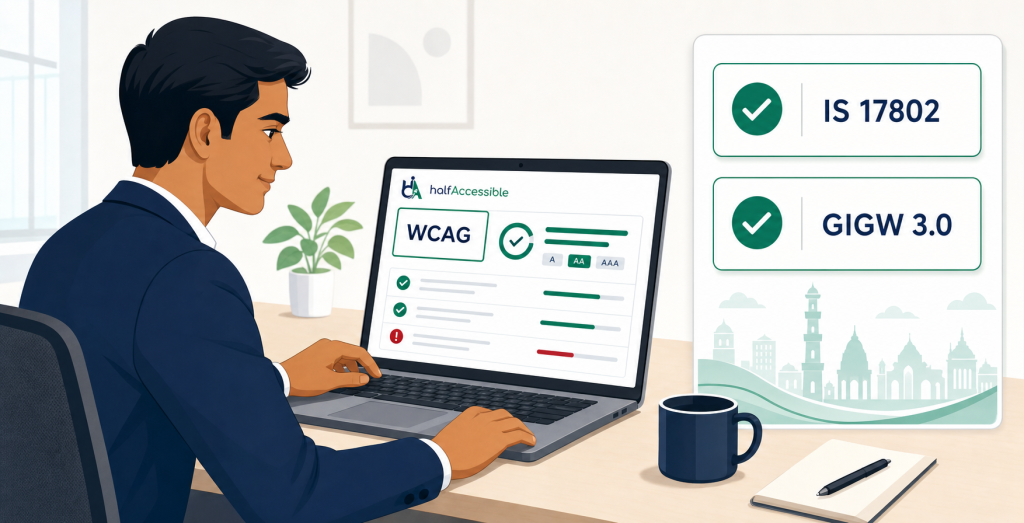
Regulated entities must comply with three technical standards at the same time:
- WCAG 2.1 or the latest version available at the time of audit. In practice, WCAG 2.2 is the expected standard in 2026 audit cycles.
- GIGW guidelines (latest version, currently GIGW 3.0) where they apply to the digital platform.
- IS 17802, India’s national standard for ICT accessibility.
According to Deque’s analysis of SEBI’s digital accessibility framework, this triple-standard requirement means regulated entities must satisfy all three frameworks, using the most demanding interpretation where they overlap.
The SEBI Compliance Timeline
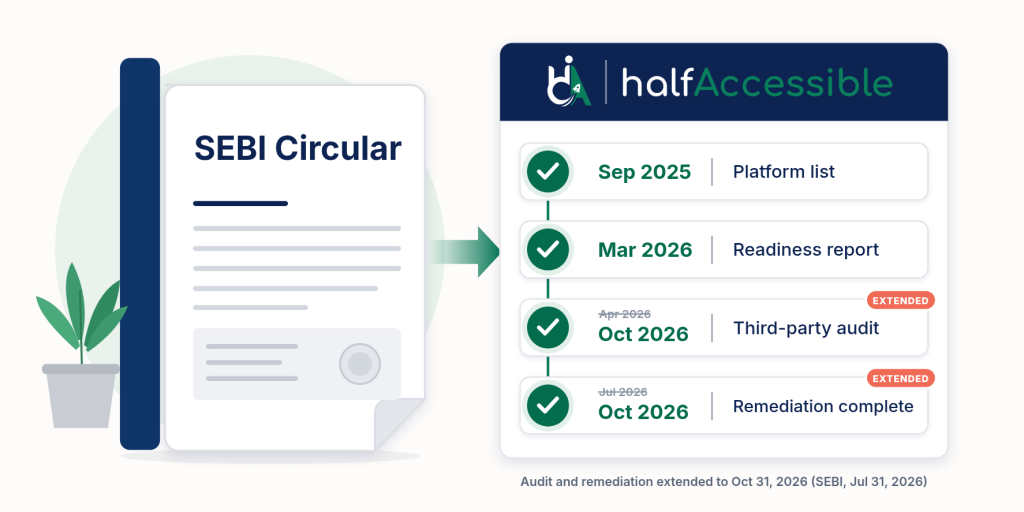
SEBI’s roadmap for regulated entities has four milestones:
| Milestone | Deadline | What SEBI asks for |
|---|---|---|
| List of digital platforms | September 30, 2025 (after the August 29, 2025 extension) | A list of every digital platform, which sets the audit scope and ongoing monitoring. |
| Readiness and compliance status report | March 31, 2026 | A platform-by-platform report stating whether each platform meets WCAG Level AA. The December 8, 2025 clarification replaced the earlier step of appointing an IAAP-certified auditor by December 14, 2025. |
| Third-party accessibility audit | October 31, 2026 (originally April 30, 2026; extended by SEBI on July 31, 2026) | An audit of all platforms by an IAAP-certified (International Association of Accessibility Professionals) auditor, combining automated tools, manual testing and assistive technology checks. |
| Remediation of all findings | October 31, 2026 (originally July 31, 2026) | Every audit finding fixed. The same circular left all other provisions of the earlier circulars unchanged. |
According to L&E Global’s analysis of the SEBI mandate, the original July 31, 2025 circular and SEBI’s September 25, 2025 compliance guidelines, entities that fail to meet these deadlines face regulatory scrutiny and potential enforcement action. Entities must also confirm compliance every year after that.
STQC Certification: How Government Websites Get Certified
The Standardisation Testing and Quality Certification (STQC) Directorate, under MeitY, runs India’s Website Quality Certification scheme. A site that passes is awarded the “Certified Quality Website” (CQW) mark, the official recognition that a government website meets GIGW 3.0, including its WCAG 2.1 AA accessibility requirements. If you are planning an STQC audit for a government project, the steps below are what to expect.
The STQC certification process follows a defined sequence. Understanding it matters if your organization is a government entity, a PSU, or a vendor supplying digital services to the government.
Pre-audit preparation. Map the website or app against the GIGW 3.0 conformity matrix, complete an internal accessibility review, and fix obvious failures before you apply. Many organizations commission an independent accessibility audit at this stage.
Formal audit submission. The organization applies through STQC’s process. The assessment covers the GIGW 3.0 guidelines, including WCAG 2.1 AA accessibility and quality and content standards. A security audit, by STQC, an STQC-empanelled lab, NIC or a CERT-In-empanelled auditor, is also submitted to STQC.
Audit and findings. STQC’s audit combines automated testing tools with manual inspection and assistive technology testing. Findings are documented and shared with the organization for remediation.
Remediation and re-verification. The organization addresses all audit findings and resubmits evidence. STQC verifies the fixes before issuing the certificate.
Certificate issuance. Under STQC’s Website Quality Certification Scheme rules, the certificate is valid for three years from the date of issue, subject to annual (and surprise) surveillance audits; major changes or failed surveillance can lead to suspension. This means accessibility is not a one-time project for government entities but a continuous compliance obligation.
According to Lumiversesolutions’ step-by-step STQC guide, the full process typically takes five to six months from initial preparation to certificate issuance, depending on the size of the website and how quickly identified issues are remediated. That is a consultancy estimate, not an official STQC timeline.
Draft RPwD (Amendment) Rules, 2026: What Is Proposed (Not Final)
The draft Rights of Persons with Disabilities (Amendment) Rules, 2026 were issued by the Department of Empowerment of Persons with Disabilities (DEPwD) for consultation in a notification dated 16 July 2026 and published in the Gazette on 20 July 2026. They are not final, and the details may change before the rules are notified. As summarised by NASSCOM, the draft would:
- make specified IS 17802 (Part 1): 2021 and IS 17802 (Part 2): 2022 requirements mandatory for establishments that make ICT products and services available in India, including websites, mobile apps, software, and electronic documents;
- require covered establishments to publish an Accessibility Conformance Report (ACR) in human-readable and machine-readable formats, and refresh it at least once every two years;
- require an accessibility review before a major change to a covered product or service goes live;
- give establishments with turnover of ₹500 crore or more (consolidated group turnover is proposed) one year to meet specified core requirements and smaller establishments 18 months, with full compliance with the referenced standards within two years.
The Supreme Court has since given the Union six months to finish these non-negotiable accessibility norms and ordered missing disability commissioners to be appointed. For the full timeline, see our RPwD Act 2026 guide to the new disability rules and the Supreme Court order.
If you already test to IS 17802 and WCAG 2.1 AA (or 2.2 AA), you are well placed. Treat these timelines as provisional and check the final notified text, or take legal advice, before you plan around them. If you run an agency, we cover the commercial side of this shift in why India is embracing digital accessibility compliance.
India Digital Accessibility Compliance: Who Must Comply and By When
The table below summarizes India digital accessibility requirements by sector:
| Sector | What applies | Deadline or status |
|---|---|---|
| Central and state government websites and apps | GIGW 3.0, IS 17802 and WCAG 2.1 AA. STQC CQW certification is valid for three years with annual surveillance audits. | Active now under the RPwD Act |
| Public Sector Undertakings (PSUs) | Public sector banks, insurers and state-owned enterprises must meet IS 17802 under Rule 15 of the RPwD Rules. Banks also fall under the 2024 banking accessibility standards and the RBI’s August 2025 instruction to comply with the Supreme Court’s digital KYC directions. | Active now |
| SEBI-regulated entities | Stock exchanges, clearing corporations, depositories, brokers, mutual funds, portfolio managers, investment advisers and research analysts must meet WCAG 2.1 (or the latest version), GIGW 3.0 where applicable, and IS 17802. | Third-party audit and all remediation by October 31, 2026 (SEBI’s July 31, 2026 extension) |
| Private healthcare platforms | Hospital, diagnostics and telemedicine websites and apps are service providers under Section 46 of the RPwD Act, so the Rule 15 standards (IS 17802 for ICT) apply. WCAG 2.1 AA is the practical test; platforms tied to government health schemes also meet GIGW-based requirements through those schemes. | Applies now through Section 46 and Rule 15 |
| EdTech and e-learning platforms | Platforms serving government institutions or schemes face IS 17802 and WCAG 2.1 AA, increasingly written into procurement conditions. | Set by each contract or scheme |
| Private businesses | Even without government contracts or SEBI regulation, they are “service providers” under Section 46, and Rule 15 already points ICT products and services to IS 17802. The draft RPwD (Amendment) Rules, 2026 would make IS 17802 requirements mandatory, with Accessibility Conformance Reports, for every establishment offering ICT products or services in India. | Enforcement has focused on government, banking and SEBI-regulated firms so far; the draft rules are not yet final |
Combined with the Supreme Court’s Article 21 ruling, that makes 2026 the year to get an audit on file.
Our government and public sector accessibility services cover GIGW 3.0 compliance, IS 17802 audits, and STQC preparation for public sector organizations. For banks, brokers and other financial firms, our banking and finance accessibility services and India accessibility compliance audit are built for the third-party audit SEBI’s circulars require, and our wider accessibility audit services cover WCAG 2.2 AA.
How to Get Compliant
The compliance path is the same regardless of which Indian standard applies to your organization. The underlying technical requirement is WCAG 2.1 Level AA, verified through manual testing with assistive technology.
Start with a gap assessment. Run your digital platforms through automated accessibility testing and document what is failing. Automated tools miss many issues: when the UK Government Digital Service tested 13 automated checkers on a page with 142 deliberate barriers, the best found only 40% (GDS tool audit). So a scan gives you a starting picture, not a complete one. For SEBI-regulated entities, this was the basis of the readiness report that was due on March 31, 2026.
Get a third-party accessibility audit. For SEBI compliance, an independent audit by an IAAP-certified auditor is mandatory. For GIGW 3.0 and STQC certification, STQC does the certification audit, but organizations usually commission an independent audit first so they can fix issues before the official submission. Our India accessibility compliance audit is led by our IAAP-certified founder, Mohammad Shadab Saifi (CPACC, WAS, CPWA), and uses JAWS, NVDA, VoiceOver, and TalkBack across web, mobile, and documents, with findings mapped to WCAG, IS 17802 and GIGW 3.0.
Remediate systematically. Audit findings should be prioritized by severity and legal risk. WCAG Level A failures first, then Level AA. Keyboard navigation failures, screen reader compatibility issues, and form accessibility problems are the most commonly cited in complaints and are typically the highest priority.
Produce an accessibility statement. GIGW 3.0 requires a published accessibility statement on every government website. SEBI’s framework requires documented evidence of compliance commitment. A clear, accurate accessibility statement with a feedback mechanism demonstrates good faith and is often a required document in audits and procurement.
Build a monitoring process. Accessibility degrades over time as new features are added, third-party tools are integrated, and content is updated. STQC runs annual surveillance audits on certified sites, and SEBI expects regulated entities to confirm compliance every year. Our accessibility monitoring and governance service handles this through scheduled automated scans, manual sampling, and regression alerts after launches.
Not sure which of these applies to you? Book a free 30-minute call (opens in a new tab) to understand where you stand and get a quote, or request a free needs assessment (we reply within two business days). If you already have audit findings or a developer with questions, the $100 one-hour technical consultation is a working session to review them live.
The Bottom Line
India’s accessibility landscape changed fundamentally in 2025. The Supreme Court made digital access a constitutional right. SEBI created enforceable compliance deadlines for the entire financial sector. GIGW 3.0 set mandatory certification requirements for every government website. And IS 17802 formalized WCAG 2.1 as the national standard across sectors.
The October 31, 2026 deadline for SEBI-regulated entities to complete accessibility audits and remediation (extended from April 30 and July 31, 2026) is the most pressing near-term milestone. But the broader direction is clear: India digital accessibility is moving from aspiration to enforcement, and the window for voluntary adoption is closing.
Organizations that begin compliance work now — with a proper audit, a documented remediation plan, and an ongoing monitoring process — will be ready when their regulatory deadline arrives. Those that wait until the last quarter will be competing for audit slots and remediation capacity in a market that is already filling up.
If you want to understand where your platforms stand against IS 17802, GIGW 3.0, or the SEBI accessibility requirements, start a $500 Quick Audit or request a free needs assessment. We work with government entities, PSUs, financial sector firms, and private businesses across India’s accessibility compliance landscape.
SEBI Deadline October 31, 2026: What To Do In The Time Left
As of October 12, 2026, SEBI-regulated entities have less than three weeks left to finish the accessibility audit of every digital platform and remediate its findings. The SEBI circular of July 31, 2026 moved both the audit and the remediation deadlines to October 31, 2026. Appointing the auditor, publishing the March 31 compliance status report, and yearly reporting rules from the earlier circulars stay in force.
If your team is still scoping work, use this short path:
- Confirm you are in scope. Stock brokers, mutual funds, depositories, clearing corporations, investment advisers, research analysts and other SEBI-regulated entities listed in the July 31, August 29, September 25 and December 8, 2025 circulars must finish both the audit and remediation by October 31, 2026.
- Book an IAAP-credentialed auditor now. SEBI requires the audit to be done by an IAAP-certified auditor. HalfAccessible’s India audits are led by founder Mohammad Shadab Saifi (IAAP CPACC, WAS, CPWA) with 10+ years of accessibility testing experience.
- Prioritize the journeys SEBI cares about. Login, KYC, onboarding, trading or order flows, statements, grievance redressal and help content usually carry the highest investor-impact findings.
- Remediate and keep evidence. Fix Critical and Serious issues first, re-test, and keep the audit report, fix log and accessibility statement for yearly compliance reporting.
Not sure whether your platform is ready for a full SEBI audit? Start with a free 30-minute call (opens in a new tab) to understand where you stand and get a written quote, or book a $100 one-hour technical consultation if you need a live walkthrough with a developer. For teams that already know the scope, go straight to the India accessibility compliance audit or the $500 Quick Audit. A free scanner such as AccessibilityScore.in is a useful starting point that complements, but does not replace, a manual audit.
Get a Formal India Accessibility Audit
This guide covers what the RPwD Act, IS 17802, GIGW 3.0 and SEBI’s accessibility circulars require. If you need a formal audit report mapped to these standards, with an Accessibility Conformance Report your organization can publish, see our India Website Accessibility Audit Services. Every audit is led by our IAAP-certified founder (CPACC, WAS, CPWA) with 10+ years of accessibility testing, which is the credential SEBI’s circulars ask regulated entities to use.
How much does an India accessibility audit cost? Our packages are fixed-price (see pricing):
- Quick Audit, $500: up to 5 key page templates, tested manually and with screen readers, with a top-issues report your developers can act on.
- Complete Audit, $2,000: up to 25 templates or key user flows, tested with JAWS, NVDA, VoiceOver and keyboard, mapped to WCAG 2.2 AA and IS 17802, with a re-test of fixed issues. This is the right fit for a SEBI audit before October 31, 2026.
- Free 30-minute call (opens in a new tab): a first conversation to scope your platforms, standards and deadlines and get a quote.
- One-hour technical consultation, $100: a working session to walk through audit findings, talk with your developer or review issues live.
Want to see what you get first? View our sample audit report. Need a published conformance report? Request an ACR or VPAT quote. Already have an audit? Our accessibility remediation service fixes the findings, and our banking and finance accessibility and government accessibility pages cover the sector rules.