
Client & Context
WCAG compliance verification is the step most accessibility projects skip, and the step that separates “we fixed some issues” from “we can prove conformance.” A11Y Pros, a US-based accessibility agency led by Ryan Mack, brought HalfAccessible in across two engagements to provide exactly that proof for a client website. Agency partners who need the same white-label model can also see our digital agencies white-label accessibility specialty.
Choose Your Next Step
Need a VPAT that buyers can trust, or an independent re-test after your fixes? Start with a conversation, request a VPAT & ACR quote, or book a technical hour. Audits start at the $500 Quick Audit and the $2,000 Complete Audit (see accessibility audit pricing), and agencies can white-label the work through our agency partner program.
Free 30-Minute Call
Best for: first conversations, scoping and quotes
Tell us what a buyer or client has asked for, which VPAT edition you need and where remediation stands. We explain where you stand, what to test first and send a quote. No technical prep needed.
Book a free 30-minute call (opens in a new tab)
VPAT & ACR Quote
Best for: teams with a procurement request or an RFP deadline
Manual WCAG 2.2 AA testing, verification of your fixes and an ACR written from the verified state, scoped and priced in writing before work starts.
$100 Technical Consultation
Best for: teams that need expert technical answers now
A one-hour working session to review audit or re-test findings, talk partial fixes through with your developer, or check issues on your site live.
The Challenge
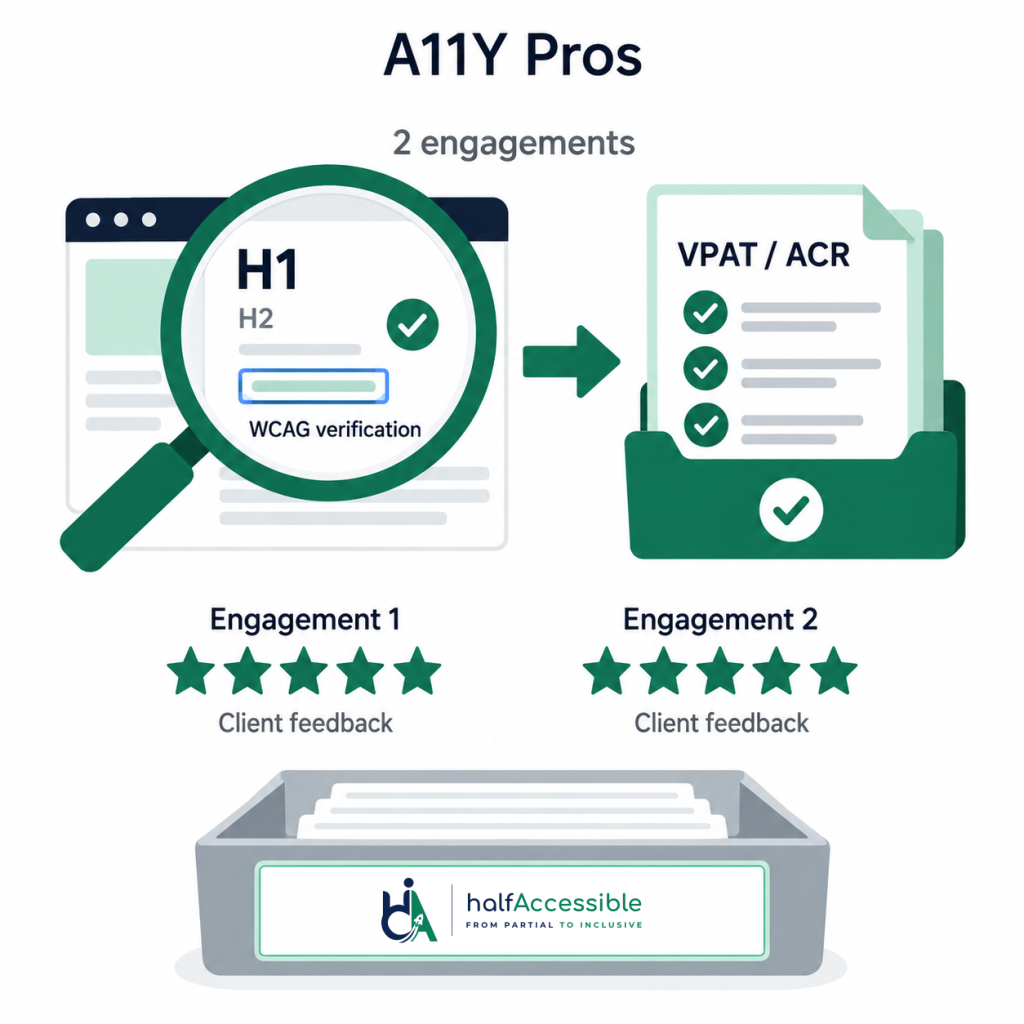
The work ran as two separate engagements on the same client website. The second was the harder part: every original finding needed independent re-testing, and the final position had to be documented in a VPAT that procurement teams would accept without follow-up questions, the same artifact Section508.gov explains for ICT sellers (opens in a new tab).
| Engagement | When | Scope | Deliverable |
|---|---|---|---|
| Engagement 1: Full audit | February | A full website accessibility audit against WCAG 2.2 (opens in a new tab) AA | Severity-ranked, developer-ready findings |
| Engagement 2: Verification + VPAT | May–June | Independent re-test of every original finding after the remediation work was completed | A verified status for each finding and a procurement-ready VPAT (ACR) |
Verification audits demand a different discipline than first-pass audits. Each issue must be re-tested in the exact context it was reported (same component, same assistive technology, same success criterion), and partial fixes have to be caught, not waved through.
Our WCAG Compliance Verification Process
We re-tested every finding manually using NVDA (opens in a new tab), JAWS, VoiceOver and keyboard-only navigation, mapped each result to its WCAG 2.2 success criterion (opens in a new tab), and gave it one of three statuses:
| Status | What it means | What happens next |
|---|---|---|
| Resolved | The barrier is gone in the original context and with every assistive technology tested | Closed and carried into the VPAT as verified |
| Partially resolved | The fix works in one place or one state but not another | Returned with precise, developer-ready guidance instead of a vague “still failing” note, then re-tested |
| Regressed | The fix broke something nearby, or the original barrier came back | Logged as a new finding with steps to reproduce, then re-tested |
Automated scanners help with coverage, but W3C WAI notes that evaluation tools cannot check every accessibility aspect (opens in a new tab); human judgement with assistive technology remains required. Once the verification pass was clean, we authored the VPAT (ACR) from the verified state of the site: honest conformance claims, documented exceptions, and language procurement reviewers actually understand, using the structure buyers expect from the ITI VPAT template (opens in a new tab).
The Results
- Full WCAG 2.2 AA audit delivered with severity-ranked, developer-ready findings
- Independent verification of all remediation work, with partial fixes caught and resolved
- Procurement-ready VPAT delivered as the final compliance artifact
- Both contracts completed on time and rated 5.0 out of 5.0 on Upwork
For an accessibility agency, sub-contracting verification to a second, independent set of eyes is also good governance: the team that fixes issues should not be the only team that signs off on them.
Why Independent Verification Matters
Remediation teams grade their own homework under deadline pressure. In our verification work, a meaningful share of “fixed” issues turn out to be partially fixed. None of this is bad faith; it is what happens when the same eyes that wrote the fix also sign off on it. Typical examples:
| Fix marked done | What the re-test finds | WCAG criterion |
|---|---|---|
| Contrast corrected | Fixed in one component, but its hover or focus state still fails | 1.4.3 Contrast (Minimum) (opens in a new tab) |
| ARIA label added | The control now has a name, but it announces the wrong thing | 4.1.2 Name, Role, Value (opens in a new tab) |
| Keyboard trap removed | The trap moved to another part of the flow instead of disappearing | 2.1.2 No Keyboard Trap (opens in a new tab) |
What Buyers Check In A VPAT
- 4: VPAT 2.5Rev editions (508, EU, WCAG and INT), so the edition must match the buyer’s market and contract (Source: ITI VPAT (opens in a new tab))
- 4: conformance levels per criterion: Supports, Partially Supports, Does Not Support and Not Applicable (Source: ITI VPAT 2.5 (opens in a new tab))
- 9: success criteria added in WCAG 2.2, which the WCAG and INT editions include (Source: W3C WAI (opens in a new tab))
- 0: official VPAT certifications: ITI does not review VPATs, though some solicitations require a third-party audit (Source: ITI VPAT FAQ (opens in a new tab))
Independent WCAG compliance verification breaks that loop. A second, independent tester re-runs each finding with fresh assistive technology sessions and no memory of how hard the fix was to write. The result either passes or it does not, and the VPAT that follows inherits that honesty. That audit trail also supports the technical baseline referenced in ADA.gov web guidance (opens in a new tab) and parallel ICT frameworks such as Section 508 (opens in a new tab).
What We Re-Test in Every Verification Pass
| Check | What we look for |
|---|---|
| Original failure context | The same page, component and interaction that produced the finding |
| Screen reader output | Names, roles, values and announcements with NVDA, JAWS and VoiceOver |
| Complete keyboard journeys | Focus order, visible focus and escape routes from start to finish |
| Adjacent regressions | Fixes that broke something nearby, which happens more often than teams expect |
| Conformance language | Whether each VPAT claim still matches the verified behaviour |
Agencies like A11Y Pros use this model because it scales trust: their clients receive a report that two independent specialists stand behind, and disputed findings get resolved with evidence instead of opinion. For procurement-bound products, that second signature is often the difference between a VPAT that closes the deal and one that triggers a vendor questionnaire.
Need WCAG Compliance Verification You Can Stand Behind?
If you have completed remediation and need independent WCAG compliance verification, or a VPAT backed by real testing, see our accessibility audit services, accessibility remediation and VPAT & ACR documentation. Every audit and verification is led by founder Shadab Saifi, who holds the IAAP (opens in a new tab) CPACC, WAS and CPWA certifications and DHS Trusted Tester, with 10+ years in accessibility. See what you receive in our sample audit report.
Not sure which path fits? Book the free 30-minute call (opens in a new tab): a first conversation to understand where your product stands, which VPAT edition you need and what to test, and to get a quote. Choose the $100 one-hour technical consultation when your team needs hands-on help now, for example reviewing re-test findings with your developer or checking issues on your site live. Agencies white-labelling this work should also review the agency partner program. You can also compare accessibility audit pricing or browse our services.
Prefer neighbouring proof? See our VPAT for SaaS (Happeo) case study, accessibility audit and VPAT SaaS engagement, and the VPAT for SaaS guide.