
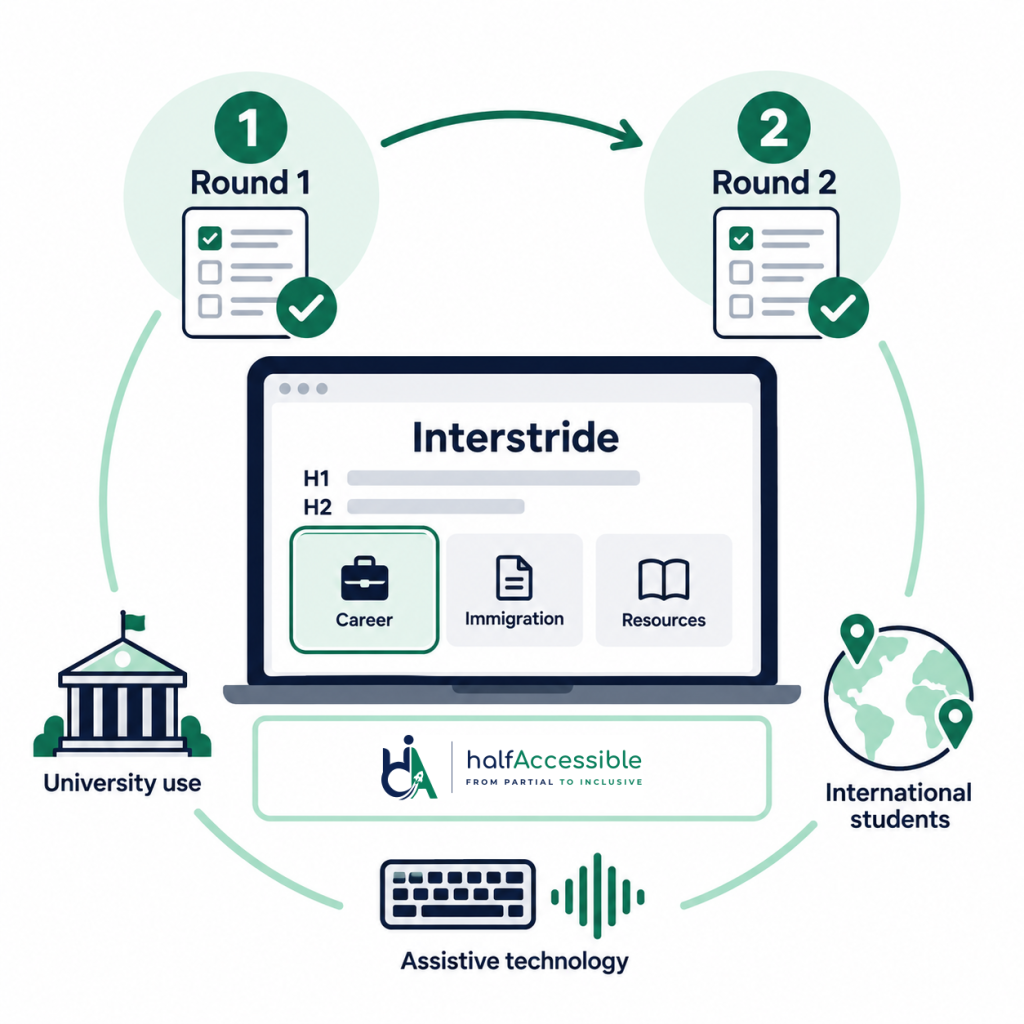
Client & Context
An EdTech accessibility audit carries higher stakes than most: universities are public-sector buyers, ADA Title II deadlines now reference WCAG directly, and students who rely on assistive technology cannot simply choose a different tool their school has licensed. Interstride — the career and immigration platform for international students — engaged HalfAccessible for exactly this reason, first in November 2025 and again in February 2026.
Choose Your Next Step
Need the same EdTech accessibility audit evidence for your university buyers? Pick how you want to start.
Free 30-Minute Call
Best for: EdTech teams fielding university accessibility questions who want to know where they stand, or need a quote.
Tell us about your platform, buyers and deadlines. We explain where you stand and scope a fixed-price EdTech accessibility audit.
Book a Free 30-Min Call (opens in new tab)
1-Hour Technical Consultation ($100)
Best for: product and developer teams that need expert technical answers now.
A working session to walk through audit findings or a procurement questionnaire, talk fixes through with your developer, or review issues on your platform live.
Quick Audit ($500)
Best for: teams that want fast, manual evidence on their key student journeys first.
Manual and assistive technology testing of up to 5 page templates, with prioritised findings you can act on before a full audit.
The Challenge
Interstride’s platform is feature-dense: dashboards, search and filtering, messaging, document workflows, and data visualisations. The audits had to cover real student journeys end to end, produce findings the in-house team could fix independently, and then hold up across a second release cycle months later.
Inside the EdTech Accessibility Audit
Each round combined automated scanning with deep manual testing: NVDA, JAWS, and VoiceOver passes over core flows, full keyboard-only navigation, focus-management review on dynamic views, and colour/contrast checks across the design system. Findings were mapped to WCAG 2.2 success criteria, ranked by user impact, and paired with code-level fix guidance. Automated scanners help with coverage, but W3C WAI notes that evaluation tools cannot check every accessibility aspect — human judgement with assistive technology remains required.
The second engagement re-tested previously reported issues alongside newly shipped features — turning a one-off audit into an accessibility regression baseline the team can keep building on.
The Results
- Two full audit rounds across six months, covering the complete student-facing platform
- Severity-ranked findings with developer-ready remediation guidance
- Re-test round confirming fixes and catching regressions before release
- Both engagements rated 5.0 out of 5.0 on Upwork
EdTech vendors that audit before procurement asks are the ones that keep university contracts when accessibility clauses tighten.
Why EdTech Cannot Wait on Accessibility
The regulatory clock is explicit now. The US Department of Justice ADA Title II web and mobile rule requires public universities to meet WCAG 2.1 Level AA on web content and mobile apps, including the third-party tools they license. The Department’s April 2026 interim final rule set these compliance dates:
The EdTech Accessibility Clock
- April 26, 2027: ADA Title II compliance date for WCAG 2.1 AA on web content and mobile apps of public entities serving 50,000+ people, including public universities (Source: ADA.gov web rule fact sheet)
- April 26, 2028: compliance date for public entities serving fewer than 50,000 people and special district governments (Source: ADA.gov web rule fact sheet)
- 21%: of US undergraduates reported having a disability in 2019–20 (Source: NCES Fast Facts)
Procurement teams are responding by pushing accessibility clauses and VPAT requests onto every EdTech vendor in their stack. Vendors with current audit evidence keep contracts; vendors without it become renewal risks. For a plain-language deadline briefing, see our DOJ Title II web accessibility deadline guide and the government accessibility specialty.
International students, Interstride’s exact audience, often combine assistive technology use with second-language reading, which makes plain structure and predictable interaction patterns even more valuable. Federal ICT buyers also recognise Section 508 as the parallel ICT accessibility framework for government-facing products.
What We Test on Student-Facing Platforms
| Platform area | What we check | Main WCAG criteria |
|---|---|---|
| Dashboards and data visualisations | Text alternatives and keyboard access to every insight | 1.1.1 Non-text Content, 2.1.1 Keyboard |
| Search and filtering | Announced result counts, operable facets and preserved focus | 4.1.3 Status Messages, 2.4.3 Focus Order |
| Messaging | Live region behaviour so new messages reach screen reader users | 4.1.3 Status Messages |
| Document workflows | Accessible upload, status feedback and error recovery | 3.3.1 Error Identification, 3.3.2 Labels or Instructions |
| Session timeouts | Warnings and extensions before a student loses their work | 2.2.1 Timing Adjustable |
Re-testing after the next release cycle is the part most vendors skip. Features ship, regressions creep, and last year’s audit becomes this year’s false confidence. Interstride’s second round converted the audit from a snapshot into a baseline — which is what universities actually want to see. Testing credentials behind that work follow paths published by the International Association of Accessibility Professionals (IAAP).
Selling Into Education?
If universities are asking about your accessibility posture, start with our accessibility audit services and the EdTech education accessibility specialty, pair findings with accessibility remediation or VPAT / ACR documentation, review accessibility audit pricing and our services, or start a $500 Quick Audit. Related proof: accessibility audit and VPAT for SaaS and the VPAT for SaaS guide.
Not sure where to start? Book a free 30-minute call (opens in new tab) to talk through your platform, university buyers and deadlines, and get a fixed-price audit quote. If your product or developer team needs expert technical answers now, book the $100 one-hour technical consultation to walk through findings or a procurement questionnaire live.
Why This Matters
Interstride’s platform serves international students navigating study and career decisions, which makes reliable keyboard and screen reader support a functional requirement, not just a compliance checkbox — a student using assistive technology still needs to complete the same applications and searches as everyone else. Testing across two release cycles, rather than a single audit, let HalfAccessible verify that new features shipped without reintroducing barriers fixed in the first round, which is the pattern that keeps a growing EdTech product compliant over time. Across both rounds of testing, the engagement maintained a 5.0 rating, reflecting consistent delivery as the platform continued to evolve.