
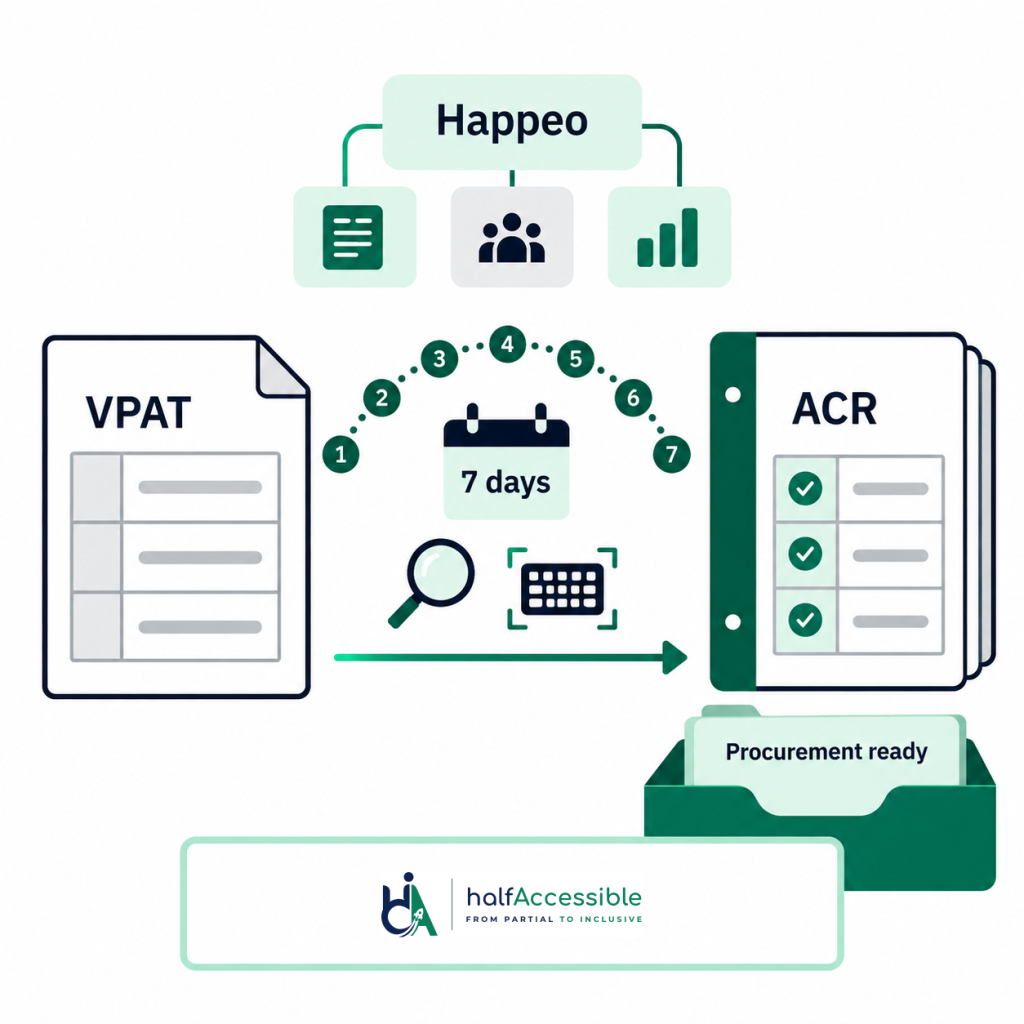
Client & Context
A VPAT for SaaS products is no longer optional paperwork — for enterprise and public-sector deals it is the gate. Happeo, the social intranet platform, needed an Accessibility Conformance Report for its web application that would stand up to procurement scrutiny, and needed it quickly. Teams shipping B2B software face the same buyer checklist — see our SaaS & B2B software accessibility specialty for how we scope product-level work.
The Challenge
The worst VPATs are written from a vendor questionnaire instead of from testing. Buyers have learned to spot them. Happeo wanted the opposite: a report whose every conformance claim traced back to an actual test result on the live application — delivered inside a single week (April 16–23) without disrupting the product team.
How We Build a VPAT for SaaS Products
We evaluated the application against WCAG 2.2 success criteria using the same evidence standard we apply in accessibility audit services: screen reader passes with NVDA and VoiceOver, full keyboard-only journeys through core flows, and inspection of dynamic components — navigation, search, content feeds, and settings. Automated scanners help with coverage, but W3C WAI notes that evaluation tools cannot check every accessibility aspect — so every conformance claim still rests on manual assistive-technology evidence.
Each criterion in the VPAT 2.5 template (ITI) was then completed with an honest conformance level — Supports, Partially Supports, or Does Not Support — with remarks that explain the finding in language both procurement reviewers and developers understand. Inflated claims create legal exposure; documented exceptions create trust. For US federal buyers, the finished Accessibility Conformance Report aligns with how Section 508.gov describes VPAT use in procurement.
The Results
- Tested, procurement-ready ACR delivered in 7 days
- Every claim backed by manual assistive-technology testing
- Clear remediation notes for criteria marked Partially Supports
- Engagement rated 5.0 out of 5.0 on Upwork
A credible VPAT does double duty: it unblocks the sales cycle today and hands the product team a prioritised accessibility roadmap for tomorrow. When buyers also need barrier fixes before the next refresh, those notes feed straight into accessibility remediation.
Choosing the Right VPAT Edition
The VPAT template ships in four editions, and choosing wrong wastes money: the WCAG edition covers the W3C WCAG 2.2 guidelines alone; the Section 508 edition adds the US federal procurement chapters described on Section508.gov; the EU edition maps to EN 301 549 (see our EN 301 549 v4.1.1 guide); and the INT edition combines all three. For a SaaS product selling internationally, the right answer depends on where the next twelve months of deals are coming from — not on which template is longest.
Buyers have also become sophisticated readers. Procurement teams now look for three tells of an untested VPAT: every criterion marked “Supports” with no remarks, evaluation methods that mention only automated tools, and remarks written in marketing language rather than testing language. A report with documented exceptions and specific remarks reads as more credible precisely because it admits imperfection. Where US private-sector buyers frame the ask around ADA risk, we also keep ADA.gov web guidance in view alongside WCAG.
Keeping a SaaS VPAT Honest Over Time
SaaS products ship weekly; conformance reports describe a moment. We advise clients to treat the VPAT for SaaS platforms as a living document on a 12-month refresh cycle — or after any major navigation, editor, or onboarding rework, whichever comes first. The refresh costs a fraction of the original evaluation because the baseline already exists.
- Annual re-test of core flows against the existing report
- Delta documentation for new features shipped since the last edition
- Updated remarks so procurement language never drifts from product reality
That cadence is what keeps the report an asset in the sales cycle instead of a liability discovered mid-deal. For a longer audit-then-document path on a SaaS product, see the sibling case study on an accessibility audit and VPAT for SaaS.
Need a VPAT That Survives Procurement?
If a buyer has asked for your VPAT — or you want one ready before they ask — start with our VPAT & ACR documentation service, pair it with an accessibility audit when the product still needs evidence depth, or review the SaaS accessibility specialty. Read the companion guide VPAT for SaaS. Browse all accessibility services, check accessibility audit pricing, or book a consultation to scope a VPAT for SaaS engagement. Reports are completed by IAAP-certified professionals and refreshed as your product evolves.
Why This Matters
A one-week VPAT turnaround only works when the underlying testing is already rigorous enough to stand behind: Happeo’s Accessibility Conformance Report was built from hands-on WCAG 2.2 testing of the intranet platform’s real workflows, not a template filled in from a generic checklist, so the document could go straight into a customer’s procurement or security review without a follow-up audit request. The finished Accessibility Conformance Report was accepted without revision, confirming the one-week timeline held up under real procurement scrutiny.