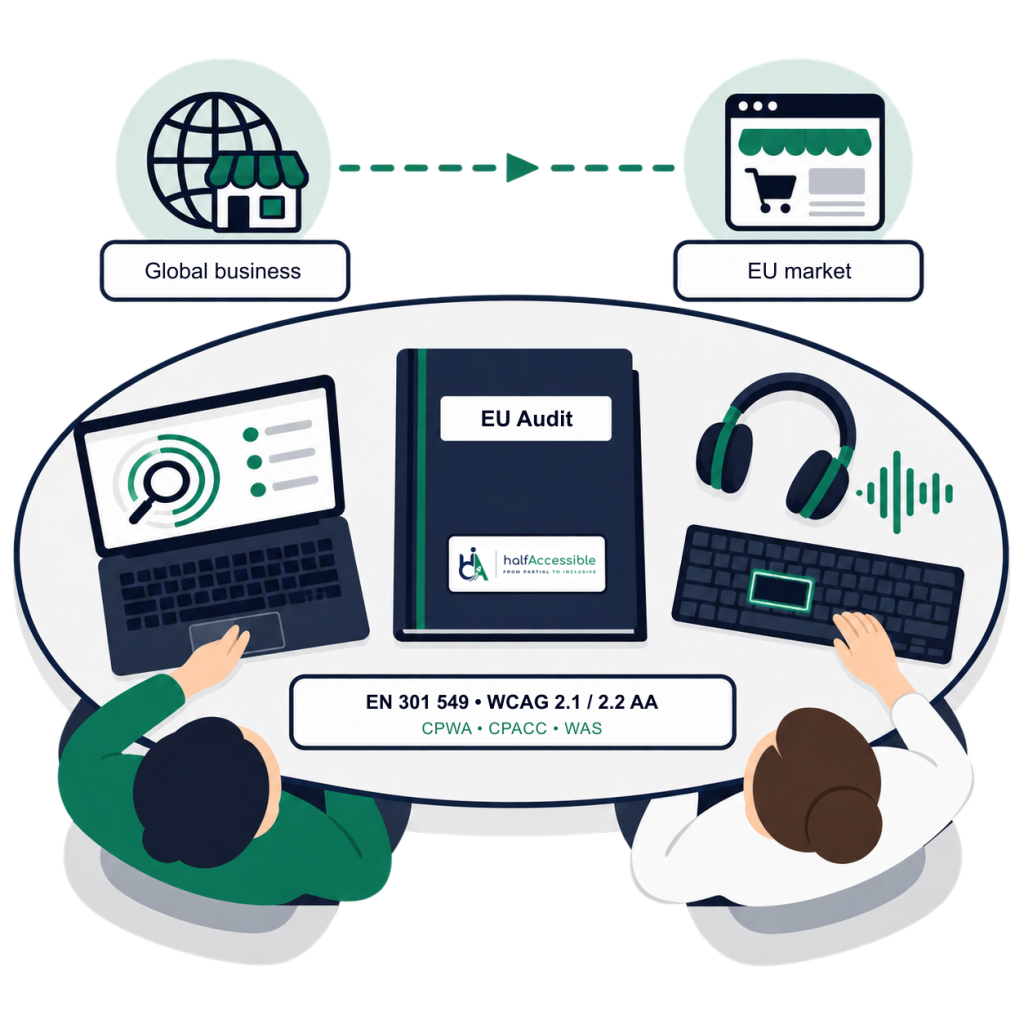
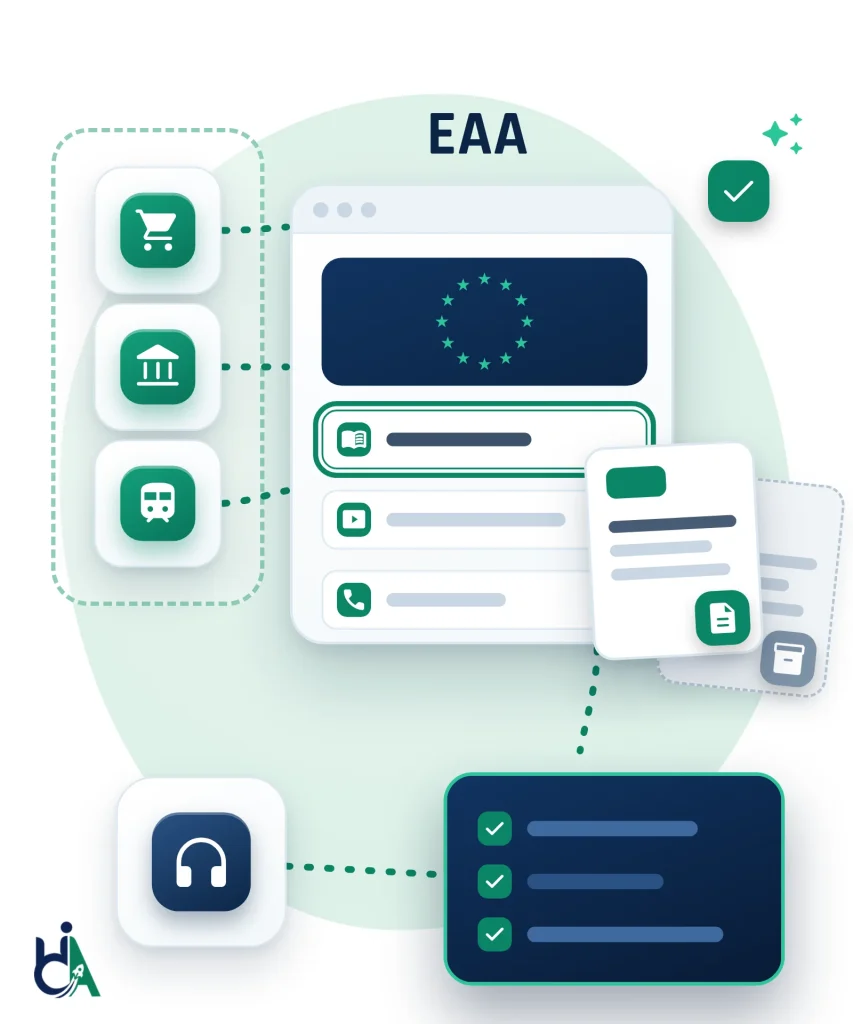
The European Accessibility Act (EAA) has been enforceable since June 28, 2025, and applies to private businesses selling digital products or services to customers anywhere in the EU, including companies based outside Europe. It covers ecommerce, banking, transport, telecoms, and digital media, and compliance is judged against the accessibility requirements in Annex I of the Directive. EN 301 549 v3.2.1, whose web chapter incorporates WCAG 2.1 Level AA, is the technical standard most businesses use as evidence; the newer EN 301 549 v4.1.1, based on WCAG 2.2 and published in September 2026, is not yet the legal reference until the European Commission cites it in the Official Journal. Enforcement runs through each member state and has started: a French court has ordered a major retailer to make its site and app accessible under threat of daily penalties, and German businesses have received private warning letters. No confirmed monetary fine under the EAA had been reported as of August 2026, but statutory maximums reach about one million euros in some countries for the most serious violations. The main size exemption covers microenterprises that provide services, meaning fewer than 10 employees and an annual turnover or balance sheet total of no more than two million euros; product manufacturers must comply regardless of size. An EU accessibility compliance audit against WCAG 2.1/2.2 AA and EN 301 549 gives EU-facing businesses both the technical evidence and the mandatory accessibility statement the EAA requires.
Think of this audit like a legal and technical health check for your website or product. Instead of guessing whether you meet local accessibility law, we test against the exact standard that law references and show you precisely where you stand.
- The EAA has applied since June 28, 2025 to covered products placed on the market and services provided to consumers; Article 32 only lets pre-existing service contracts and products already in use run until June 28, 2030 at the latest
- EN 301 549 v3.2.1 (WCAG 2.1 AA) is the technical evidence most businesses use against the EAA's Annex I requirements; v4.1.1 (WCAG 2.2, September 2026) is not yet cited in the Official Journal
- Non-EU businesses serving EU customers must comply, not just companies based in Europe
- Enforcement has started through national authorities and courts, such as a June 2026 French court order, though no confirmed EAA monetary fine had been reported as of August 2026
- Statutory maximum fines vary by country and reach about one million euros in some states (Spain, for example) for the most serious violations, plus daily penalties in some states
- A published accessibility statement is a mandatory EAA requirement, not optional documentation
- Fixed prices: a $500 Quick Audit or a $2,000 Complete Audit with a re-test and an accessibility statement draft
workspace_premium
10+ Years of Accessibility Experience
verified
Founder-Led: CPACC, WAS and CPWA Certified
fact_check
Manual + Automated Testing
hearing
Screen Reader Testing
code
Developer-Friendly Reports
public
Global Accessibility Consulting
The EAA Already Applies
The European Accessibility Act has applied since June 28, 2025 to covered products placed on the EU market and services provided to consumers. Article 32 transition rules are narrow: service contracts agreed before that date can run until they expire, but no later than June 28, 2030, and services can keep using products already lawfully in use until then. A new or redesigned website or app gets no grace period.
It Reaches Far Beyond EU-Based Companies
Any business selling covered products or services into EU markets is in scope — including e-commerce retailers, banks, and digital service providers headquartered outside the EU.
Fines Are Set Per Member State, And Can Be Severe
Each EU country defines its own enforcement and penalties. In Spain, for example, the sanctions that apply through Royal Legislative Decree 1/2013 carry statutory maximums of €30,000 for minor, €90,000 for serious, and €1,000,000 for very serious infringements.
Requirements Are Specific To Each Product Or Service
Obligations vary by offering — accessible fonts and formats, text alternatives, and compatibility with assistive technology — rather than a single blanket checklist.
An Accessibility Statement Is Required
Under Article 13 and Annex V of the Directive, service providers must publish information on how their service meets the accessibility requirements, in written and oral format. An audit gives you the findings that statement must be based on, and our $2,000 Complete Audit includes a statement draft.
Scanners Cannot Prove Conformance
The W3C says evaluation tools cannot determine accessibility on their own and human judgement is required. The WebAIM Million 2026 found detectable WCAG failures on 95.9% of the top one million home pages, and barriers such as unclear screen reader output or a broken checkout focus order can only be confirmed by a person.
Who it is for
Public-facing teams
Marketing, ecommerce, healthcare, government, education, nonprofit, and service organizations use accessibility audits to make essential public content available to more people.
Product and SaaS teams
Product teams use audits to validate complex workflows, reduce accessibility debt, improve component libraries, and prepare for enterprise accessibility reviews.
Procurement and compliance teams
Legal, compliance, procurement, and sales teams use audit evidence to answer buyer questions, support VPAT work, and document remediation commitments.
What it covers
Website Accessibility Audits
Evaluate public websites against WCAG 2.2 AA using manual testing, automated scanning, keyboard-only navigation, and assistive technologies.
Web Application Accessibility Audits
Review authenticated user journeys, dashboards, complex forms, data tables, notifications, custom widgets, and enterprise workflows.
Mobile Accessibility Audits
Test native and hybrid applications using VoiceOver, TalkBack, keyboard alternatives, zoom, orientation changes, touch target review, and gesture accessibility checks.
PDF And Document Accessibility Audits
Assess PDFs and office documents for tagging, reading order, alternative text, bookmarks, form fields, headings, tables, and screen reader compatibility.
Accessibility Design Reviews
Identify accessibility issues in Figma files, design systems, and component specs before development begins, reducing rework and improving handoff quality.
VPAT And Procurement Reviews
Evaluate products and prepare accessibility documentation that supports enterprise and government procurement conversations.
Missing Alternative Text
Missing or inaccurate alternative text prevents screen reader users from understanding meaningful images, icons, charts, infographics, product photos, and linked graphics. We identify images that need concise alternatives, images that should be marked decorative, and complex visuals that need longer explanations.
Keyboard Accessibility
Many users navigate with a keyboard, switch device, voice control, or assistive technology that relies on keyboard behavior. We test focus order, skip links, menus, modals, tabs, accordions, custom widgets, and form flows without a mouse.
Color Contrast
Low contrast can make text, buttons, icons, form controls, and charts difficult or impossible to perceive. We evaluate contrast for normal text, large text, UI components, focus indicators, disabled states, links, and error messages.
Forms
Forms often block users when labels, instructions, required indicators, validation messages, and error handling are not accessible. We test forms with keyboard navigation and screen readers to confirm users can complete and submit successfully.
Headings And Structure
Headings, lists, landmarks, tables, and reading order help assistive technology users understand a page quickly. We identify skipped heading levels, missing landmarks, and reading-order mismatches.
Dynamic Content
Modern applications often update content without refreshing the page. We test status messages, ARIA live regions, notifications, and single-page app transitions to confirm important changes are announced correctly.
Checkout, Payment And Login Flows
Annex I of the European Accessibility Act covers ecommerce and consumer banking journeys from search to payment. We test carts, payment forms, one-time codes and session timeouts with a keyboard and screen readers, including embedded third-party widgets, and check the WCAG 2.2 criteria for accessible authentication and redundant entry.
Mobile Apps And Documents
The EAA covers mobile device-based services, including mobile applications, and the information you provide about a service. We test native and hybrid apps with VoiceOver and TalkBack, and check PDFs and downloadable documents for tags, reading order and alternative text. See our PDF document remediation service.
| Feature |
Automated Testing |
Manual Testing |
| Speed |
Fast (minutes) |
Slower (days) |
| Cost |
Low |
Higher, but more accurate |
| Manual WCAG Review |
cancelNo |
check_circleYes |
| Keyboard Navigation |
Limited |
Complete |
| Screen Reader Compatibility |
cancelNo |
check_circleYes |
| Logical Reading Order |
cancelNo |
check_circleYes |
| Meaningful Alternative Text |
cancelNo |
check_circleYes |
| Form Usability |
remove_circlePartial |
check_circleYes |
| Overall User Experience |
cancelNo |
check_circleYes |
Helpful Statistics
-
1 in 6 people The World Health Organization estimates that roughly 1 in 6 people globally live with a significant disability, a substantial share of any organization's customers, patients, students, or employees.
WHO Disability Fact Sheet →
-
90 million people. The European Commission says 90 million people in the EU live with a disability. The EAA exists so they can use the same online shops, banking apps, e-books and booking services as everyone else.
European Commission disability strategy →
-
56.1 errors per page The WebAIM Million 2026 found an average of 56.1 detectable errors per home page and WCAG 2 failures on 95.9% of the one million home pages tested. Automated tools find only part of the problem, which is why every audit includes manual testing.
WebAIM Million 2026 →
-
June 28, 2025. The date the European Accessibility Act started to apply to covered products and services, set by Directive (EU) 2019/882. Member states enforce it through national laws and market surveillance authorities.
Directive (EU) 2019/882 on EUR-Lex →
-
$500 or $2,000, fixed. The Quick Audit covers up to 5 page templates with a top-10 issues report. The Complete Audit covers up to 25 templates or key user flows with a re-test of fixed issues, an accessibility statement draft and 90-day support.
Accessibility Audit Pricing →
Choose This Service If You Need
- EAA applicability review for EU-facing businesses
- EN 301 549 and WCAG 2.1 AA gap analysis
- Ecommerce and checkout accessibility review
- EAA accessibility statement preparation
- Multi-country fine and enforcement risk assessment
- Developer-ready remediation roadmap
- EAA compliance audit for a non-EU business selling to EU consumers
- WCAG 2.2 AA testing that is ready for EN 301 549 v4.1.1
- A free 30-minute first call: which services and EU markets are in scope, and a quote
- A $100 one-hour technical session: EN 301 549 questions, developer Q&A or live issue review
-
01
Discovery And Scoping
We confirm which of your products or services the EAA covers, which EU markets you serve and whether the microenterprise exemption applies, then pick the templates and journeys a consumer must complete, such as sign-up, search, checkout, booking and support.
-
02
Automated Scanning
We run automated tools across the defined scope to catch code-level issues quickly, giving us a baseline before manual review begins.
-
03
Manual Expert Testing
Our manual auditors test keyboard navigation, focus order, forms, headings, and interactive components against WCAG success criteria.
-
04
Assistive Technology Testing
We test with screen readers (NVDA, JAWS, VoiceOver, TalkBack), voice control, and switch access to confirm real-world usability, not just code compliance.
-
05
Reporting And Prioritization
Findings are documented with severity, standard references, screenshots, and reproduction steps, then organized into a prioritized remediation roadmap.
-
06
Retest And Validation
With the Complete Audit we retest the issues your team fixes to confirm they are resolved and no new barriers were introduced, then help you finish the accessibility statement draft.
European Accessibility Act (EAA)
Directive (EU) 2019/882, applied since June 28, 2025. Annex I sets the accessibility requirements for covered consumer products and services, such as ecommerce, consumer banking, e-books, electronic communications and passenger transport, including businesses based outside the EU.
EN 301 549 v3.2.1 And v4.1.1
The harmonised European standard for ICT accessibility. The web chapter of v3.2.1 incorporates WCAG 2.1 Level A and AA. Version 4.1.1, published in September 2026, moves to WCAG 2.2 and awaits citation in the Official Journal before it becomes the legal reference.
WCAG 2.2 AA
The current W3C Recommendation. It adds criteria such as focus not obscured, target size, dragging movements and accessible authentication to WCAG 2.1 AA. We test to WCAG 2.2 AA so your evidence works under both versions of EN 301 549.
Web Accessibility Directive
Directive (EU) 2016/2102 covers public sector bodies, which must make websites and mobile apps conform to EN 301 549 and publish an accessibility statement. We audit public sector sites against the same standard.
National Enforcement Laws
Each member state enforces the EAA through its own law, such as the BFSG in Germany or the General Law on the rights of persons with disabilities in Spain, with different authorities, fines and complaint routes. We note the markets you serve when we scope the audit.
Accessibility Statement (Annex V)
Service providers must publish how their service meets the accessibility requirements. The report maps findings to that statement, and the Complete Audit includes a statement draft you can publish once fixes are in place.
Assistive technologies
NVDA
JAWS
VoiceOver
TalkBack
Keyboard-only navigation
Browser zoom
Voice Control
Switch Control
Tools
Axe
ARC Toolkit
WAVE
Accessibility Insights
Chrome DevTools
Safari
Firefox
React
Next.js
Angular
Vue
WordPress
Drupal
Shopify
Magento
WooCommerce
Laravel
ASP.NET
Java
Flutter
React Native
Executive Summary
A clear summary of audit scope, key risks, priority themes, and recommended next steps for stakeholders.
Accessibility Score
A practical status snapshot that helps teams understand current accessibility maturity and remediation priorities.
Detailed Issue Report
Issue-by-issue findings with screenshots, affected URLs or screens, severity ratings, standard references, and reproduction steps.
Developer Recommendations
Practical remediation guidance, code-level notes, component recommendations, and examples your developers can act on.
Compliance-Ready Documentation
Findings organized to support accessibility statements, VPAT and ACR documentation, and procurement or legal review.
Retest Report And Statement Draft
Included with the $2,000 Complete Audit: validation after remediation, showing which issues were fixed and what remains open, plus an accessibility statement draft.
Industries
Healthcare
Accessibility audits for patient portals, provider websites, medical forms, telehealth journeys, and healthcare documents.
Government
Audits for public services, citizen portals, forms, documents, and procurement requirements.
Banking
Audits for financial journeys, statements, account dashboards, authentication flows, reports, and high-risk transactional experiences.
SaaS
Audits for B2B products, dashboards, analytics, onboarding, admin settings, and enterprise procurement readiness.
Education
Audits for university websites, LMS experiences, EdTech platforms, digital documents, admissions journeys, and student services.
Retail
Audits for ecommerce product pages, carts, checkout, filters, account flows, promotions, and customer support journeys.
Proof points
Founder-Led CPACC, WAS & CPWA Audits
Audits are led by founder Mohammad Shadab Saifi, who holds all three IAAP credentials (CPACC, WAS and CPWA), is a DHS Section 508 Trusted Tester and brings 10+ years of accessibility experience. He reviews every audit, supported by a team that handles manual testing, remediation support and documentation.
Developer-Friendly Reporting
Reports are written for action. Developers receive clear reproduction steps, expected behavior, affected users, standard mapping, and remediation guidance.
Cross-Border Experience
We support businesses operating across multiple regulatory regions with a single audit benchmarked to the highest applicable standard.
Practical Turnaround
Audit scope is tailored to your product and priorities so your team receives useful findings without unnecessary reporting overhead.
- Page title is unique and descriptive
- Headings follow a logical structure
- Landmarks identify major page regions
- Keyboard users can reach every interactive element
- Focus order matches the visual and logical order
- Visible focus indicators are clear
- No keyboard traps are present
- Links and buttons have meaningful accessible names
- Images have appropriate alternative text
- Text and UI components meet contrast requirements
- Forms have labels, instructions, and accessible error handling
- Dialogs, menus, tabs, and accordions expose state correctly
- Tables include appropriate headers
- Media includes captions or transcripts
- PDFs include tags and a logical reading order
- Mobile screens support zoom, orientation, and large touch targets
- Authentication flows are accessible
- Reports include standard references and remediation guidance
Ready to Meet EU Accessibility Requirements?
Whether you are based in the EU or serve EU customers from anywhere in the world, our founder-led audit finds the real barriers in your key journeys and gives your team a prioritised, developer-ready roadmap mapped to EN 301 549 and WCAG 2.2 AA. Start with the $500 Quick Audit, or ask for a free needs assessment and we will scope a $2,000 Complete Audit with a re-test and an accessibility statement draft. Not sure what the EAA means for you yet? Book a free 30-minute call to talk through where you stand and get a quote. If you need hands-on technical answers now, such as reviewing audit findings with your developer, book the $100 one-hour technical consultation.
Start My $500 EU Accessibility Audit