Section 508 And Title II Focused
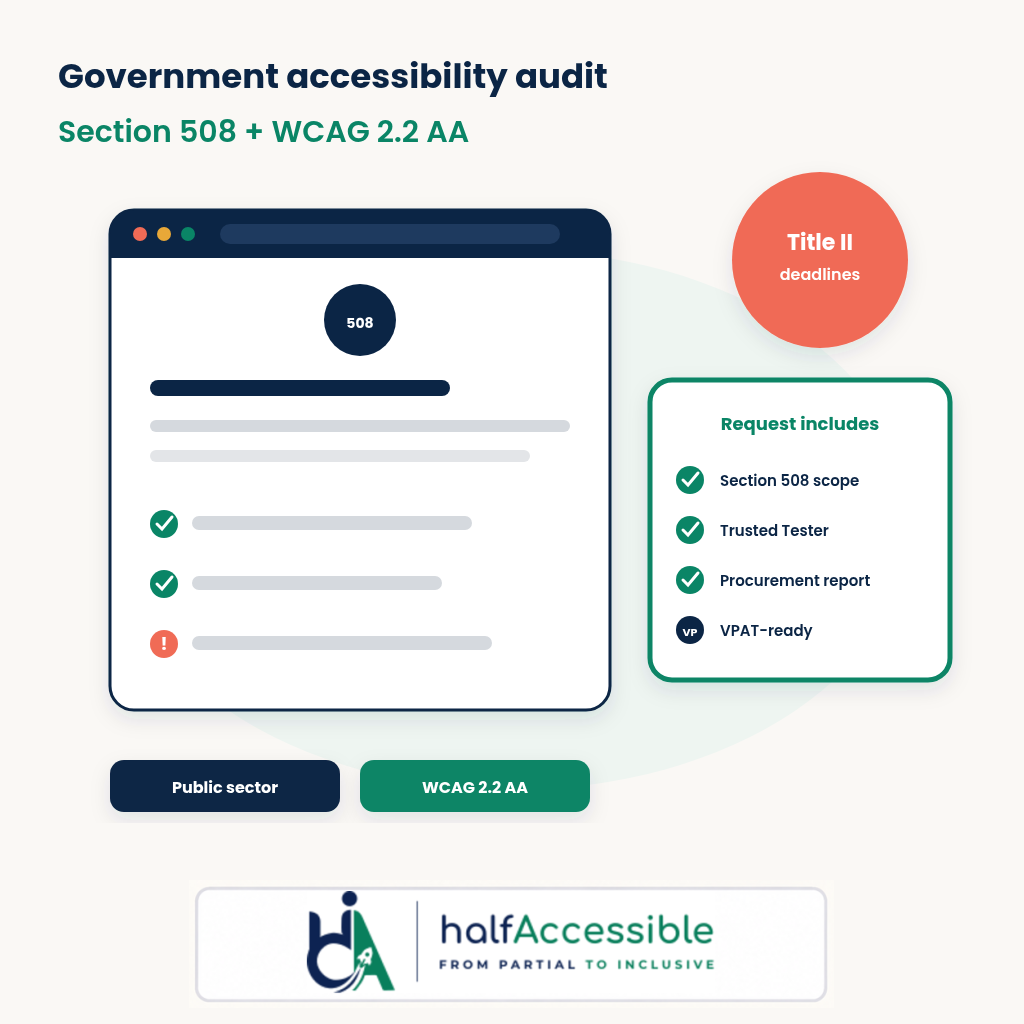
Testing covers the Revised Section 508 Standards (WCAG 2.0 AA), the ADA Title II web rule for state and local governments (WCAG 2.1 AA) and WCAG 2.2 AA, so one audit answers the standard you report against.

section 508 & public sector
Submit a government accessibility audit request for your agency's website, citizen portal, documents or mobile app. We scope testing against the ADA Title II rule (WCAG 2.1 AA), the Revised Section 508 Standards (WCAG 2.0 AA) and WCAG 2.2 AA, then send a proposal that names the compliance date that applies to you.
get started
Share a few details about your agency site or system and we will follow up with a scoped government accessibility audit request proposal.
Free 30-minute consultation (opens in new tab)
Free 30-minute call: talk through where you stand, scope a project or get a quote.
Need technical answers now? Book the $100 one-hour consultation to walk through an audit, talk with a developer or review your site live.
Indicates a required field.
Your information is kept private and never shared with third parties.
Testing covers the Revised Section 508 Standards (WCAG 2.0 AA), the ADA Title II web rule for state and local governments (WCAG 2.1 AA) and WCAG 2.2 AA, so one audit answers the standard you report against.
Screen reader and keyboard testing on top of automated scanning, so findings hold up under compliance review.
Findings, severity, and remediation guidance documented in a format built for procurement and agency review.
Audits are led by our founder, a DHS Section 508 Trusted Tester who holds the IAAP CPACC, WAS and CPWA certifications and has 10+ years in digital accessibility.
We confirm whether your compliance date is April 26, 2027 or April 26, 2028 and rank fixes so your most-used services become accessible first.
Scope can include PDFs, forms and mobile apps, plus code and document remediation with a re-test of fixed issues when you want gaps closed.
A clear brief helps us scope your government accessibility audit request against the right standard and deadline.
Public sector teams use a government accessibility audit request when procurement, an internal finding, or a Title II policy requires documented Section 508 / WCAG evidence. We map findings to WCAG 2.2, reference ADA web guidance, and test against Section 508 with DHS Trusted Tester methods. ICT baselines also align with the U.S. Access Board.
Need the specialty overview first? Read government & public sector accessibility, the ADA Section 508 accessibility audit service, or the DOJ Title II web accessibility deadline guide (April 2027 / 2028). Compare packages on pricing ($100 / $500 / $2,000). For a formal ACR after the audit, see VPAT/ACR documentation or submit a VPAT quote request.
Prefer a lighter start? Download a sample audit report, start a $500 accessibility audit for a smaller site, or book a consultation. After findings, many agencies move into accessibility remediation.
A government accessibility audit request should name the standard you report against, because the common rules use different WCAG versions and dates:
If you test to WCAG 2.2 AA, W3C states that conforming content also conforms to WCAG 2.0 and 2.1, so one audit can cover both Title II and Section 508.
The rule has five limited exceptions: archived web content, preexisting conventional electronic documents, content posted by third parties who are not acting for the government, individualized password-protected documents and preexisting social media posts. Each has strict conditions. Archived content, for example, must be created before your compliance date, kept only for reference, research or recordkeeping, stored in a special archive area and left unchanged. Calendars, maps, reservation and payment tools that a government posts from an outside company are not exempt. Even exempt content may still need to be provided in an accessible format to a person with a disability who asks. Our audit report lists which content is in scope and which may be exempt, so your remediation budget goes where the rule applies. Read the full Title II deadline guide.
Government engagements are quoted after we review your URL, because cost depends on the number of templates, user flows, PDFs and apps. Our fixed packages are a useful reference: a 1-hour consultation for $100, the $500 Quick Audit (up to 5 page templates) and the $2,000 Complete Audit (up to 25 templates or key user flows, with a re-test of fixed issues). Larger portals get a written quote before any work starts. Compare them on pricing or in the accessibility audit cost guide.
Not sure where to start? Ask for a free accessibility needs assessment, plan your work with an accessibility roadmap, or read our government accessibility and education accessibility pages.
Yes. A government accessibility audit request is scoped against Section 508 (the Revised 508 Standards use WCAG 2.0 AA) alongside WCAG 2.2 AA. Audits are led by our founder, a DHS Section 508 Trusted Tester. See also the ADA Section 508 accessibility audit service page.
Yes. Audit findings can support VPAT/ACR documentation and give procurement teams documented evidence of conformance status. Start with a VPAT quote request when you already know you need an ACR.
Yes. We audit public services, citizen portals, forms, and documents for Section 508 and WCAG alignment. Browse the government & public sector accessibility specialty for the full program overview.
State and local government Title II web and mobile content must meet WCAG 2.1 AA by April 26, 2027 (population 50,000+) or April 26, 2028 (smaller entities), per the DOJ rule summarized on our Title II deadline page. A government accessibility audit request helps you document gaps before those dates. See also ADA web guidance.
Scope depends on site size, templates, and documents. Our fixed packages are a $100 one-hour technical consultation (audit walkthrough, developer Q&A or live issue review), a $500 Quick Audit and a $2,000 Complete Audit, on our pricing page. Government and Section 508 engagements are scoped after we review your URL and compliance driver. Submit the form on this page for a proposal.
Audits are led by our founder, who holds the IAAP CPACC, WAS and CPWA certifications (see IAAP), is a DHS Section 508 Trusted Tester and has 10+ years in digital accessibility, working with our testing team. Testing includes keyboard checks and screen reader review with tools such as NVDA, mapped to WCAG and Section 508. Meet our team or see a sample audit report for the deliverable format.
It depends on total population. Under the DOJ Interim Final Rule published April 20, 2026, public entities with a total population of 50,000 or more must meet WCAG 2.1 AA by April 26, 2027. Entities with a population under 50,000 and all special district governments have until April 26, 2028. See ADA.gov or our Title II deadline guide.
Yes. ADA.gov lists public schools, community colleges and public universities as state and local government entities. A school district is not a special district government, so it uses the population of its city or county to find its compliance date. See our education accessibility services.
Usually, yes. Under Title II, PDFs, Word, PowerPoint and spreadsheet files posted after your compliance date must meet WCAG 2.1 AA. Older documents posted before that date are usually exempt, with some exceptions. Section 508 applies WCAG 2.0 AA to electronic documents too. Our PDF remediation service fixes documents in bulk.
Yes. The Title II rule covers mobile apps a government provides or makes available, including apps run for it by a private company, such as a parking payment app. Calendars, maps, reservation and payment tools from outside companies that you post on your site are not exempt either. We include these in scope so you can hold vendors to the standard.
A tester certified in the DHS Section 508 Trusted Tester conformance test process. It follows the ICT Testing Baseline, which meets the minimum requirements of the Revised 508 Standards (WCAG 2.0 Levels A and AA), so results are consistent and repeatable across agencies. Our founder and our accessibility compliance manager both hold this certification.
Title II requires WCAG 2.1 AA and Section 508 uses WCAG 2.0 AA. W3C says content that conforms to WCAG 2.2 also conforms to WCAG 2.0 and 2.1, and recommends WCAG 2.2 as the target. We report against the version you are required to meet and flag the extra WCAG 2.2 criteria separately.