
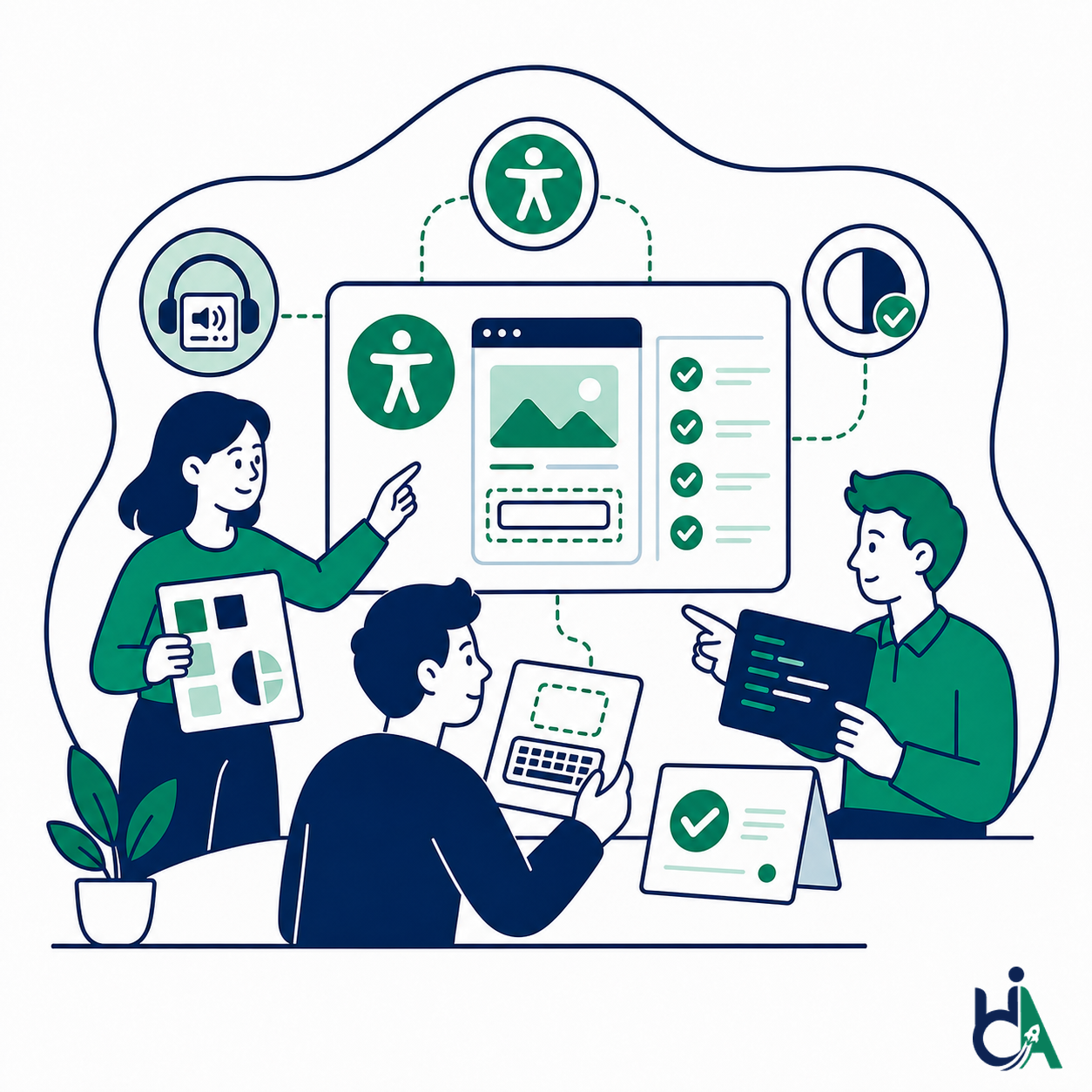
build accessibility skills across your entire organization

Accessibility Training & Workshops

Accessibility is most effective when every team understands its role. HalfAccessible delivers practical, hands-on accessibility training for developers, designers, QA engineers, product managers, content authors, leadership teams, and customer support. Our workshops focus on real projects, real accessibility issues, and practical techniques your teams can apply immediately.

Quick Answer

Accessibility Service Summary

Quick Answer

Accessibility training teaches teams how to design, develop, test, and maintain digital products that are usable by people with disabilities. Effective training combines WCAG principles with practical exercises, real-world examples, and role-specific guidance so accessibility becomes part of everyday workflows instead of a final compliance check.

In Simple Terms

Accessibility workshops help teams turn accessibility from a specialist task into a shared product skill. Developers learn implementation patterns, designers learn inclusive design decisions, QA teams learn validation techniques, content teams learn accessible publishing, and leaders learn how to support sustainable accessibility programs.

Key Takeaways

  • Role-based WCAG 2.2 accessibility training for developers, designers, QA, product, content, and leadership
  • Hands-on workshops with real accessibility issues, live demonstrations, and practical exercises
  • Training for accessibility testing, accessible design, development, PDFs, and governance
  • Virtual, on-site, half-day, full-day, bootcamp, and ongoing coaching formats
  • Custom training based on your technology stack, industry, maturity, products, and audit results
CPWA, CPACC and WAS Certified Trainers
8+ Years of Accessibility Experience
Hands-on Learning
Live Accessibility Demonstrations
Role-Based Training
Virtual and On-Site Workshops
Why Training Matters

Why Accessibility Training Matters

Many accessibility issues occur because teams are unfamiliar with accessibility requirements during planning, design, development, content creation, and testing.

Prevent Issues Before Development

Training helps teams recognize accessibility requirements during planning and design instead of discovering them after release.

Reduce Future Remediation Costs

When developers, designers, QA teams, and content authors understand accessibility, fewer defects reach production and fewer fixes are needed later.

Improve Product Quality

Accessible interfaces are often clearer, more consistent, easier to navigate, better structured, and more usable for everyone.

Strengthen Internal Knowledge

Role-based training builds accessibility confidence across teams so knowledge does not sit with one specialist or one external vendor.

Support Governance

Training gives accessibility champions, product owners, managers, and leadership the shared vocabulary needed for sustainable governance.

Create Inclusive Experiences

Teams learn how real users experience inaccessible content, forms, navigation, documents, and application workflows.

Audience

Who Should Attend?

Accessibility training is most effective when each role understands how its everyday decisions affect disabled users.

Developers

Frontend, backend, full stack, and mobile developers learn semantic HTML, ARIA, keyboard navigation, forms, focus management, accessible components, React, Next.js, and Angular patterns.

Designers

UI designers, UX designers, design system teams, and researchers learn accessible design, color contrast, typography, focus indicators, Figma practices, and component standards.

QA Teams

Manual testers, automation engineers, and accessibility testers learn keyboard testing, screen reader testing, WCAG validation, issue reporting, and severity assessment.

Product Teams

Product managers, business analysts, and project managers learn how accessibility affects requirements, acceptance criteria, roadmap planning, releases, and product quality.

Content Teams

Content authors, marketing teams, editors, and SEO teams learn headings, alt text, accessible tables, meaningful links, PDFs, plain language, and accessible documents.

Leadership

Executives, engineering managers, compliance teams, and accessibility champions learn accessibility strategy, governance, procurement, KPIs, compliance, and roadmaps.

Half-Day Workshop

A focused session for one audience or one topic, such as WCAG fundamentals, design accessibility, developer basics, or testing essentials.

One-Day Workshop

A deeper practical workshop with live demonstrations, hands-on exercises, team discussion, and role-specific takeaways.

Two-Day Bootcamp

A comprehensive bootcamp covering fundamentals, design, development, testing, tools, documents, and applied exercises.

Virtual Training

Remote accessibility training for distributed teams with live facilitation, demos, Q&A, and optional recordings.

On-Site Training

In-person workshops for teams that benefit from hands-on facilitation, group exercises, and cross-functional collaboration.

Executive Sessions

Short leadership-focused sessions covering strategy, governance, KPIs, risk, procurement, compliance, and long-term ownership.

Team Coaching

Role-based coaching for design, development, QA, product, content, and accessibility champion teams.

Ongoing Office Hours

Recurring accessibility support that lets teams ask questions, review work, and build confidence after the workshop.

Training Programs

Training Programs We Offer

Choose focused workshops for WCAG fundamentals, developers, designers, QA teams, content authors, leadership, and cross-functional teams.

WCAG 2.2 Fundamentals

A practical introduction to POUR principles, WCAG structure, success criteria, accessibility laws, common mistakes, and everyday accessibility responsibilities.

Developer Accessibility Training

Covers semantic HTML, ARIA, keyboard navigation, forms, focus management, accessible components, React, Next.js, Angular, and implementation patterns.

Designer Accessibility Workshop

Covers accessible design, color contrast, typography, focus indicators, design systems, accessible components, and Figma best practices.

QA Accessibility Testing

Covers manual testing, screen reader testing, keyboard testing, WCAG validation, issue reporting, severity assessment, and release review.

Content Accessibility Training

Covers headings, alt text, accessible tables, links, PDFs, plain language, document structure, and accessible publishing workflows.

Leadership Workshop

Covers accessibility strategy, governance, procurement, KPIs, compliance, accessibility roadmaps, ownership models, and program support.

Hands-on Exercises

Participants practice screen reader testing, keyboard navigation, color contrast evaluation, form accessibility, accessible HTML, ARIA, debugging, and PDF remediation basics.

Learning Outcomes

Participants learn WCAG 2.2, accessible interfaces, screen reader testing, accessible code, component design, PDF accessibility, issue identification, Agile integration, and release review.

Customized Training

Workshops can be tailored by technology stack, industry, team role, accessibility maturity, product type, existing audit results, and internal workflows.

Team Activities

Collaborative exercises help teams discuss real product decisions, prioritize accessibility issues, and apply learning to their daily workflow.

Decision Support

How To Choose The Right Accessibility Service

Feature Automated Testing Manual Testing
Training goal One-off presentation Practical skill transfer
Audience Same content for everyone Role-based developer, design, QA, product, content, and leadership tracks
Examples Generic slides Real project examples and live accessibility demonstrations
Practice Passive learning Hands-on exercises, testing, debugging, and team activities
Outcome Compliance awareness Teams that apply accessibility in daily workflows
Follow-through No next step Checklists, resources, coaching, and office hours available

Helpful Statistics

  • Training prevents rework. Organizations that invest in accessibility education are better positioned to build accessibility into the development lifecycle rather than relying only on post-release fixes. Accessibility Monitoring And Governance
  • Role-based learning scales. Developers, designers, QA teams, content authors, product teams, and leaders each need practical guidance for the decisions they make every day. Accessibility Consulting

Choose This Service If You Need

  • Understand WCAG 2.2
  • Build accessible interfaces
  • Test with screen readers
  • Write accessible code
  • Design accessible components
  • Create accessible PDFs
  • Identify accessibility issues
  • Integrate accessibility into Agile development
  • Review accessibility before release
  • Report accessibility issues clearly
  • Use accessibility tools effectively
  • Build accessibility confidence across teams
Methodology

Training Methodology

Our workshops combine accessibility fundamentals, live demonstrations, hands-on exercises, team activities, code reviews, Q&A, and practical takeaways.

Topics And Tools

Accessibility Topics, Tools, And Technologies Covered

NVDA JAWS VoiceOver TalkBack Keyboard navigation Screen reader testing Browser Accessibility Tree Chrome DevTools axe DevTools WAVE ARC Toolkit Accessibility Insights NVDA JAWS VoiceOver TalkBack Chrome DevTools Browser Accessibility Tree Adobe Acrobat Pro Figma Accessibility Plugins React Next.js Angular Vue WordPress Drupal Shopify Flutter React Native Laravel ASP.NET Java
Participant Materials

What Participants Receive

Training Slides

Role-based slides that explain core concepts, examples, patterns, testing workflows, and practical guidance.

Workshop Recording

Optional recording for virtual workshops so participants can revisit explanations, demonstrations, and Q&A.

Practical Exercises

Hands-on exercises for testing, design review, accessible code, forms, contrast, screen readers, keyboard navigation, and PDF basics.

Accessibility Checklists

Reference checklists for developers, designers, QA teams, content authors, product teams, and release reviewers.

Reference Materials

Curated guidance, standards references, tool recommendations, workflow notes, and role-specific resources.

Sample Code

Developer workshops can include accessible HTML, ARIA, focus management, forms, React, Next.js, Angular, or component examples.

Testing Resources

Tool lists, testing steps, issue reporting guidance, severity examples, and screen reader or keyboard testing workflows.

Completion Certificate

Optional completion certificates for participants who attend the workshop or training program.

Healthcare

Train teams working on patient portals, provider sites, medical documents, healthtech products, and healthcare support workflows.

Government

Train public sector teams responsible for websites, forms, documents, procurement, citizen services, and Section 508 expectations.

Banking

Train teams building account portals, statements, loan flows, dashboards, mobile banking, and customer communication workflows.

SaaS

Train product teams building multi-tenant apps, dashboards, settings, onboarding, AI interfaces, and enterprise software.

Education

Train teams creating student portals, LMS experiences, course materials, research documents, institutional websites, and educational software.

Retail

Train ecommerce teams working on product pages, checkout, filters, account areas, promotions, mobile commerce, and content operations.

Manufacturing

Train teams responsible for product catalogs, technical manuals, distributor portals, safety documents, and customer support content.

Automotive

Train teams building configurators, dealer tools, finance flows, service portals, product content, and connected vehicle experiences.

CPWA-Certified Trainers

Learn from accessibility specialists with practical experience across audits, remediation, testing, governance, procurement, and product delivery.

Practical, Hands-On Sessions

Workshops focus on exercises, demonstrations, real issues, tools, and practical decisions instead of abstract compliance theory.

Real Project Examples

Training can use realistic product patterns, common accessibility failures, and examples that match your team environment.

Role-Based Learning

Developers, designers, QA teams, content authors, product managers, leaders, and customer support teams get guidance relevant to their work.

Live Accessibility Testing

Participants see how screen readers, keyboard navigation, browser tools, and automated checkers reveal accessibility barriers.

Ongoing Support Available

Follow-up support, office hours, consulting, audits, and remediation guidance can help teams continue applying what they learn.

Workshop Formats

Workshop Formats And Custom Training Options

  • Half-day workshop
  • One-day workshop
  • Two-day bootcamp
  • Virtual training
  • On-site training
  • Executive sessions
  • Team coaching
  • Ongoing office hours
  • Customized by technology stack
  • Customized by industry
  • Customized by team role
  • Customized by accessibility maturity
  • Customized by product type
  • Customized using existing audit results

Empower Your Team to Build Accessibility from Day One

The most cost-effective accessibility issue is the one that never reaches production. Equip your developers, designers, testers, content authors, and leadership teams with practical accessibility skills through expert-led workshops from HalfAccessible.

Schedule Accessibility Training
Accessibility Training FAQs

Frequently Asked Questions

Answers to common questions about accessibility training, WCAG 2.2 workshops, role-based learning, developer training, design workshops, QA testing, content training, and custom team enablement.

What is accessibility training?

Accessibility training teaches teams how to design, develop, test, publish, and maintain digital products that are usable by people with disabilities.

Who should attend accessibility workshops?

Developers, designers, QA engineers, product managers, content authors, leadership teams, compliance teams, customer support, and accessibility champions can all benefit from role-based training.

Do you provide virtual training?

Yes. We provide virtual accessibility training with live facilitation, demonstrations, practical exercises, Q&A, and optional recordings.

Can training be customized for our team?

Yes. Workshops can be customized by role, technology stack, industry, product type, accessibility maturity, existing audit results, and team goals.

Do you provide developer training?

Yes. Developer training can cover semantic HTML, ARIA, keyboard navigation, forms, focus management, accessible components, React, Next.js, Angular, and testing workflows.

Do you offer QA accessibility workshops?

Yes. QA workshops cover manual testing, screen reader testing, keyboard testing, WCAG validation, issue reporting, severity assessment, and release review.

Can designers attend?

Yes. Designer workshops cover accessible design, contrast, typography, focus indicators, Figma best practices, component standards, and design system accessibility.

How long are workshops?

Formats include half-day workshops, one-day workshops, two-day bootcamps, executive sessions, team coaching, and ongoing office hours.

Do participants receive certificates?

Completion certificates can be provided when included in the training scope.

Can you train multiple teams?

Yes. We can train multiple teams with shared fundamentals and role-specific sessions for developers, designers, QA, product, content, and leadership.

Do you cover WCAG 2.2?

Yes. WCAG 2.2, POUR principles, success criteria, accessibility laws, and practical application are core training topics.

Do you include hands-on exercises?

Yes. Workshops can include screen reader testing, keyboard navigation, contrast evaluation, form accessibility, accessible HTML, ARIA implementation, debugging, and PDF basics.

Can you train using our own product?

Yes. When access and scope allow, we can use your product, designs, code examples, audit results, or workflows as training material.

Do you provide follow-up support?

Yes. Follow-up support can include office hours, team coaching, consulting, issue review, design review, and remediation guidance.

Do you offer leadership accessibility training?

Yes. Leadership workshops cover accessibility strategy, governance, procurement, KPIs, compliance, roadmaps, and program ownership.

Do you train content teams?

Yes. Content training covers headings, alt text, accessible tables, meaningful links, PDFs, plain language, and accessible document workflows.

Do you cover PDF accessibility?

Yes. Workshops can include PDF accessibility basics, document structure, headings, reading order, tags, alt text, tables, links, and forms.

Which accessibility tools do you teach?

Tools can include axe DevTools, WAVE, ARC Toolkit, Accessibility Insights, NVDA, JAWS, VoiceOver, TalkBack, Chrome DevTools, the browser accessibility tree, Adobe Acrobat Pro, and Figma plugins.

Do you provide on-site workshops?

Yes. We can provide on-site accessibility workshops depending on location, schedule, scope, and team needs.

Can workshops be role-based?

Yes. Role-based training is recommended because developers, designers, QA teams, content authors, product teams, and leaders each make different accessibility decisions.

Can you train accessibility champions?

Yes. We can help accessibility champions learn testing, issue triage, team coaching, governance, documentation, and escalation practices.

Do you cover accessible design systems?

Yes. Design system training can cover accessible components, reusable patterns, tokens, Figma reviews, documentation, and component validation.

Can you train teams on screen reader testing?

Yes. We provide practical screen reader testing guidance using tools such as NVDA, JAWS, VoiceOver, and TalkBack depending on the scope.

Can training support accessibility governance?

Yes. Training helps teams understand their responsibilities and supports governance, release reviews, KPIs, policies, and long-term accessibility programs.

What do participants receive?

Participants can receive slides, practical exercises, accessibility checklists, reference materials, sample code, testing resources, optional recordings, and completion certificates.

How do we book accessibility training?

Start by sharing your audience, goals, preferred format, technologies, current accessibility maturity, and whether you want custom training based on your product or audit results.