Introduction
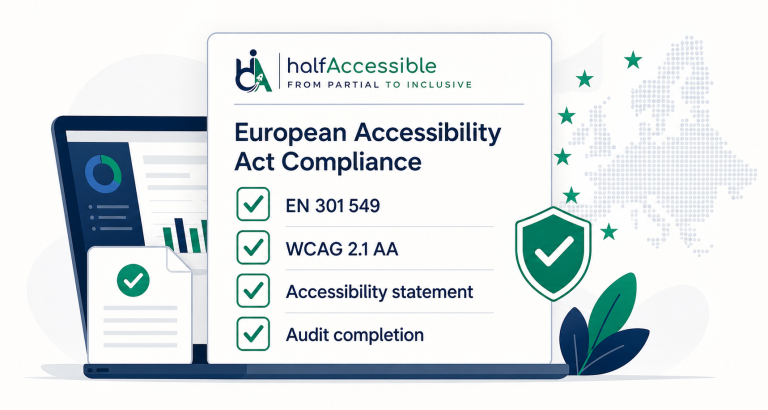
The European Accessibility Act (EAA) is one of the most significant accessibility regulations ever introduced in the European Union. It establishes a common set of accessibility requirements for products and services sold or provided within the EU, ensuring that people with disabilities can access digital and physical experiences without barriers.
Although the EAA is an EU regulation, its impact extends globally. Any company, regardless of where it is headquartered, may be required to comply if it offers products or services to customers within the European Union.
For organizations operating websites, mobile applications, SaaS platforms, e-commerce stores, banking services, telecommunications platforms, or digital products, understanding EAA compliance is now a business necessity rather than a future consideration.
What Is the European Accessibility Act?
The European Accessibility Act (Directive (EU) 2019/882) was created to harmonize accessibility requirements across all EU member states. Prior to the EAA, accessibility regulations varied significantly between countries, creating challenges for businesses operating across Europe.
The primary objectives of the EAA are to:
- Improve access to products and services for people with disabilities.
- Create consistent accessibility requirements throughout the EU.
- Remove barriers to trade caused by differing national regulations.
- Encourage inclusive design and innovation.
When Did the EAA Take Effect?
The EAA became enforceable on 28 June 2025. From this date forward, covered products and services placed on the EU market must comply with accessibility requirements.
Some transitional provisions apply to existing products and services, with certain legacy systems receiving extended compliance timelines.
Who Must Comply?
The EAA applies to organizations that provide covered products or services to consumers within the European Union.
Importantly, the law is not limited to European companies.
Examples of Organizations That May Need to Comply
- E-commerce businesses selling to EU customers
- SaaS providers serving EU users
- Financial institutions
- Telecommunications providers
- E-book publishers
- Transportation booking platforms
- Mobile application providers
- Online marketplaces
- Digital service providers operating within the EU market
A company based in India, the United States, Canada, or Australia may still fall under EAA requirements if its products or services are available to EU consumers.
Products and Services Covered by the EAA
The EAA applies to a broad range of products and services.
Products
- Computers and operating systems
- Smartphones and tablets
- Payment terminals
- ATMs
- Ticketing machines
- Self-service kiosks
- E-readers and related technologies
Services
- E-commerce platforms
- Banking services
- Electronic communications services
- Consumer-facing mobile applications
- Transportation booking systems
- E-book services
- Audiovisual media services and associated platforms
For digital businesses, websites and mobile applications are among the most common areas requiring remediation and ongoing compliance efforts.
The Technical Standard Behind EAA Compliance
One of the most common questions organizations ask is:
“What accessibility standard should we follow?”
The answer is EN 301 549.
EN 301 549 is the European accessibility standard for Information and Communication Technology (ICT). It provides the technical requirements organizations use to demonstrate accessibility compliance under the EAA.
For websites and mobile applications, EN 301 549 incorporates WCAG 2.1 Level AA requirements.
In practice:
| Requirement | Standard |
|---|---|
| Website Accessibility | WCAG 2.1 AA |
| Mobile App Accessibility | WCAG 2.1 AA |
| Documents (PDFs, Office Files) | EN 301 549 |
| Software Applications | EN 301 549 |
| Hardware & Terminals | EN 301 549 |
Understanding WCAG 2.1 AA
WCAG (Web Content Accessibility Guidelines) is built around four core principles known as POUR:
1. Perceivable
Users must be able to perceive information regardless of disability.
Examples:
- Alternative text for images
- Captions for videos
- Transcripts for audio
- Adequate color contrast
- Content that remains usable when zoomed to 200%
2. Operable
Users must be able to interact with all functionality.
Examples:
- Full keyboard accessibility
- Visible focus indicators
- Skip navigation links
- No keyboard traps
- Accessible menus and controls
3. Understandable
Users should easily understand content and interactions.
Examples:
- Clear error messages
- Consistent navigation
- Predictable interfaces
- Plain language content where appropriate
4. Robust
Content must work with assistive technologies.
Examples:
- Semantic HTML
- Proper ARIA implementation
- Screen reader compatibility
- Accessible forms and controls
Common Accessibility Issues That Cause Non-Compliance
Organizations frequently encounter the following issues during accessibility audits:
Content Issues
- Missing image alt text
- Poor heading structure
- Inaccessible PDFs
- Missing video captions
Design Issues
- Low color contrast
- Text that cannot be resized
- Reliance on color alone for meaning
Development Issues
- Missing form labels
- Incorrect ARIA usage
- Keyboard navigation failures
- Screen reader incompatibility
- Focus management problems
E-Commerce Issues
- Inaccessible checkout flows
- Unlabeled payment forms
- Dynamic content not announced to assistive technologies
- Product filters inaccessible via keyboard
These issues are commonly identified during automated and manual WCAG audits.
How to Achieve EAA Compliance
Step 1: Conduct an Accessibility Audit
Begin with a comprehensive accessibility assessment that includes:
- Automated testing
- Manual keyboard testing
- Screen reader testing
- Mobile accessibility testing
- Document accessibility testing
Automated tools alone cannot identify all accessibility barriers. Manual evaluation remains essential.
Step 2: Prioritize Remediation
Focus first on issues that prevent users from completing critical tasks such as:
- Account creation
- Login
- Purchases
- Form submission
- Customer support access
Addressing high-impact barriers provides immediate improvements for users.
Step 3: Train Internal Teams
Accessibility should not be limited to a one-time project.
Organizations should train:
- Designers
- Developers
- QA teams
- Content authors
- Product managers
Accessibility becomes sustainable only when embedded into daily workflows.
Step 4: Implement Continuous Monitoring
Accessibility is an ongoing process.
Organizations should establish:
- Regular audits
- Accessibility testing during releases
- Accessibility acceptance criteria
- User feedback mechanisms
- Accessibility governance policies
Continuous monitoring helps prevent regressions and supports long-term compliance.
What Happens If You Ignore the EAA?
Enforcement is managed by individual EU member states, and penalties can vary.
Potential consequences may include:
- Regulatory fines
- Market access restrictions
- Customer complaints
- Legal disputes
- Reputational damage
Beyond legal risk, inaccessible products exclude millions of potential users and customers.
Business Benefits of EAA Compliance
Many organizations view accessibility solely as a compliance requirement. In reality, accessibility often delivers measurable business benefits.
Increased Market Reach
More than 100 million people in Europe live with disabilities and represent a significant consumer market. Accessible products reach a broader audience.
Better User Experience
Accessibility improvements often benefit all users, including those using mobile devices, older users, and users with temporary impairments.
Improved SEO
Many accessibility practices align with search engine optimization best practices, including semantic HTML, heading structure, and alternative text.
Reduced Legal Risk
Proactive compliance significantly lowers regulatory and litigation exposure.
Stronger Brand Reputation
Organizations that prioritize inclusion often build greater trust and customer loyalty.
EAA Compliance Checklist
Before launching a website, application, or digital product in the EU market, verify that:
- All images have meaningful alternative text
- Videos include captions
- Audio content has transcripts
- Color contrast meets WCAG requirements
- All functionality works with a keyboard
- Forms include labels and error identification
- Screen readers can navigate content correctly
- PDFs and documents are accessible
- Mobile applications support assistive technologies
- Accessibility testing is part of the development lifecycle
- Ongoing monitoring and governance processes are established
Conclusion
The European Accessibility Act represents a major shift toward a more inclusive digital ecosystem across Europe. Since enforcement began on 28 June 2025, organizations that serve EU consumers should treat accessibility as a core business requirement rather than a compliance afterthought.
For most digital products, achieving compliance means aligning with WCAG 2.1 Level AA and EN 301 549, conducting thorough accessibility audits, remediating barriers, and integrating accessibility into every stage of design, development, and quality assurance.
Organizations that act early will not only reduce compliance risk but also create better experiences for every user.
Need Help With EAA Compliance?
If your organization serves customers in the European Union, the best approach is to start with a comprehensive accessibility audit against WCAG 2.1 AA and EN 301 549, followed by remediation, testing, and continuous monitoring. Taking action now reduces compliance risk while creating a better experience for all users.
Work With Us
Need to document EAA conformance for your business? Our VPAT & Accessibility Conformance Report service and WCAG 2.2 audits give you the paper trail regulators and partners ask for.
Get a free accessibility assessment — no commitment required.
Get an EU Accessibility Audit
For a full audit benchmarked to EN 301 549 and WCAG 2.1/2.2 AA, see our EU Accessibility Audit Services page, or contact us to get started.