India’s Supreme Court sent a strong message on July 29, 2026.
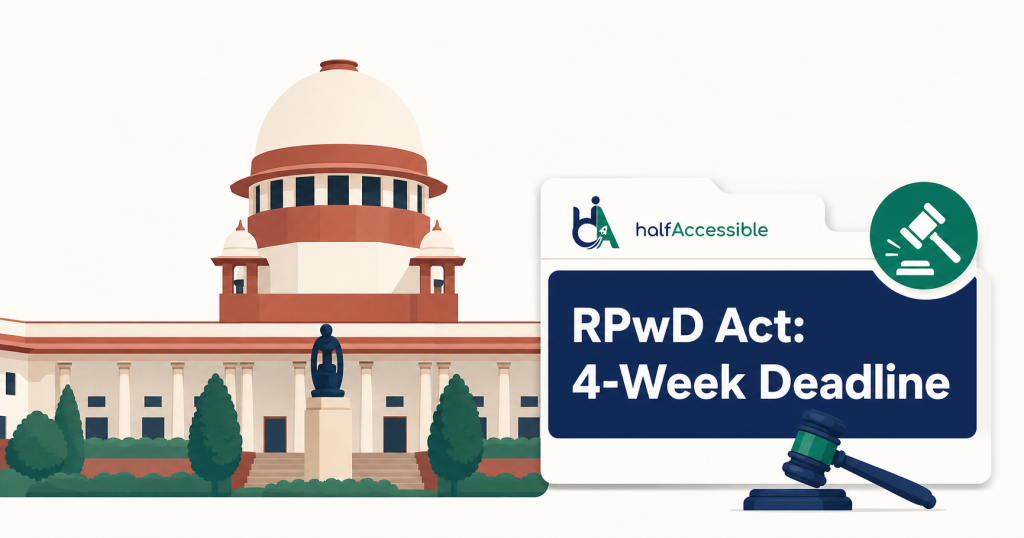
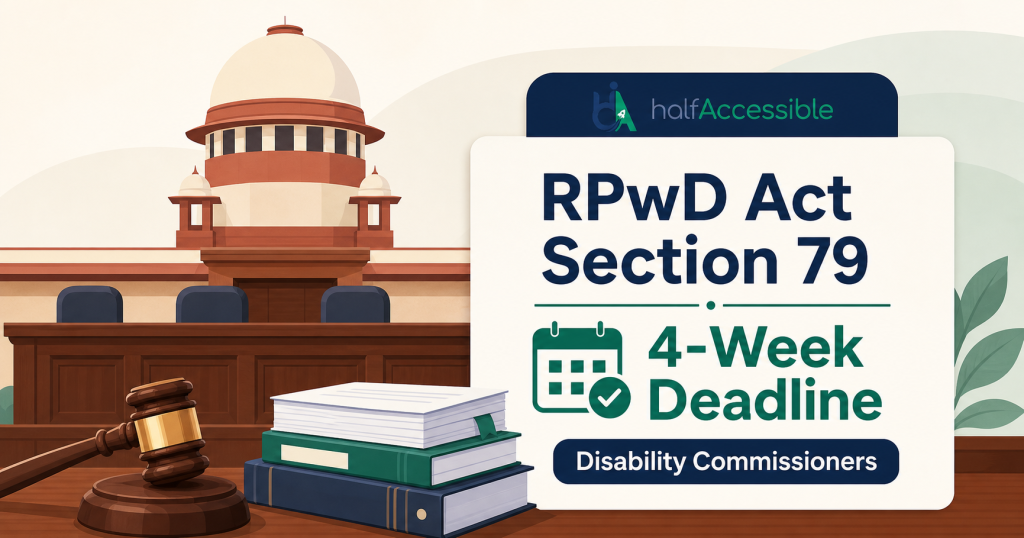
A bench of Justice JB Pardiwala and Justice KV Viswanathan directed ten states and Union Territories that have not appointed State Commissioners for Persons with Disabilities to do so within four weeks. The warning was direct: “This direction shall be strictly complied with and none of the states should exhibit any laxity. Laxity, if any, shall be viewed very strictly.”
The order came in the long-running case Rajive Raturi v Union of India (Diary Number 9321/2005), which has been pushing India’s disability rights framework forward for over twenty years. This latest ruling is significant not just for physical accessibility but for RPwD Act disability rights India-wide, and particularly for the digital accessibility space that is currently being reshaped by the government’s draft ICT accessibility rules published just days before.
If your organization operates in India and has a website, app, or digital platform, this ruling directly affects your compliance risk. Here is what happened, why it matters, and what you need to do.
Key Takeaways
- On July 29, 2026, the Supreme Court directed 10 states and UTs to appoint State Commissioners for Persons with Disabilities under Section 79 of the RPwD Act within four weeks.
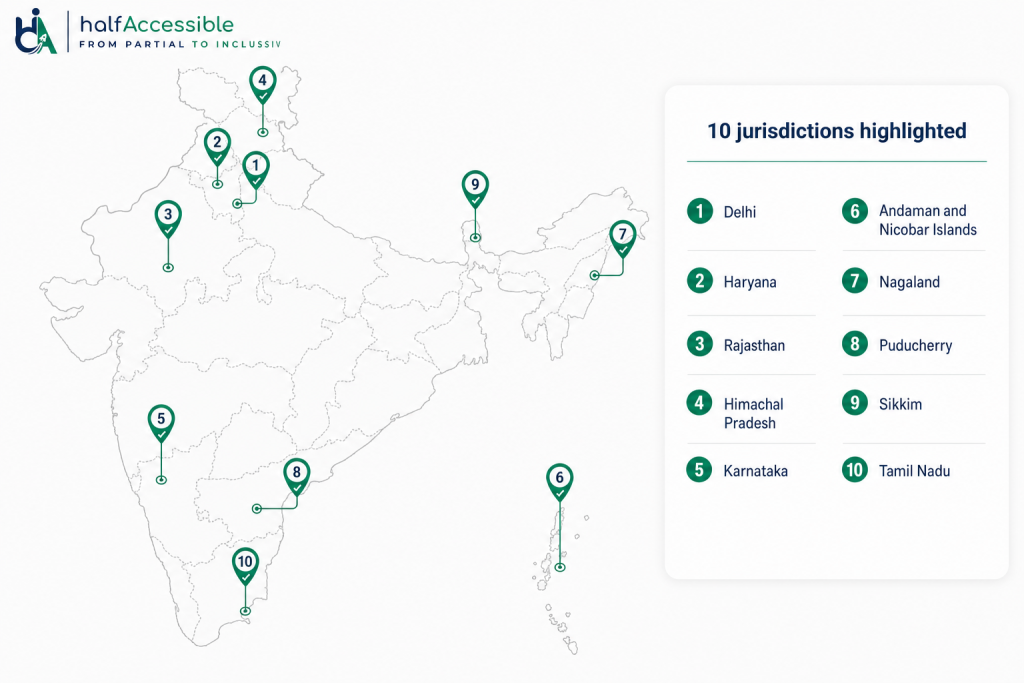
- The 10 named jurisdictions are Delhi, Haryana, Rajasthan, Himachal Pradesh, Karnataka, Andaman and Nicobar Islands, Nagaland, Puducherry, Sikkim, and Tamil Nadu.
- The Central Government was also directed to appoint a full-time Chief Commissioner and two Additional Commissioners within four weeks.
- The entire rule-making exercise for new accessibility standards must be completed within six months.
- The draft RPwD (Amendment) Rules 2026, published July 16, 2026, propose mandatory ICT accessibility requirements for all tech companies in India, including foreign firms.
- State Commissioners are the primary enforcement body for disability rights complaints, including complaints about inaccessible websites and digital services.
- Without a Commissioner in place, there is no mechanism to file complaints or enforce Section 89 fines against non-compliant organizations.
- Once Commissioners are in place and the new ICT rules are finalized, enforcement of digital accessibility standards will become real and active.
What Happened: The July 29, 2026 Supreme Court Order
The Supreme Court of India, hearing a batch of petitions on accessibility for persons with disabilities, found that multiple states and Union Territories had not fulfilled a basic statutory obligation under the Rights of Persons with Disabilities Act, 2016: appointing a State Commissioner.
Advocate Rahul Bajaj, appearing for the petitioner, pointed out that despite Section 79 of the RPwD Act creating a clear mandate, many states had simply not made the appointment. The Court responded with a strict, time-bound direction.
The bench directed all affected states and UTs to appoint a Commissioner in accordance with Section 79 within four weeks, and added that the Commissioner so appointed must hold the post with independent charge.
The “independent charge” requirement matters. It closes a loophole that some governments had used to assign the Commissioner’s duties to an existing official who was already doing another job. The Court made clear that the post must be a dedicated, full-time appointment.
The Court also flagged a concern raised by advocates: Section 89 of the RPwD Act provides for punishment when the Act is violated, but there is currently no mechanism prescribed for actually recovering the fines imposed. The Court directed the Union to address this while finalizing the new rules, so that penalties have real teeth.
Which States and UTs Are Affected
The states and Union Territories specifically called out in the July 29 order for not having a State Commissioner for Persons with Disabilities are:
- Delhi
- Haryana
- Rajasthan
- Himachal Pradesh
- Karnataka
- Andaman and Nicobar Islands
- Nagaland
- Puducherry
- Sikkim
- Tamil Nadu
This list includes some of India’s most populous and economically significant states. Delhi and Karnataka, in particular, are major hubs for tech companies. The absence of a Commissioner in these states has meant that disability rights complaints, including complaints about inaccessible digital platforms, have had no formal channel.
Organizations based in or serving users in these states should take note. As Commissioners are appointed and begin operations, complaint handling and enforcement will begin.
What Is a State Commissioner for Persons with Disabilities?
Under Section 79 of the RPwD Act, 2016, every State Government must appoint a State Commissioner for Persons with Disabilities. The Commissioner must have special knowledge or practical experience in matters relating to rehabilitation of persons with disabilities.
The role is not ceremonial. State Commissioners have real powers under Section 82 of the RPwD Act, including quasi-judicial authority equivalent to a civil court under the Code of Civil Procedure, 1908. This means a Commissioner can:
- Summon witnesses and require attendance
- Call for discovery and production of documents
- Requisition public records from any court or office
- Investigate complaints of violations of the RPwD Act
- Monitor implementation of the Act by state agencies and private organizations
For digital accessibility, this matters directly. If a user with a disability cannot access a website, app, or digital service, and the company fails to remediate, the State Commissioner is the body they file a complaint with. The Commissioner can then investigate, direct remediation, and recommend penalties under Section 89.
When the Commissioner’s post is vacant, this entire chain breaks down. Complaints have nowhere to go. Companies face no accountability. People with disabilities have no recourse.
The Chief Commissioner Problem at the Centre
The problem is not only at the state level. Advocate Bajaj also informed the Court that there is currently no full-time Chief Commissioner for Persons with Disabilities at the Central level. The post is being held by a Secretary in the Department of Empowerment of Persons with Disabilities on “additional charge.”
This arrangement violates Rule 30(3) of the RPwD Rules, 2017, which requires that an officer relinquish all other charge on assuming the post of Chief Commissioner. Holding the role on additional charge while continuing in another position directly contravenes this rule.
Under Section 74 of the RPwD Act, the Chief Commissioner heads a three-person body that also includes two Additional Commissioners. The Court directed the Union to appoint all three within four weeks: a full-time Chief Commissioner and two Additional Commissioners.
The Chief Commissioner plays the same oversight and enforcement role at the national level that State Commissioners play at the state level. Notices to major organizations, investigations of systemic failures, and coordination with sectoral regulators all go through this office. With the post effectively vacant in substance, this enforcement capacity has been missing.
The RPwD Act and Digital Accessibility: Why This Ruling Matters for Tech
Many technology companies in India have treated the RPwD Act as a physical accessibility law, not a digital one. That understanding is incorrect and is becoming costly.
The RPwD Act covers ICT accessibility explicitly. Section 42 requires establishments to ensure that their electronic content and ICT systems are accessible to persons with disabilities. Section 46 sets timelines for compliance.
What has been missing is enforcement, and that is precisely what the July 29, 2026 Supreme Court order begins to put in place.
When a State Commissioner is appointed in Delhi or Karnataka, companies operating there will have a body that can receive accessibility complaints, investigate them, and direct remediation. Companies that have ignored ICT accessibility because enforcement was weak will find that the enforcement gap is closing.
The implications are clearest for:
Tech companies and SaaS platforms with users across India, especially in the affected states. Once Commissioners are active, inaccessible apps and web platforms become a complaint risk.
Ecommerce and consumer platforms where users with disabilities cannot complete purchases due to inaccessible checkout, missing alt text, broken keyboard navigation, or incompatible screen reader behavior.
Banks and financial services which were specifically directed by regulators in 2024 to make digital platforms accessible, and where complaints from users with visual or motor disabilities are most common.
Government service portals that have historically had the worst compliance rates, now under direct judicial supervision.
The Draft RPwD Amendment Rules 2026: What ICT Companies Need to Know
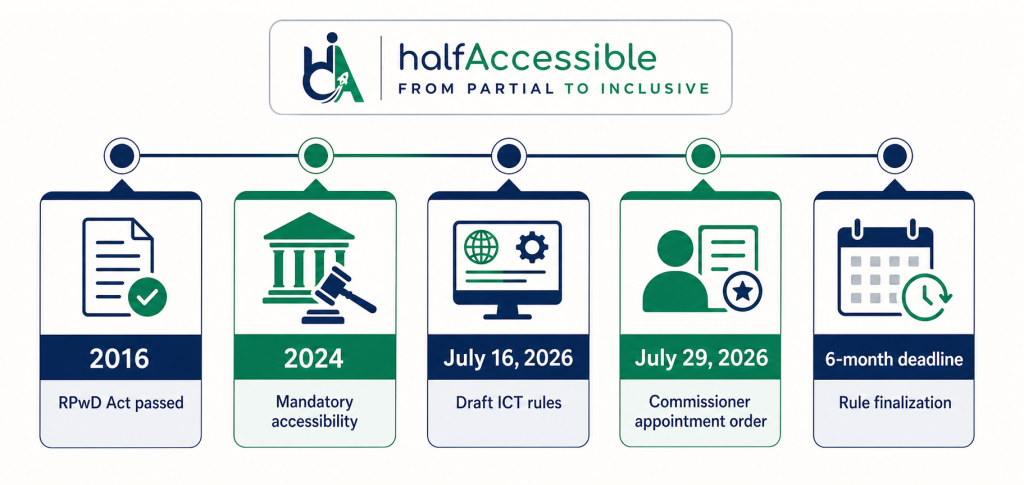
The Supreme Court’s July 29 order did not happen in isolation. Just thirteen days earlier, on July 16, 2026, the Department of Empowerment of Persons with Disabilities published the draft Rights of Persons with Disabilities (Amendment) Rules, 2026 for public comment.
These draft rules are the most significant development in India’s digital accessibility regulatory history.
Who they cover: The draft rules apply to all establishments that manufacture, design, develop, exercise decisive technical control over, or make available ICT products and services to persons in India. This explicitly includes foreign establishments. A US or European tech company serving Indian users is in scope.
What they require: The rules mandate accessibility of ICT products and services to BIS standards (IS 17802, which aligns with WCAG 2.1). The goal is to prescribe a mandatory accessibility floor that all covered organizations must meet, not just the aspirational guidance that existed before.
Compliance timelines: The draft proposes a phased approach based on turnover.
- Establishments with annual turnover of Rs 500 crore or more will have 12 months to comply with the mandatory minimum requirements.
- Establishments below this threshold will have 18 months.
Accessibility Conformance Reports: The draft introduces mandatory ACRs, similar to VPATs in the US market, with re-testing obligations. Organizations must not only achieve compliance but document it formally.
Penalty enforcement: The rules align with Section 89 of the RPwD Act for fines, and explicitly state that sectoral regulators, such as SEBI, RBI, TRAI, and others, can impose additional penalties or suspend registrations for continued non-compliance.
The Supreme Court’s role: The Court directed on July 29 that the entire rule-making exercise be completed within six months. That means these draft rules, once finalized, will be the enforceable standard India’s digital accessibility landscape operates under.
The Rajive Raturi Case: 20 Years of Pushing India Forward
The July 29, 2026 order is the latest chapter in a case that has been running for over twenty years.
Rajive Raturi, a visually challenged person working with a human rights organisation, filed a Writ Petition before the Supreme Court in 2005 seeking directions to ensure safety and accessibility in public spaces. Over two decades, the case has expanded to cover built environments, transport, and the ICT ecosystem.
Despite repeated Supreme Court directions, compliance by the Union and State governments had been partial and inconsistent. Reports were filed, but implementation lagged. Standards existed but were recommendatory rather than mandatory.
The November 2024 judgment was the turning point. The Court found that Rule 15 of the RPwD Rules, 2017, which used recommendatory language, was ultra vires the RPwD Act, which requires mandatory compliance. The Court directed the Union to create a mandatory floor for accessibility across built environments, ICT, and assistive technology within three months.
The July 2026 draft rules are the government’s response to that direction. The July 29, 2026 Commissioner appointment order is the Court continuing to monitor compliance with its directions.
For the 90 million people with disabilities in India, this case represents the difference between rights on paper and rights in practice.
What Organizations Should Do Now
This ruling and the draft ICT rules together create a compliance window that organizations should use now, before finalization and enforcement begin.
Step 1: Understand your exposure. If your organization operates a website, app, software platform, or any digital service accessible to users in India, you are in scope for the draft ICT rules. This includes foreign companies serving Indian users.
Step 2: Run an accessibility audit. An accessibility audit against WCAG 2.1 Level AA (the standard referenced in IS 17802) will identify your current compliance gaps and give you a remediation roadmap before the rules are finalized. Starting with a gap analysis now is far cheaper than emergency remediation after enforcement begins.
Step 3: Begin remediation. The most critical issues to fix first are those that block users from completing core tasks: inaccessible login flows, broken keyboard navigation, missing screen reader support for dynamic content, and inaccessible forms. Accessibility remediation should be planned and prioritized based on severity and user impact.
Step 4: Prepare your Accessibility Conformance Report. The draft rules make mandatory ACRs a compliance requirement. Organizations that already have a VPAT or ACR from prior audits are well positioned. If you do not, now is the time to commission one. See our VPAT and ACR documentation service.
Step 5: Set up ongoing monitoring. Accessibility is not a one-time project. New releases, third-party integrations, and content updates can introduce new barriers. Accessibility monitoring and governance keeps you compliant as your product evolves.
Step 6: Watch the rule finalization timeline. The Court has directed completion of the rule-making exercise within six months of the July 29, 2026 order. Monitor the DEPwD gazette for the final notification.
For government agencies and public sector organizations, compliance is not optional and has not been since 2016. If your public portal is not yet accessible, the combination of active State Commissioners and the new ICT rules will create direct accountability in a way that has not existed before.
Our government and public sector accessibility specialty page has more detail on what public bodies need to do.
Not sure where to start? Contact HalfAccessible for a free consultation.
The Bottom Line
India’s Supreme Court is no longer treating RPwD Act compliance as aspirational. The July 29, 2026 order mandating Commissioner appointments in 10 states within four weeks, combined with the draft ICT accessibility rules published just two weeks prior, signals a new phase of enforcement.
For 90 million people with disabilities in India, this is a long-overdue shift.
For organizations with digital products and services in India, the compliance window is open now. Auditing your accessibility, remediating known issues, and documenting your conformance before the rules are finalized is far more cost-effective than scrambling after complaints begin.
We help organizations across India prepare for RPwD Act compliance. Start with our accessibility audit services or contact us to discuss where your products stand today.
Also read: India Digital Accessibility Compliance: What Every Business Must Know in 2026
Sources:
- Supreme Court Directs States Without Commissioners Under RPwD Act to Make Appointments — Live Law, July 30, 2026
- Supreme Court Sets Four-Week Deadline for Disability Commissioners, Orders Revised Accessibility Rules — Law Trend
- The New Accessibility Conformance Regime: Key Takeaways from the Draft RPwD Amendment Rules, 2026 — Mondaq / India Law
- Global Tech Firms to Come Under India’s Mandatory Disability-Access Rules — The Print
- Ministry of Social Justice Releases Draft Accessibility Rules 2026 — NASSCOM
- Rajive Raturi v Union of India, November 8, 2024 — Indian Kanoon
- How the RPwD Act Impacts Digital Accessibility in India — Deque
- Commissioner for Persons with Disabilities — Law and Justice Wiki
- RPWD Act Compliance for Websites — Continual Engine
- Has Landmark SC Order on Accessibility Translated on Ground? — The Print