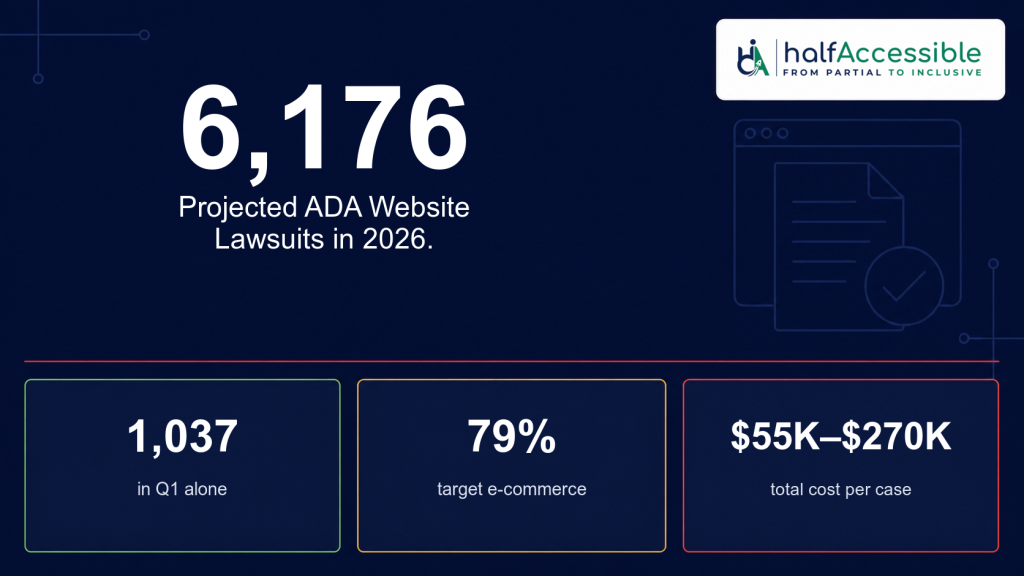
From January to June 2026, plaintiffs filed 2,045 ADA website lawsuits in US courts, according to EcomBack’s 2026 mid-year report. That is more than 11 new cases every day, holding the record pace set in 2025. The first quarter alone brought 1,037 cases.
UsableNet, which also tracks state courts, projects about 6,176 digital accessibility lawsuits for 2026 in its 2026 Midyear Report. That would be a new record and roughly 20% more than the 5,114 lawsuits (3,195 federal and 1,919 in New York and California state courts) it counted in its 2025 year-end report.
ADA website lawsuit 2026 filings are not slowing down. If your website has not been tested against WCAG 2.1 or 2.2 Level AA, your business is already in the pool of potential targets. Updated October 7, 2026 with mid-year 2026 data from EcomBack and UsableNet.
2026 At A Glance
- 2,045: ADA website lawsuits filed in US courts from January to June 2026 (Source: EcomBack 2026 mid-year report)
- 6,176: digital accessibility lawsuits projected for all of 2026, about 20% more than 2025 (Source: UsableNet 2026 Midyear Report)
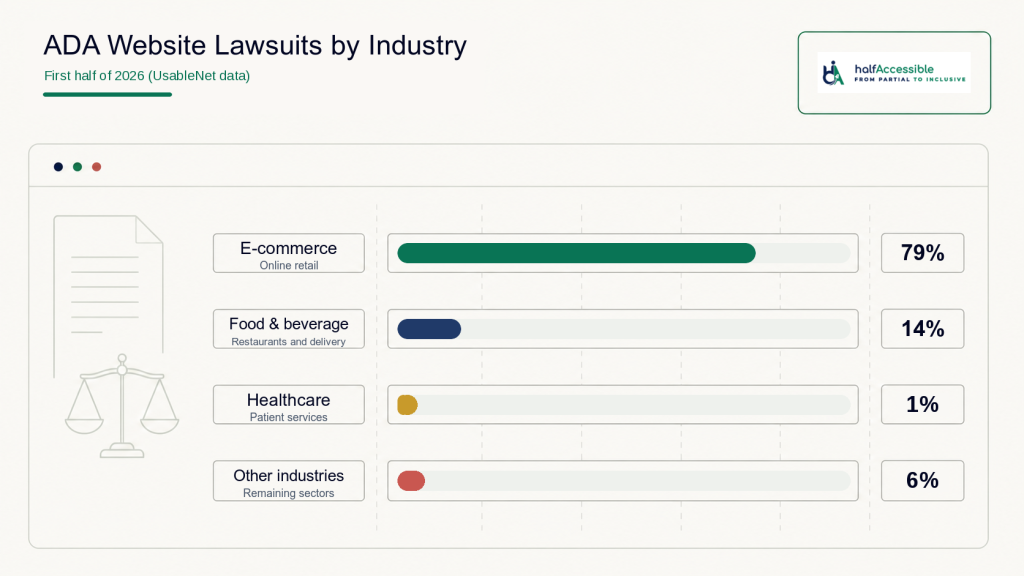
- 79%: of H1 2026 filings targeted e-commerce websites (Source: UsableNet 2026 Midyear Report)
- $55K–$270K: typical total cost of one ADA website case, from defense to monitoring (Source: TestParty cost estimates)
Choose Your Next Step
Worried about your own site? Start with a free check, read what to do after a demand letter, or talk it through with us before you spend anything.
Check Your Site First (Free tool)
Best for: a quick first look before you decide anything
Run a free one-page WCAG scan on AccessibilityScore.in (powered by axe-core). It is a starting point: a manual audit still finds the barriers automated checks miss.
Run a free accessibility scan (opens in a new tab)
Got A Demand Letter? (Guide)
Best for: businesses already named in a complaint or letter
What to do in the first weeks, how remediation fits a settlement and which mistakes make a second lawsuit more likely.
Read the lawsuit remediation guide
Talk It Through (Free)
Best for: first conversations, scoping and quotes
A free 30-minute call to see where your site stands and what to test first. Need hands-on technical help instead? Book the $100 one-hour consultation.
Key Takeaways
- UsableNet projects about 6,176 ADA digital accessibility lawsuits in 2026, roughly 20% more than in 2025 and a new record.
- EcomBack counted 2,045 ADA website lawsuits from January to June 2026, up 1.54% on the same period of 2025 (1,037 of them in Q1).
- E-commerce is the primary target, accounting for 79% of H1 2026 filings in UsableNet’s data. Shopify stores alone drew 46.55% of EcomBack’s count.
- Illinois (463), California (424), New York (399) and Florida (333) filed 79% of H1 2026 cases in EcomBack’s count, and Illinois is now number one.
- Just 10 plaintiff law firms filed 80.59% of H1 2026 cases, and 30 plaintiffs filed more than half.
- The total cost per ADA website case ranges from $55,000 to $270,000 when adding legal defense, settlement, remediation, and monitoring.
- The six most common WCAG failures account for 96% of all accessibility errors and appear in almost every lawsuit complaint.
- Nearly one in four lawsuits (496, or 24.25%) in H1 2026 targeted sites that already had an accessibility widget installed. Widgets are not a legal defense.
- Automated tools miss a large share of barriers: in a GOV.UK test, 29% of barriers were found by none of the 10 tools tested. The rest needs manual testing.
ADA Website Lawsuit Statistics 2026: The Numbers
ADA website litigation has run at a high level for years, with dips in 2023 and 2024. But 2025 and 2026 brought a sharp rebound.
Here is how the numbers have moved:
In 2024, plaintiffs filed 2,452 ADA website accessibility cases in federal court. In 2025, that number jumped to 3,117, a 27% increase in a single year, according to Seyfarth Shaw’s federal court count. Website cases made up 36% of the 8,667 ADA Title III lawsuits filed in federal court in 2025, which also cover physical locations.
According to EcomBack’s Q1 2026 report, 1,037 ADA website cases were filed in the first three months of 2026, up 5.49% from Q1 2025. Its mid-year report then counted 2,045 for January to June, up 1.54% from 2,014 a year earlier. The national total barely moved, but the map did: Illinois nearly doubled, New York fell to third, and Indiana grew 275%.
UsableNet, which runs one of the most widely cited lawsuit tracking databases, projects the full-year 2026 total at about 6,176 cases based on filings recorded through June 14. Its monthly tracker shows the pace continuing: 360 new lawsuits in September 2026, with 78 defendants that had been sued before and 91 sued while using a third-party accessibility widget.
The lawsuits are only part of the picture. Demand letters never enter public court records, so every count above is a floor, not a ceiling. EcomBack notes that some filing activity moves into demand letters and state courts, neither of which appears in its totals. A demand letter lands in your inbox, names specific WCAG failures on your site and asks for a settlement. Because these settlements are private, there is no reliable public figure for what a demand letter costs to resolve; the cost breakdown below shows the published estimates for cases that are filed.
According to the WebAIM Million 2026 report, 95.9% of home pages have detectable WCAG failures — up from 94.8% in 2025. That is nearly every website in the country sitting inside the target zone.
ADA website lawsuit statistics 2026 at a glance
| Statistic | Figure | Source |
|---|---|---|
| ADA website lawsuits, January to June 2026 | 2,045 (up 1.54%) | EcomBack mid-year 2026 |
| Projected digital accessibility lawsuits, full year 2026 | About 6,176 | UsableNet 2026 Midyear Report |
| Federal website accessibility lawsuits, 2025 | 3,117 (up 27% from 2,452) | Seyfarth Shaw |
| Digital accessibility lawsuits, 2025 (federal plus NY and CA state courts) | 5,114 | UsableNet 2025 year-end |
| Share of H1 2026 cases against e-commerce | 79% | UsableNet 2026 Midyear Report |
| Share of H1 2026 cases against Shopify stores | 46.55% (952 cases) | EcomBack mid-year 2026 |
| H1 2026 cases against sites with a widget installed | 24.25% (496 cases) | EcomBack mid-year 2026 |
| Cases filed by the top 10 plaintiff firms, H1 2026 | 80.59% | EcomBack mid-year 2026 |
| Home pages with detectable WCAG failures | 95.9% | WebAIM Million 2026 |
Which Industries Are Being Targeted
Not every industry faces equal risk. ADA website lawsuit 2026 filings are heavily concentrated in a few sectors.
E-commerce and Retail
E-commerce is by far the most targeted sector. In UsableNet’s 2026 Midyear Report, 79% of H1 2026 filings hit e-commerce sites, up from 70% across 2025. EcomBack sorts cases by product category instead: restaurants, food and beverages drew 593 lawsuits (29.00%), fashion and apparel 565 (27.63%), health, beauty and wellness 308 (15.06%) and home, furniture and garden 206 (10.07%). Plaintiffs focus here because checkout flows, product pages and forms are easy to test and easy to document in a complaint.
If your business sells products online, regardless of size, you are in the highest-risk category. Our guide to e-commerce accessibility covers the specific patterns that attract the most complaints, and Shopify merchants should also read our Shopify ADA compliant playbook, or book a Shopify accessibility audit that tests the theme, apps, cart and checkout.
Food and Beverage
Food service is the second most targeted sector: 14% of H1 2026 filings in UsableNet’s data, down from 21% in 2025. Restaurant websites, online ordering systems and delivery platforms are popular targets. A menu that cannot be navigated by keyboard, an ordering form without labels, or a reservation system that does not work with a screen reader are common complaint triggers.
Healthcare
Healthcare providers made up about 1% of H1 2026 filings in UsableNet’s data (2% in 2025). The numbers are smaller but the regulatory environment is intensifying. HHS has extended its Section 504 deadline: healthcare organizations receiving federal financial assistance must bring their websites and mobile apps into WCAG 2.1 Level AA compliance by May 11, 2027 if they have 15 or more employees, or by May 10, 2028 if they have fewer. Hospitals, health systems, and medical practices that receive Medicare or Medicaid funding are covered. Our healthcare accessibility page covers what healthcare organizations specifically need to address.
SaaS and Financial Services
Banking, financial services and software companies each make up less than 1% of UsableNet’s H1 2026 filings, but their risk comes from more than lawsuits. The driver in financial services is the combination of high-value transactions, a large user base, and the regulatory attention that comes with handling money. SaaS companies selling to government and enterprise clients face a parallel risk: procurement requirements that demand a current VPAT. A VPAT or ACR is no longer optional for software sold to federal agencies or large enterprises. For SaaS-specific accessibility requirements, see our SaaS and B2B accessibility guide.
Which platforms get sued: Shopify now leads
In EcomBack’s mid-year data, Shopify overtook custom-coded websites for the first time. Shopify stores drew 952 lawsuits (46.55%), up from 653 (32.42%) a year earlier, followed by custom-coded sites (661) and WordPress (265, down from 403). That reflects where online selling happens, not a flaw in one platform: the theme, apps, content and checkout setup decide whether a store is accessible. Our Shopify ADA compliance guide lists the barriers we find most, and the $2,000 Shopify Accessibility Audit tests the theme, apps, cart and checkout.
Company size: small businesses and big brands
UsableNet found that companies with under $50 million in revenue were 68% of H1 2026 defendants, those with $50 million to $1 billion were 22%, and companies above $1 billion were 10%. It also reports that 20% of the top 500 e-commerce retailers have faced a lawsuit so far in 2026. Being small does not keep you out of scope, and being big makes you easier to find.
Which States Drive the Most Filings
ADA website lawsuits are filed in federal and state courts, so they can originate anywhere in the country. But filings are heavily skewed toward a handful of states.
In EcomBack’s H1 2026 count, Illinois led with 463 filings (22.64%, up 95.36%), followed by California with 424 (20.73%), New York with 399 (19.51%, down 37.36%) and Florida with 333 (16.28%). Together those four states filed 79% of all cases. Minnesota grew 42.86% to 120 filings and Indiana jumped 275% to 105. Concentration is loosening, though: the top three states fell from 74.7% to 62.9% of the national total in a year.
UsableNet, which also tracks New York state courts, still ranks New York first overall, with Illinois second and Florida third. Either way, Illinois is the story of 2026, driven largely by one high-volume plaintiff firm. If you sell to customers in the Midwest, read our breakdown of Minnesota ADA website lawsuits.
The state concentration matters for one key reason. Plaintiffs in these states file cases against companies regardless of where those companies are headquartered. A business in Texas with a website that serves New York customers can be sued in the Southern District of New York. Where your customers are located determines your exposure, not where your business is registered.
What Is Driving the Surge: AI-Filed Complaints and Serial Plaintiffs
Two trends are accelerating the lawsuit volume in 2026 in ways that were not present a few years ago.
AI-enabled filing
AI tools including ChatGPT, Microsoft Copilot, and others have made it significantly easier for individuals without legal representation to draft and file ADA complaints. Seyfarth Shaw found 40% more federal pro se ADA Title III lawsuits (cases filed without an attorney) in 2025 than in 2024, based on average monthly filings: 1,867 in the first nine months of 2025 against 1,774 in all of 2024. A person who knows how to run a basic browser-based accessibility scan can feed those results into an AI tool, generate a legally formatted complaint, and file it in federal court. The barrier to entry for ADA litigation has dropped substantially.
We covered this trend in detail in our earlier piece on AI-filed ADA lawsuits.
Repeat and serial litigation
UsableNet found that 1,427 of the 2025 lawsuits targeted companies that had already been sued, 45% of all federal cases. Plaintiffs re-target businesses for two reasons. First, settlements often do not result in genuine remediation: a business pays, agrees to fix the site, and then either does not fix it or a later update brings the same failures back. Second, serial plaintiffs test previously sued businesses because they know those sites are likely to still have issues.
The filing side is highly concentrated. In EcomBack’s H1 2026 data, 225 plaintiffs filed all 2,045 lawsuits, but just 30 of them filed 50.61%, and 10 law firms filed 80.59%. One firm, Equal Access Law Group, filed 526 cases (25.72%) on its own. These are repeat filers running the same tests on site after site, which is why the same barriers show up again and again.
Getting sued once and settling does not make you safe. It may make you more likely to be targeted again.
ADA Website Lawsuit 2026: What It Actually Costs
The headline settlement figure understates the true cost of an ADA website case. The figures below come from TestParty’s lawsuit cost analysis (November 2025). TestParty sells accessibility remediation software and most settlements are confidential, so treat these as industry estimates, not court data.
How Much Do ADA Website Lawsuits Cost to Settle?
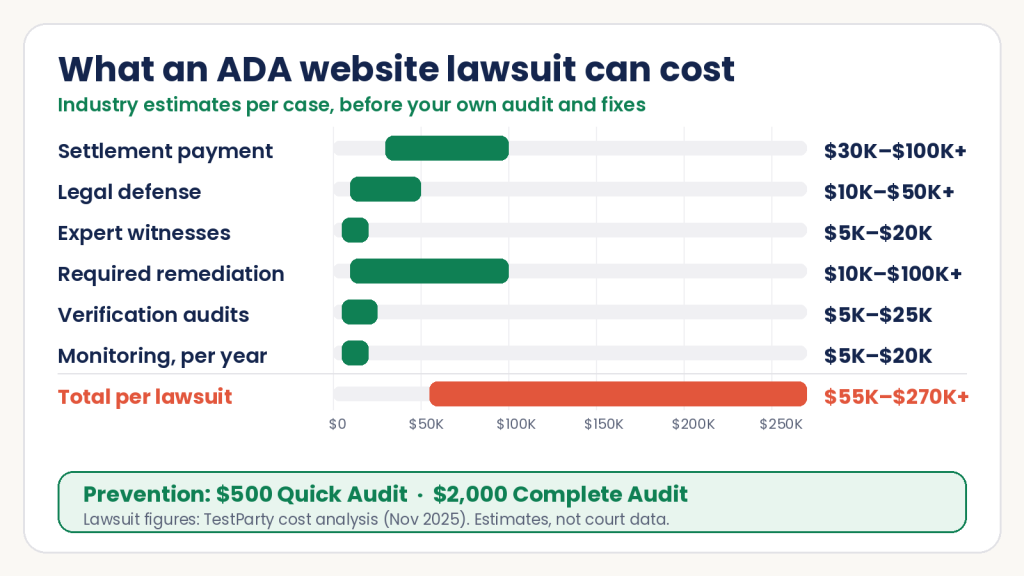
TestParty puts a typical ADA web accessibility settlement at $30,000 to $100,000 or more, with most e-commerce cases between $30,000 and $75,000. Its settlement ranges by type of defendant:
- $5,000 to $15,000: small businesses that settle quickly
- $15,000 to $30,000: mid-market businesses with standard cases
- $30,000 to $75,000: the most common range
- $75,000 to $150,000: larger businesses or severe violations
- $150,000 or more: enterprises, repeat defendants and high-profile cases
The settlement payment is only the first bill. It does not include your own legal fees, and most settlements also require you to fix the site and prove it.
What Does a Demand Letter Cost to Resolve?
Demand letters are settled privately and never reach court records, so no public dataset prices them reliably, and TestParty does not publish a separate demand-letter figure. Its lowest settlement band, $5,000 to $15,000, covers small businesses that settle quickly. Paying a letter does not remove the barriers it names: as the repeat-defendant figures below show, a business that pays without fixing its site can be sued again by another plaintiff. If a letter has arrived, start with ADA lawsuit remediation rather than a widget.
Legal Defense and Expert Witness Costs
TestParty estimates legal defense at $10,000 to $50,000 or more per case: initial response and evaluation $2,000 to $5,000, discovery $5,000 to $15,000, settlement negotiation $3,000 to $10,000, and trial preparation $15,000 to $50,000 or more if the case does not settle. Expert accessibility witnesses add $5,000 to $20,000. Most cases settle before trial, which keeps defense costs toward the lower end.
Remediation, Verification and Monitoring Costs
Settlements usually require real fixes on a deadline. TestParty estimates required remediation at $10,000 to $100,000 or more depending on scope, third-party verification audits at $5,000 to $25,000, and ongoing monitoring at $5,000 to $20,000 a year, often for two to three years. The same fixes cost less when you plan them yourself: our accessibility remediation services start from your audit findings, and the free accessibility needs assessment tells you where to begin.
Total Cost per ADA Website Lawsuit
Add it up and a single ADA website case costs $55,000 to $270,000 or more from start to finish, according to TestParty. Repeat lawsuits multiply that, because each case carries its own costs: TestParty puts two lawsuits at $110,000 to $540,000 and three at $165,000 to $810,000.
For context, a professional accessibility audit that finds and documents every issue before a lawsuit is filed costs a fraction of the cheapest resolution path. Our audit pricing starts at $100, with $500 and $2,000 tiers (Shopify Accessibility Audit $2,000). Our accessibility audit cost guide explains what each budget level buys and how to compare quotes. A remediation project that actually fixes those issues usually costs less than the average settlement alone. If a demand letter or complaint already arrived, start with ADA lawsuit remediation.
Lawsuit costs compared with prevention
| Option | Typical cost | What you get |
|---|---|---|
| Quick settlement by a small business | $5,000 to $15,000 | The claim goes away, but the barriers usually stay |
| Typical settlement | $30,000 to $100,000+, plus legal defense of $10,000 to $50,000+ | A settlement that often requires remediation anyway |
| Full case (defense, settlement, remediation, monitoring) | $55,000 to $270,000+ | Fixes made under a deadline you do not control |
| Accessibility consultation | $100 (1 hour) | A plan for your site and your risk |
| Quick Audit | $500 | Up to 5 templates tested by hand, top-10 issues report |
| Complete Audit | $2,000 | Up to 25 templates or flows, NVDA, JAWS and VoiceOver, re-test |
| Shopify Accessibility Audit | $2,000 | Theme, apps, cart and checkout tested end to end |
The 6 WCAG Failures That Appear in Almost Every Lawsuit
Accessibility lawsuits do not cite random violations. Plaintiffs focus on failures that are easy to test, easy to document, and difficult for defendants to dispute. The WebAIM Million 2026 report found that six failure types account for 96% of all WCAG errors on the web.
1. Low contrast text (83.9% of sites)
Text that does not meet the minimum contrast ratio of 4.5:1 against its background fails WCAG 1.4.3. This is the single most common failure on the web. It affects users with low vision, color blindness, and anyone reading in bright light.
2. Missing alt text (53.1% of sites)
Images without alternative text are invisible to screen readers. WCAG 1.1.1 requires all meaningful images to have descriptive alt text. Missing alt text on product images, promotional graphics, and icons is one of the most frequently cited failures in ADA complaints. Read our detailed guide on alt text for images.
3. Missing form labels (51% of sites)
Form inputs without associated labels cannot be understood by screen reader users. When a user tabs to an unlabeled search box or checkout field, their screen reader announces nothing useful. WCAG 1.3.1 and 4.1.2 both address this. Contact forms, search bars, and checkout flows are the most common failure locations.
4. Empty links (46.3% of sites)
A link that contains no text, or only an image with no alt text, gives screen reader users no information about where the link goes. WCAG 2.4.4 requires link purpose to be clear from the link text or its context. Icon-only links without aria-labels are a frequent target.
5. Empty buttons (30.6% of sites)
Buttons that have no accessible name, typically icon buttons or image buttons without labels, fail WCAG 4.1.2. A shopping cart icon with no text and no aria-label is a button that a screen reader user cannot identify or use.
6. Missing document language (13.5% of sites)
The lang attribute on the HTML element tells screen readers what language to use when reading the page. Without it, the screen reader may use the wrong language and mispronounce content. WCAG 3.1.1 requires the page language to be specified.
These six failures are not obscure edge cases. They are the most basic expectations of an accessible website. Their prevalence on 95.9% of home pages explains why demand letters and complaints can be filed at such scale. These criteria map to WCAG 2.2 (and 2.1) Level A/AA success criteria that plaintiffs routinely cite alongside ADA.gov web guidance.
Our automated accessibility testing catches many of these failures at the scanning stage. But automated tools miss a lot: when GOV.UK tested 10 automated tools on a page with known barriers, 29% of the barriers were found by none of them, and the best single tool found 41%. Missing form label associations, keyboard flow breaks, and focus management failures require manual testing against actual assistive technology.
Why Accessibility Widgets Are Not a Defense
In the first half of 2026, 496 ADA website lawsuits (24.25%) were filed against sites that already had an accessibility overlay or widget installed, according to EcomBack. That is up from 458 (22.74%) a year earlier, so widget users made up a bigger share of defendants, not a smaller one.
Accessibility overlays are third-party JavaScript tools that add a floating icon to your website, typically offering options to increase font size, change contrast, or enable a “screen reader mode.” They are marketed as a quick compliance fix.
A widget does not fix the underlying code. A screen reader interacts with the page’s code, not with the overlay’s visual adjustments, and plaintiffs test the actual code. Regulators have reached the same view: in April 2025 the Federal Trade Commission approved a final order requiring accessiBe to pay $1 million over claims that its widget could make any website WCAG compliant.
In some cases, overlays have made things worse by conflicting with genuine assistive technology and introducing new barriers. Plaintiffs know which overlay products are in widespread use and specifically test sites that carry them.
We covered the full legal and technical case against overlays in our post on accessibility overlays and ADA lawsuits.
What Actually Protects Your Business
The only defensible position in ADA website litigation is genuine conformance with WCAG 2.2 / 2.1 Level AA, consistent with ADA.gov guidance on web accessibility. Not a widget. Not a statement that says you are working toward compliance. Actual conformance, documented by a credible audit.
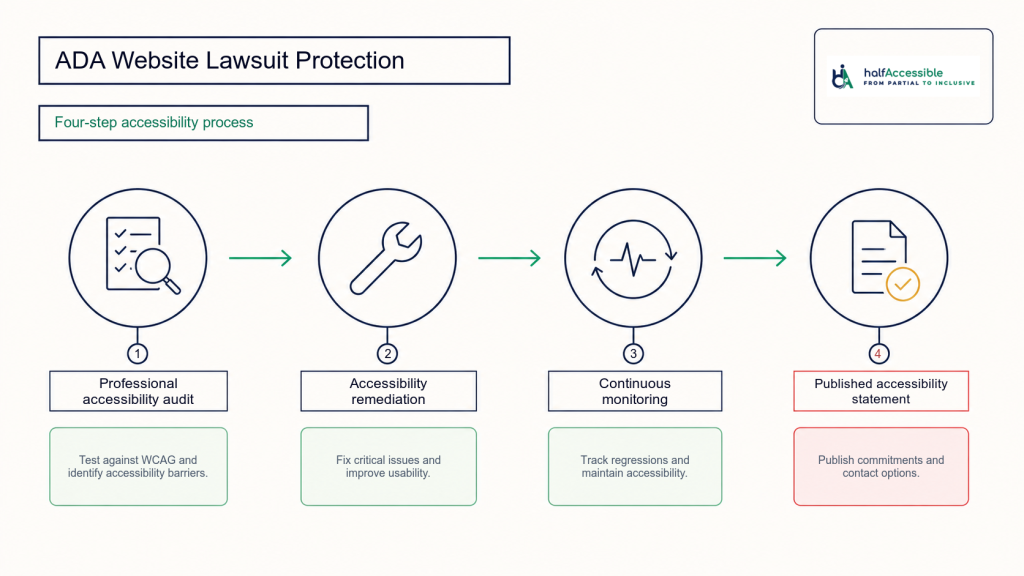
Here is what a defensible compliance program looks like.
Step 1: Professional accessibility audit
A WCAG 2.1 or 2.2 AA audit conducted by a qualified accessibility specialist covers both automated scanning and manual testing with real screen readers. The audit produces a documented report of every failure, organized by WCAG criterion, with clear remediation guidance. This report becomes your evidence of good-faith effort if a complaint is filed. Our accessibility audit services include both automated scanning and manual keyboard and screen reader testing. Start with a $500 Quick Audit for your highest-risk templates, or go straight to the $2,000 Complete Audit for full coverage.
Step 2: Remediation
The audit findings need to be fixed in the code. This is not optional. Documented failures that are not remediated are worse than no audit at all, because they show you knew about the problems. Our website accessibility remediation services work directly with your development team to close every reported issue.
Step 3: Ongoing monitoring
A website that was accessible after remediation can become inaccessible after the next content update, theme change, or third-party widget addition. Continuous monitoring catches regressions before a plaintiff does. Our accessibility monitoring and governance service keeps a live record of your site’s conformance status so you always have current documentation if a complaint arrives.
Step 4: Accessibility statement
A published accessibility statement on your website shows users and plaintiffs that you take compliance seriously, provides a mechanism for users to report barriers, and demonstrates ongoing commitment. Courts and plaintiffs consider its presence when assessing good faith.
The Bottom Line
The ADA website lawsuit 2026 numbers are not going down. Federal filings dipped in 2023 and 2024, bounced back 27% in 2025, and 2026 is on pace for a record. Every structural factor that drives filings, including AI-assisted complaint drafting, a large specialized plaintiff bar, and the enormous pool of non-compliant sites, is still in place and growing.
For most businesses, the decision is simple: spend on compliance now or spend far more on litigation later.
The path to a defensible position starts with understanding what is actually broken on your site. A professional accessibility audit gives you that picture, along with the documented evidence of good-faith effort that matters if a complaint arrives.
If you want to start with a conversation about where your site stands, book a free 30-minute call. It is the right first step if you are still scoping or want a quote. If your team needs hands-on technical help now, such as walking through findings with your developer, book the $100 one-hour technical consultation. Ready to test? A $500 Quick Audit checks up to 5 key templates by hand and gives you a top-10 issues report, and a $2,000 Complete Audit covers up to 25 templates or user flows with NVDA, JAWS and VoiceOver, plus a re-test after fixes. Every audit is led by our founder, who holds the IAAP CPACC, WAS and CPWA certifications and has 10+ years of accessibility testing experience. You can also compare pricing, see a sample audit report, or browse our services. Not sure which option fits? Fill in the free accessibility needs assessment and we will point you to the right starting point. We work with e-commerce brands, SaaS companies, healthcare organizations, and businesses across every industry to close the gap between where their websites are and where the law requires them to be.
Get an ADA and Section 508 Accessibility Audit
If your organization needs to meet the DOJ Title II web accessibility deadlines or Section 508 requirements, our ADA & Section 508 Accessibility Audit Services page covers the exact standards, deadlines, and pricing. You can also book a consultation or start from pricing.