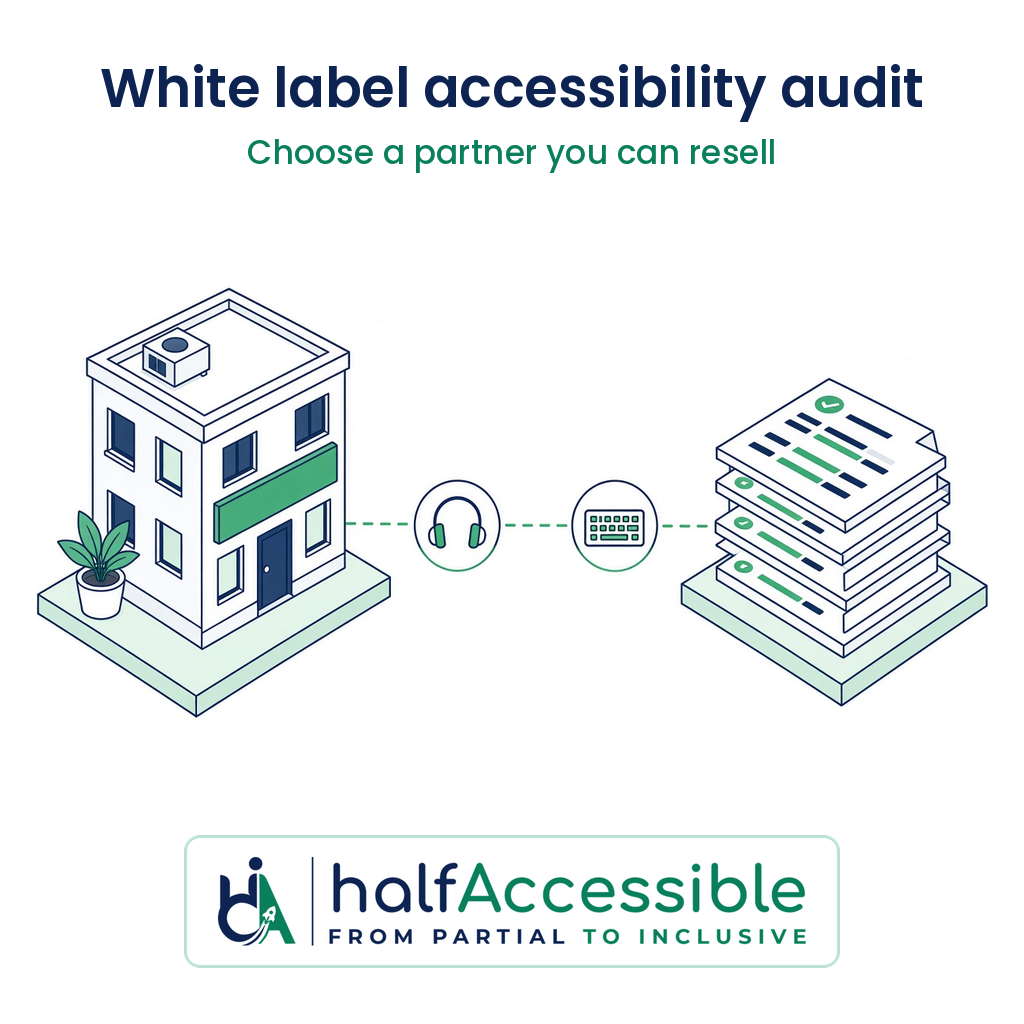
A white label accessibility audit is a manual WCAG audit carried out by a specialist partner and delivered to your client under your agency’s name. The partner you pick decides whether that report makes your agency look expert or exposed, so judge candidates on five things before you sign: proof of manual testing with real assistive technology, a report you would happily put your logo on, fixed scope and pricing you can mark up, confidentiality in writing, and a clear path to fixes and a re-test.
This guide is for web, Shopify, WordPress, product and marketing agencies that keep getting accessibility requests and want to sell audits without hiring a full-time specialist. It is written by Shadab Saifi, founder of HalfAccessible, who holds the IAAP (opens in a new tab) CPACC, WAS and CPWA certifications, has 10+ years of accessibility testing experience and runs white label audits for partner agencies. It covers what to ask, what to put in the contract, how pricing and margin work, and how to run a low-risk pilot. It is not legal advice.
Why Agency Clients Are Asking For Audits, At A Glance
- 95.9%: Of the top one million home pages had detected WCAG 2 failures in February 2026, an average of 56.1 errors per page (Source: WebAIM Million 2026 (opens in a new tab))
- 26 Apr 2027: ADA Title II deadline for state and local governments of 50,000+ people, even when a local web design company built and updates the page (smaller entities: 26 Apr 2028) (Source: ADA.gov fact sheet (opens in a new tab))
- 28 Jun 2025: Date the European Accessibility Act started to apply to covered products and services such as ecommerce and banking (Source: Directive (EU) 2019/882 (opens in a new tab))
- $1M: Paid by accessiBe under an April 2025 FTC final order over claims its automated products could make any website WCAG compliant (Source: FTC press release (opens in a new tab))
Choose Your Next Step
Comparing white label partners? Put HalfAccessible through the same 8 questions below. Most agencies start with a free call to scope one client site and get a fixed quote they can mark up. If your developers already have findings, or you need an expert on a live client site now, the $100 one-hour technical consultation is the better fit. Full sites use the $2,000 Complete Audit on our accessibility audit services page, every package is listed on the pricing page, and you can check the format first in our sample audit report.
Free 30-Minute Call
Best for: agencies new to white label work, or quoting a client right now
A first conversation with our founder about the client URL, deadline and target standard. You leave with a recommended scope and a fixed-price quote. No prep needed.
Book a free 30-minute call (opens in a new tab)
Quick Audit Pilot ($500)
Best for: testing a partner on one real client site before you commit
Manual and automated testing of up to 5 templates with a top-issues report mapped to WCAG 2.2, delivered unbranded or in your template.
Agency Partner Program (Partners)
Best for: agencies with steady accessibility requests from clients
Project or retainer terms for recurring white label audits, re-tests, remediation support and VPAT/ACR documentation under your brand.
See the agency partner program
What a White Label Accessibility Audit Is (and What It Is Not)
In a white label arrangement your agency owns the client relationship, the timeline and the final deliverable. The partner owns the testing, the findings and the accuracy of every WCAG reference. Your client sees one name on the report: yours.
| Area | Your agency | The audit partner |
|---|---|---|
| Client contact and sales | Owns it | Never contacts the end client |
| Scope and deadline | Agrees it with the client | Confirms it is realistic before you quote |
| Testing | Provides access and test accounts | Manual testing with keyboard and screen readers, plus automated scans |
| Report | Delivers it under your brand | Writes it unbranded or in your template |
| Developer questions | Routes them | Answers them while your team fixes |
| Re-test and documentation | Schedules it with the client | Re-tests fixes, and can prepare a VPAT/ACR under your brand |
What it is not: a scanner export with your logo pasted on top, or an overlay licence you resell. W3C says plainly that web accessibility evaluation tools “can not determine accessibility, they can only assist in doing so”. If your partner’s “audit” is a tool report, your agency is the one signing off on something nobody actually tested.
Why Agency Clients Are Asking for Audits Now
Public-sector clients have firm dates
Under the DOJ’s ADA Title II rule, state and local government web content must meet WCAG 2.1 AA by April 26, 2027 for entities of 50,000 or more people and April 26, 2028 for smaller entities and special districts. The ADA.gov fact sheet gives the example of a county web page that must conform “even if a local web design company made the web page and updates it.”
- Clients: Cities, counties, schools, public universities and transit
- Read: DOJ Title II deadline guide
EU clients are already in scope
The European Accessibility Act (Directive (EU) 2019/882) has applied since June 28, 2025 to covered products and services such as ecommerce and banking. Clients selling into the EU now ask for evidence, not promises.
- Standard: EN 301 549, which points to WCAG for web content
- Read: European Accessibility Act audit guide
Most sites start with obvious failures
The WebAIM Million 2026 report found detected WCAG 2 failures on 95.9% of the top one million home pages, an average of 56.1 errors per page. Almost any redesign client you take on will have issues to find.
- Opportunity: Audit plus fixes on redesigns and launches
- Watch for: Selling a scan score as the audit
Overlay shortcuts carry their own risk
In April 2025 the FTC approved a final order requiring accessiBe to pay $1 million and barring it from claiming its automated products can make any website WCAG compliant without evidence. Reselling a widget as “compliance” puts that claim on your agency.
- Avoid: Widget licences sold as compliance
- Read: Accessibility overlays and ADA lawsuits
The Partner Checklist: 8 Things to Get in Writing
Send every candidate the same eight questions and compare the written answers. Sales calls are useful, but the proposal is what you will be held to.
1. How do you test, and with which assistive technologies?
Expect a named mix of automated scanning plus manual keyboard-only testing and screen reader testing, for example NVDA and JAWS on Windows and VoiceOver on macOS and iOS, along with zoom, reflow and contrast checks. Our screen reader accessibility testing guide shows what that work involves.
- Good answer: A written list of screen readers, browsers and devices
- Red flag: A tool name and a PDF
2. Who does the testing, and who signs off the report?
Ask for named people and credentials. Certifications from the International Association of Accessibility Professionals (CPACC, WAS, CPWA) are a good sign, and federal work benefits from DHS Section 508 Trusted Tester experience. Your brand is on the report, so a second, senior review matters.
- Good answer: Named testers plus a senior reviewer before delivery
- Red flag: No names, so you cannot defend the method
3. Which standard will each client be tested against?
WCAG 2.2 Level AA is a sensible default. Some clients need a specific version because of their law: WCAG 2.1 AA for ADA Title II, EN 301 549 for European Accessibility Act work, and the Revised Section 508 Standards (which incorporate WCAG 2.0 AA) for US federal sales.
- Good answer: Standard and level named in writing for each project
- Red flag: One generic “ADA compliant” promise for every client
4. How do you choose what to test?
Prefer partners that sample by templates and complete user journeys rather than raw page counts. W3C’s WCAG Evaluation Methodology (WCAG-EM) describes defining scope, exploring the product, selecting a representative sample that includes complete processes, evaluating it and reporting. A 3,000-page site might only have 10 to 20 unique templates.
- Good answer: Templates plus checkout, login and forms tested end to end
- Red flag: Per-page pricing with no template logic
5. What does the report look like, and can it carry our brand?
Each finding should give the WCAG success criterion, severity, location, steps to reproduce and a recommended fix your developers can apply, in language a project manager can triage. Review ours on the sample audit report page.
- Good answer: Unbranded or in your template, with a sample shared up front
- Red flag: No sample report before you sign
6. What turnaround and response times will you commit to?
Agency deadlines are set by the client, so you need numbers in the proposal: how quickly a new client site is scoped and quoted, the delivery window for a standard audit, how fast developer questions are answered during fixes, and how soon a re-test can start.
- Good answer: Written turnaround and response times
- Red flag: “It depends” with no numbers
7. How do you protect the client relationship?
Put confidentiality and non-solicitation in writing: the partner never contacts, markets to or takes on your end client directly, and does not mention the work in its own marketing unless you agree. Also agree how staging URLs, test accounts and passwords are handled and removed at the end.
- Good answer: Non-solicitation and confidentiality in the contract
- Red flag: The partner wants to join client calls by default
8. What happens after the report?
A report alone leaves your client with a backlog. Ask whether the partner can support your developers during fixes, take on accessibility remediation when your team is at capacity, re-test the fixed issues, and prepare VPAT and ACR documentation under your brand for clients that sell software to enterprise or government buyers.
- Good answer: Developer Q&A, re-test and documentation under your brand
- Red flag: A report handed over with no support window
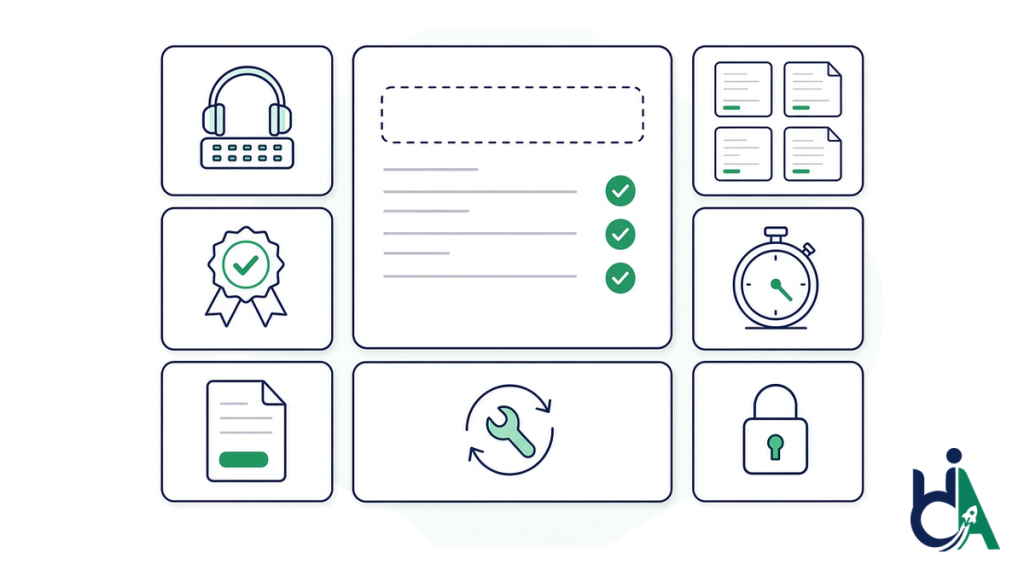
Contract Terms Agencies Often Forget
Most agency and partner disputes come from things nobody wrote down. Add these to your partner agreement or statement of work.
| Term | What to write down | Why it matters |
|---|---|---|
| Report ownership | Your agency may rebrand, edit the format of and deliver the report as its own | You can reuse findings in proposals and client portals |
| Non-solicitation | The partner will not approach or accept work directly from your end clients | Protects the relationship you paid to win |
| Confidentiality | Client names, URLs, credentials and findings stay private | Clients trust you with staging sites and accounts |
| Scope definition | Templates, user journeys, standard and level, devices and assistive technologies | Stops “we did not test that” arguments later |
| Change requests | How extra templates or new journeys are priced before work starts | Keeps your margin intact when scope grows |
| Re-test | Whether a re-test is included, how many rounds and within what window | Your client needs evidence that fixes worked |
| No legal guarantees | Neither party promises lawsuit immunity or “full compliance” | No auditor can promise that, and overpromising is how agencies get blamed |
| Dispute process | How a finding or severity can be challenged, with recordings or steps | Lets you resolve disagreements before the client sees them |
How White Label Pricing and Margin Work
Fixed, published package prices make reselling simple: you know your cost before you quote, and you set your own margin on top. Hourly or “discovery-first” pricing makes that much harder. At HalfAccessible, partners quote from the same public packages listed on our pricing page:
| Option | Price | What it covers | Best for |
|---|---|---|---|
| Free 30-minute call | Free | A first discussion about a client site, its deadline and standard, so we can scope and quote | Agencies new to white label work, or quoting a new client |
| 1-hour technical consultation | $100 | Audit walkthrough, time with your developers, or a live review of a client site’s issues | Teams that already have findings and need technical answers |
| Quick Audit | $500 | Manual WCAG 2.2 AA testing of up to 5 page templates with a top-issues report; re-test optional | A pilot or a small client site |
| Complete Audit | $2,000 | Up to 25 templates or key user flows, a re-test of fixed issues and 90 days of support | Full client sites, redesigns and launches |
| Shopify Accessibility Audit | $2,000 | Theme, apps and checkout flow on a client’s Shopify store | Shopify and ecommerce agencies |
| Partner program | Quoted | Project or retainer terms for recurring client work | Agencies with steady accessibility requests |
Two things help margins hold. Scope by templates and journeys, not page counts, so a large catalogue site does not explode the quote. And agree the re-test up front, because clients nearly always ask “is it fixed now?” For what drives audit prices across the market, see our accessibility audit cost guide.
Run a Pilot Before You Sign a Retainer
You do not need a long contract to find out whether a partner fits. Run one real client project and judge the result.
| Step | What to do | What you learn |
|---|---|---|
| 1. Pick one live client | Ideally one with a clear driver: a redesign launch, an EU customer request or a public-sector contract | Whether the partner handles a real deadline |
| 2. Qualify it with a quick scan | Run a free single-page check on AccessibilityScore.in, HalfAccessible’s free WCAG checker powered by axe-core. It is a starting point only: it cannot test keyboard use, screen reader behaviour or full journeys, and it is not a compliance certificate | A talking point that shows the client automated issues exist |
| 3. Buy a small fixed-scope audit | A Quick Audit on up to 5 templates | The partner’s method, report quality and responsiveness |
| 4. Review the report as your client would | Can your project manager triage it? Can your developers fix from it without a call? | Whether you would put your logo on it unchanged |
| 5. Score the experience | Was the turnaround met? Were developer questions answered quickly? Did anyone contact your client? | Whether the partner protects your relationship |
| 6. Then agree terms | Move to project or retainer terms once one report has landed | A partner your team already trusts |
Red Flags When Choosing a White Label Partner
| Red flag | Why it hurts your agency | Ask for instead |
|---|---|---|
| “Our tool makes the site compliant.” | Tools assist; they do not decide conformance, and the FTC order shows how those claims are treated | Manual testing of key journeys, with fixes in the client’s code |
| No sample report | You would be reselling something you have never seen | A real sample audit report |
| No named testers or assistive technology list | You cannot defend the method to your client | Named testers and a written AT and device list |
| Per-page pricing with no template logic | Your quote becomes unpredictable on large sites | Fixed prices scoped by templates and journeys |
| The partner wants to “join the client call” by default | Fine when you invite it, a problem when it is the plan | Non-solicitation in writing |
| No re-test or remediation path | Your client is left with a list and no proof it was fixed | A re-test and developer support window |
| Guarantees of lawsuit protection | Evidence and fixes reduce risk; nobody can promise immunity | Dated evidence: report, fixes and re-test |
For a wider buyer checklist that also works for direct clients, see how to choose an accessibility audit company.
How HalfAccessible Works With Agencies
If you want a concrete reference point while you compare partners, here is how we answer the same questions:
| Area | How we work |
|---|---|
| Proof | Our white label accessibility audits case study covers three partner firms served under their own brand, including web agency Anblik and Bay Area Web Solutions, plus an independent IAAP-certified review of an existing report for a QA company. Every rated contract scored 5.0 out of 5 on Upwork. |
| Who tests | Founder-led work. Audits are led and reviewed by Mohammad Shadab Saifi (IAAP CPACC, WAS and CPWA, DHS Section 508 Trusted Tester, 10+ years), with manual testing in NVDA, JAWS and VoiceOver plus keyboard-only checks. |
| Branding and confidentiality | Reports ship unbranded or in your template, and we never contact your end clients. |
| Timing | Most client sites are scoped and quoted within 1 to 2 business days, and standard sites typically run one to two weeks once access is in place. |
| After the report | Developer Q&A during fixes, remediation, re-testing and VPAT/ACR documentation under your brand. |
| Platforms | Shopify stores use the Shopify accessibility audit, WordPress sites the WordPress accessibility audit, and React or custom builds follow the same process. |
The full service menu for agencies is on our white label accessibility services for digital agencies page.
Next Step: Put Your Brand on a Partner-Tested Audit
If clients are already asking for accessibility and you want to say yes without hiring, start with one project and a written scope. Quoting a client now? Book a free 30-minute call (opens in a new tab): share the client URL, deadline and target standard, and leave with a fixed-price quote you can mark up. Your developers already have findings? Book the $100 one-hour technical consultation for an audit walkthrough or a live review of a client site.
Ready for a pilot? ($500)
Best for: one client site you want to review with your team
Steady accessibility requests? (Partners)
Best for: project or retainer terms. See the full white label accessibility services for agencies.
Apply to the agency partner program
Want to compare first?
Best for: agencies still shortlisting. Review the sample audit report and our case studies.