
Client & Context
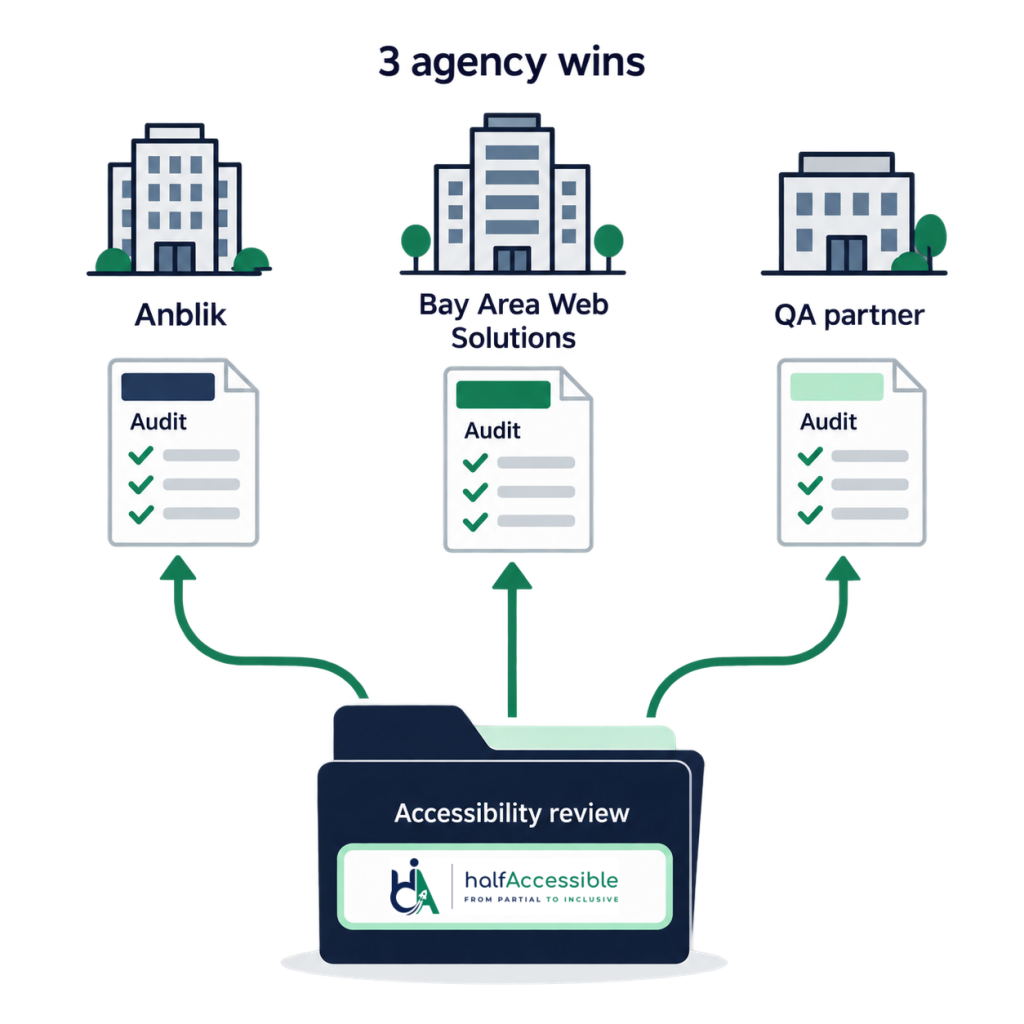
White label accessibility audits let agencies say yes to compliance work without hiring a certified specialist full-time: the agency sells and manages the work, and an accessibility audit partner does the testing behind its brand. Across late 2025 and early 2026, three firms — web agency Anblik, Bay Area Web Solutions, and a QA company requiring IAAP-certified report review — engaged HalfAccessible to deliver audit work their clients received under the agency’s own banner.
The Challenge
Agency work has two extra constraints that direct engagements do not. First, the deliverable represents the agency’s brand, so the reporting quality must be flawless and consistent. Second, timelines are set by the agency’s client, not the auditor — which means clear scope, fast turnaround, and zero surprises.
For the QA firm, the ask was different again: an existing accessibility report needed independent review by an IAAP-certified tester before it went to their client — certification as a quality gate.
How White Label Accessibility Audits Work
Each engagement followed the same backbone: manual WCAG testing with NVDA, JAWS, VoiceOver, and keyboard-only navigation, automated scanning for coverage, and findings mapped to WCAG 2.2 success criteria with severity and fix guidance. Automated tools help with coverage, but W3C WAI notes that evaluation tools cannot check every accessibility aspect — human judgement with assistive technology is still required. Reports were formatted to drop directly into each agency’s client deliverables, and we stayed available for developer questions during remediation — invisible to the end client, indispensable to the agency.
Where US clients needed ADA context alongside WCAG, findings were framed against ADA.gov web guidance on how the ADA applies to websites. IAAP credentials behind the work (CPWA, WAS, CPACC) follow the certification paths published by the International Association of Accessibility Professionals.
The Results
- Three agencies delivered certified-quality WCAG audit work under their own brand
- Independent IAAP-certified review provided as a quality gate for an existing report
- Long-running engagement with Bay Area Web Solutions spanning three months
- Every rated contract scored 5.0 out of 5.0 on Upwork
How the White-Label Arrangement Works
The mechanics are simpler than agencies expect. The agency owns the client relationship, the timeline, and the final deliverable; we own the testing, the findings, and the standards accuracy. Reports are delivered unbranded or in the agency template, written so the agency can present them confidently — no jargon walls, no defensive hedging, severity levels a project manager can triage without an accessibility background.
Confidentiality runs both directions: end clients are never contacted directly, and the agency decides whether the partnership is visible or invisible. Several of our agency relationships have run for months across multiple end clients precisely because that boundary holds. For a standing partnership rather than a one-off, see our white label accessibility partner program and the white label accessibility services specialty for digital agencies.
What Agencies Receive on Every Engagement
- Manual WCAG testing by IAAP-certified specialists (CPWA, WAS, CPACC) with real assistive technology
- Findings with severity, WCAG mapping, locations, and code-level fix guidance the dev team can apply directly
- A report formatted for the agency’s own deliverable pipeline
- Developer Q&A support during remediation, invisible to the end client
- Optional independent review of existing reports as a certification quality gate
For agencies, the economics are straightforward: accessibility requests arrive irregularly, certified hires are expensive, and a white-label partner converts an unpredictable cost centre into a margin-positive service line. The 5.0 ratings across these three partnerships suggest the model holds up in practice, not just on paper. When an end client also needs barrier fixes after the report, agencies can hand work to our accessibility remediation services without breaking the white-label boundary.
Our White Label Accessibility Audit Process, Step by Step
Every agency accessibility audit in these case studies followed the same seven steps, and the agency stayed the client-facing contact at each one.
- Scope call. You share the client URL, key user journeys, deadline and target standard. Most audits are scoped and quoted within 1–2 business days.
- Sample selection. We choose representative page templates and complete processes such as checkout, forms and login, following the W3C WCAG-EM evaluation methodology.
- Automated scan. Tools cover the whole sample quickly and flag repeated issues, but they cannot judge every requirement, so they only start the audit.
- Manual testing. Keyboard-only use, NVDA and JAWS on Windows, VoiceOver on macOS and iOS, plus zoom, reflow and contrast checks against WCAG 2.2 AA.
- Findings and fixes. Each issue gets its WCAG success criterion, severity, location, steps to reproduce and code-level fix guidance, in your template or unbranded.
- Certified review. An IAAP-certified specialist checks the report before it reaches you, the same quality gate the QA firm in this case study asked for.
- Remediation support and retest. Your developers get Q&A while they fix. The $2,000 Complete Audit includes a re-test of fixed issues (optional on the $500 Quick Audit), and VPAT/ACR documentation is available under your brand.
How to Choose an Accessibility Audit Agency Partner
If you are comparing accessibility audit agencies to sit behind your brand, check these six things before you sign.
- Manual testing, not just a scanner. W3C WAI states that evaluation tools cannot check every accessibility requirement, so ask which screen readers, browsers and devices the auditors use.
- Named credentials. Look for IAAP certifications (CPACC, WAS, CPWA) and, for US federal work, a DHS Section 508 Trusted Tester.
- The standards your clients face. WCAG 2.2 AA as the default; WCAG 2.1 AA for US state and local government sites, including content built by contractors, under the ADA Title II rule, with compliance dates of April 26, 2027 and April 26, 2028 (ADA.gov fact sheet); and EN 301 549 for EU clients covered by the European Accessibility Act, which has applied since June 28, 2025.
- A report you can resell. Ask for a sample before you commit. Ours is on the sample accessibility audit report page.
- Confidentiality. The partner should never contact your client directly and should deliver unbranded or in your template.
- A path after the audit. Remediation, re-testing and VPAT and ACR documentation keep the project moving once the report lands.
What White Label Accessibility Audits Cost
Agencies resell the same public packages listed on our accessibility audit pricing page: a $100 one-hour consultation, the $500 Quick Audit for up to 5 page templates, and the $2,000 Complete Audit for up to 25 templates or key user flows, with a re-test of fixed issues and 90 days of support. Shopify stores use the $2,000 Shopify Accessibility Audit. For recurring client work, project or retainer terms are confirmed after you apply to the partner program, so you can set your own margin before you quote.
Agency Looking for an Accessibility Partner?
If your clients are asking for WCAG compliance and you need certified capacity behind your brand, start with our accessibility audit services and agency-friendly accessibility audit pricing, or join the white label accessibility partner program. Digital agencies can also review the white label accessibility specialty for how we plug into agency workflows.
Apply to the white label partner program, start a $500 Quick Audit for one client site, request a free accessibility needs assessment, or book a $100 accessibility audit consultation to scope a white-label arrangement before you commit a timeline to your client. Prefer proof from a remediation-led engagement? See our sibling ADA website remediation case study — that programme led with code fixes; these three engagements led with white label accessibility audits under the partner agency’s brand.
Why This Matters
For agencies, white-label accessibility work only succeeds if it holds up under the agency’s own name and the end client’s scrutiny. Each of these three engagements was delivered under the partner agency’s brand, with documentation formatted for their existing client reporting — accessibility expertise added as a service, not a subcontractor’s separate report the agency has to translate. That is the conversion path buyers searching for white label accessibility audits usually need: certified testing capacity, confidential delivery, and a partner who stays invisible until the agency decides otherwise.