The United Arab Emirates is one of the world’s most digitally connected countries. Internet penetration sits at 99%. Government services are largely digital. Ecommerce is growing fast. And yet most businesses operating in the UAE have never reviewed their websites or apps for accessibility compliance.
That gap is closing — and the legal consequences of ignoring it are real.
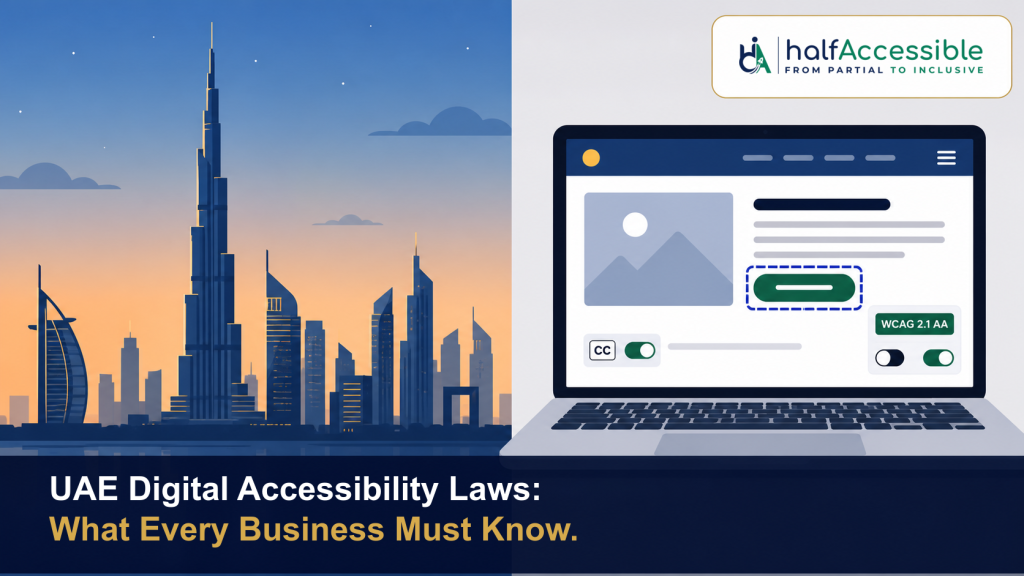
UAE digital accessibility laws now cover private sector organizations alongside government entities. The framework spans federal disability law, emirate-level legislation in Dubai, a national digital policy, and criminal law provisions that carry penalties of up to AED 1,000,000. If your business operates a website, app, or digital platform serving users in the UAE, this guide covers what you need to know.
Key Takeaways
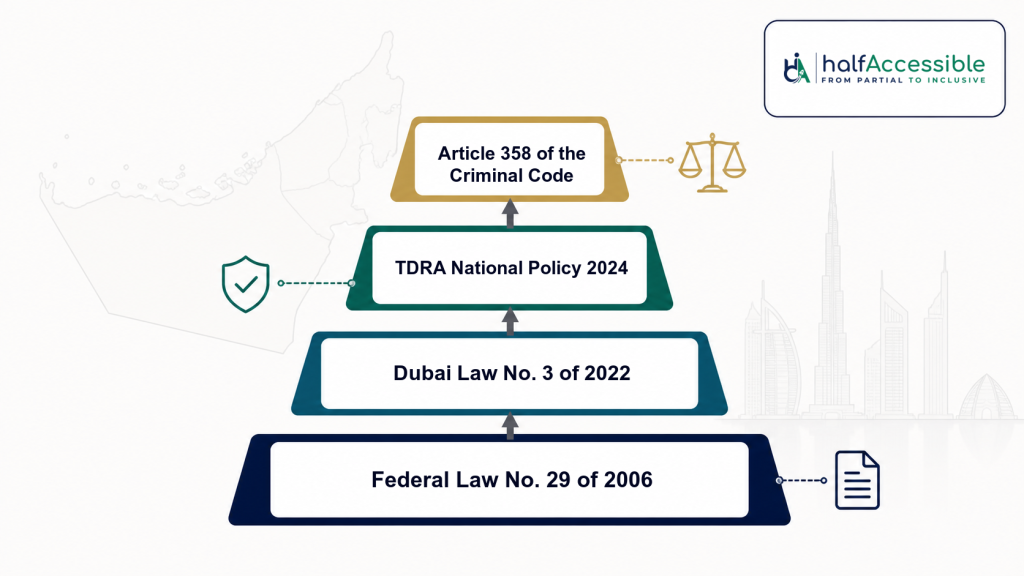
- The UAE’s digital accessibility framework has five layers: Federal Law No. 29 of 2006, Dubai Law No. 3 of 2022, the TDRA National Digital Accessibility Policy (March 2024), the Dubai Universal Design Code, and Article 358 of the 2021 Criminal Code.
- The compliance standard across all layers is WCAG 2.1 Level AA. Some government entities are already moving to WCAG 2.2.
- The 2024 National Digital Accessibility Policy extends requirements to private sector companies providing public-facing services, including ecommerce, health, education, and financial services.
- Administrative penalties reach AED 200,000 under the Disability Act. Criminal penalties under Article 358 reach AED 1,000,000.
- The UAE uses the term “People of Determination” for persons with disabilities. It is the official and preferred term.
- Government entities must publish accessibility statements and submit compliance reports. Private sector organizations providing public services face the same standards.
- TDRA is updating its Web Accessibility Policy to align with WCAG 2.2, with finalization expected in 2026.
- With 99% internet penetration, accessibility failures affect a vast portion of UAE residents and visitors.
Why UAE Digital Accessibility Matters Now
The UAE has been building its digital accessibility framework for nearly two decades. Federal Law No. 29 was passed in 2006. Dubai issued its own disability law in 2022. The TDRA launched a national digital accessibility policy in March 2024. Each layer has tightened requirements and broadened the scope of who must comply.
The UAE’s phrase “People of Determination” reflects a national philosophy: disability is framed around strength and capability, not limitation. Sheikh Mohammed bin Rashid Al Maktoum introduced the term in April 2017. It is the official and legally recognized term across all UAE government communications and legislation.
Approximately 15,782 people are registered with disability cards in the UAE. But accessibility requirements are designed for a much larger population: they benefit senior citizens, people with temporary impairments, residents whose first language is not Arabic or English, and users on older devices or slow connections.
With the UAE’s Vision 2031 targeting an inclusive, barrier-free society, digital accessibility is not just a legal obligation. It is a core component of the national agenda.
Layer 1: Federal Law No. 29 of 2006
Federal Law No. 29 of 2006 Concerning the Rights of People with Special Needs is the foundational disability rights law in the UAE. It establishes that a person’s disability shall not be a reason to deprive them of their rights and services in welfare, social, economic, health, educational, professional, cultural, and leisure domains.
The law has been updated since its original passage, with amendments explicitly extending its scope to digital services. Key obligations under the law include:
- Equal access to public services, including digital and online services
- Prohibition of discrimination against People of Determination in service provision
- Requirements for both government and private entities to accommodate persons with disabilities
- Mandatory accessibility compliance for all entities — public and private — providing services to the public
For digital platforms, Federal Law No. 29 means that a website, app, or digital service that excludes People of Determination by being inaccessible is in breach of their legal rights. The law provides the foundation. The TDRA policy and Dubai Code provide the technical specifics.
Layer 2: Dubai Law No. 3 of 2022
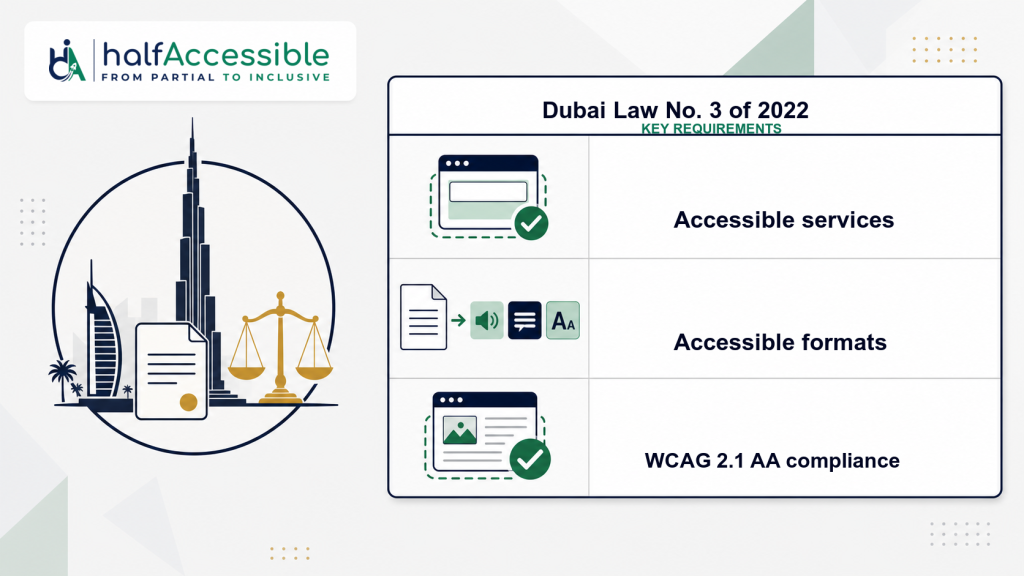
The Emirate of Dubai took a significant step forward with Law No. 3 of 2022 Concerning the Rights of Persons with Disabilities in the Emirate of Dubai. This law is more specific than the federal legislation and more directly addresses digital services.
Law No. 3 of 2022 requires concerned entities to comply with Inclusive Design standards so that People of Determination can access all services, programs, products, and commodities. It mandates that information be provided in accessible formats.
The Executive Council Resolution No. 1 of 2022, which issues the implementing bylaw of the law, provides operational detail. The law explicitly references the Dubai Universal Design Code as the technical compliance standard — which in turn mandates WCAG 2.1 Level AA for websites and digital platforms.
Any business operating in Dubai that provides digital services to the public is covered by Law No. 3 of 2022. This is not limited to government entities. Retail, hospitality, healthcare, financial services, and ecommerce platforms are all in scope.
Layer 3: The National Digital Accessibility Policy (TDRA, March 2024)
The most significant recent development in UAE digital accessibility law is the National Digital Accessibility Policy, published by the Telecommunications and Digital Government Regulatory Authority (TDRA) in March 2024 and endorsed by Cabinet.
This policy moves beyond government websites and establishes national-level requirements for digital accessibility across the entire economy.
Who it covers: The policy applies to government entities, semi-governmental entities, and private sector companies providing public-facing services. It explicitly lists health, education, ecommerce, and financial services as sectors in scope.
What it requires: Compliance with WCAG 2.1 Level AA as the baseline standard, alongside W3C’s WAI guidelines and the Mobile Devices Guidelines Manual. All public-facing digital platforms — websites, apps, kiosks, and e-services — must meet these standards.
Accessibility statements: Government entities are required to publish accessibility statements detailing their compliance status, known issues, and contact information for reporting barriers. Private sector organizations providing public services face equivalent documentation expectations.
Compliance reporting: All government entities must furnish accessibility reports to the competent authority. The policy creates a structured accountability mechanism that did not previously exist at this scale.
WCAG 2.2 update in progress: TDRA’s updated Web Accessibility Policy aligned with WCAG 2.2 was in stakeholder consultation through 2026, with publication expected in the second half of the year. Organizations that adopt WCAG 2.2 now will be ahead of the next compliance cycle.
The 2024 National Policy is the clearest signal that the UAE is treating digital accessibility as a universal requirement, not just a public sector obligation.
Layer 4: The Dubai Universal Design Code
The Dubai Universal Design Code is the technical standards document that gives practical meaning to the accessibility requirements in Dubai Law No. 3 of 2022. Originally developed for the built environment, the Code has been extended to cover digital platforms.
For digital accessibility, the Dubai Universal Design Code mandates WCAG 2.1 Level AA compliance for websites and apps. It establishes Dubai’s regional benchmark for accessible digital experiences, aligning with global standards while setting specific requirements for entities operating in the emirate.
The Code sits alongside the federal and emirate legislation as the technical rulebook. If the law says “comply with Inclusive Design standards,” the Code defines what those standards are. For most web teams, the practical answer is: meet WCAG 2.1 Level AA and you meet the Code.
Layer 5: Article 358 of the 2021 Criminal Code
The most serious legal exposure for digital accessibility failures in the UAE comes from Article 358 of Federal Decree-Law No. 31 of 2021, the UAE’s Criminal Code.
Article 358 criminalizes the denial of services on discriminatory grounds. When an inaccessible website or app effectively denies a Person of Determination access to a service that sighted, non-disabled users can access freely, it can constitute discrimination under this provision.
The penalties are significant. Conviction under Article 358 can result in imprisonment of up to one year and fines of up to AED 1,000,000 (approximately USD 272,500).
This is not a compliance technicality. It is criminal law. The combination of administrative fines under the Disability Act and criminal exposure under Article 358 creates what analysts describe as a five-layer legal exposure stack: administrative penalties, emirate-level fines, criminal prosecution, public procurement disqualification, and CRPD reporting pressure for the UAE government.
Organizations serving the UAE market should treat this layer of the framework as the serious legal risk it is.
Who Must Comply: Public Sector, Private Sector, and Foreign Businesses
One of the most common misconceptions about UAE digital accessibility law is that it only applies to government websites. The 2024 National Policy, Dubai Law No. 3 of 2022, and Federal Law No. 29 together make clear that this is not correct.
Federal and local government entities have the most explicit compliance obligations. They must meet WCAG 2.1 AA, publish accessibility statements, and submit compliance reports to TDRA.
Semi-governmental entities including state-linked companies, utilities, and government-backed organizations are fully in scope.
Private sector companies providing public-facing services are covered by the 2024 National Policy and Dubai Law No. 3. The explicitly listed sectors are health, education, ecommerce, and financial services. Any private company whose digital platform is used by the public — including tourists and residents — falls under this framework.
Foreign businesses with users in the UAE are exposed to UAE law to the extent that they serve UAE residents. This parallels the approach taken by the EAA in Europe: location of the business does not exempt it from the law of the market it serves.
Hospitality, tourism, and retail are sectors of particular focus given the UAE’s economic profile. A hotel booking platform, airline website, or retail ecommerce store that is inaccessible to People of Determination may face complaint risk under both Law No. 3 and the Criminal Code. See our eCommerce & Retail Accessibility and Finance & Banking Accessibility specialty pages for sector-specific guidance.
What WCAG 2.1 Level AA Requires for Your Website
The technical compliance target across all UAE digital accessibility frameworks is WCAG 2.1 Level AA. Here are the most critical requirements that most websites currently fail on.
Color contrast is the most common failure globally and in the UAE market. Normal text needs a contrast ratio of at least 4.5:1 against its background. The 2026 WebAIM Million report found contrast failures on 83.9% of websites.
Alternative text for images is required for all meaningful images. Product photos, infographics, icons used as buttons, and data visualizations all need descriptive alt text. Decorative images should carry empty alt attributes so screen readers skip them. For a practical guide, read Demystifying Alt Text.
Keyboard accessibility means every feature of the site must work without a mouse. Navigation menus, search fields, forms, modals, and checkout steps must all be operable using Tab, Enter, Space, and arrow keys.
Focus indicators must be clearly visible. When a keyboard user navigates the page, a visible outline must show which element is currently active. Removing the browser’s default focus ring without replacing it is a WCAG failure.
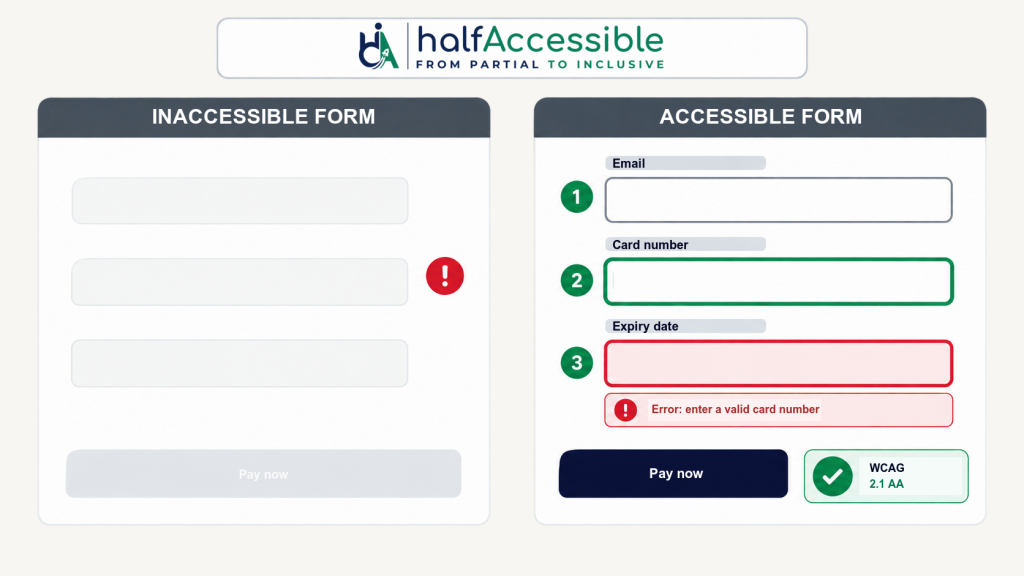
Form labels must be programmatically linked to their inputs using proper HTML <label> elements. Placeholder text alone does not count. Every field needs a persistent label that screen readers can announce.
Error messages must be specific. “Something went wrong” fails. “Please enter a valid phone number in the format 050-123-4567” passes.
Page language must be declared in the HTML lang attribute so screen readers use correct pronunciation.
Video captions and audio descriptions are required for all pre-recorded multimedia content. This matters especially for UAE brands that produce video content for product pages or landing pages.
ARIA usage must be correct. Using ARIA without proper understanding makes sites worse for screen reader users. Use semantic HTML first; add ARIA only where native elements are insufficient.
Penalties for Non-Compliance
UAE digital accessibility non-compliance creates exposure across multiple legal channels.
Administrative fines under Federal Law No. 29: Violations of the UAE Disability Act may result in penalties of up to AED 200,000 (approximately USD 54,500). Higher fines apply for repeat offenses.
Criminal penalties under Article 358: Conviction for denying services on discriminatory grounds carries fines of up to AED 1,000,000 (approximately USD 272,500) and up to one year of imprisonment.
Dubai-specific enforcement: Dubai Law No. 3 of 2022 is enforced through the emirate’s own regulatory machinery. Non-compliance with the Dubai Universal Design Code can result in additional emirate-level penalties.
Public procurement disqualification: Government contracts in the UAE increasingly require accessibility compliance. A business that cannot demonstrate WCAG 2.1 AA conformance may be disqualified from bidding. For companies in the government services sector, this is often the highest-stakes risk.
Reputational damage: The UAE’s media environment is active, and high-profile accessibility failures by major brands generate significant public attention. Given the government’s stated commitment to People of Determination, non-compliance is a brand risk, not just a legal one.
UAE Accessibility vs ADA vs EAA: How They Compare
If your business already manages ADA compliance for the US market or EAA compliance for the EU, here is how UAE requirements fit in.
Technical standard: All three frameworks converge on WCAG 2.1 Level AA as the baseline. Meeting WCAG 2.1 AA satisfies the technical requirements of the ADA (as applied in US courts), the EAA (via EN 301 549), and the UAE’s TDRA National Policy.
Private sector scope: The ADA has always covered private businesses open to the public. The EAA and UAE’s 2024 National Policy both extend compliance obligations to the private sector. There is strong convergence.
Enforcement mechanism: The ADA is enforced through private litigation and DOJ. The EAA is enforced through national regulatory bodies with fines up to €1,000,000 in some EU countries. The UAE has a combination of regulatory fines (up to AED 200,000) and criminal law exposure (up to AED 1,000,000).
Documentation requirements: VPATs and ACRs are the standard documentation format in the US procurement context. The UAE’s National Policy requires accessibility statements. The EAA also mandates accessibility statements. An organization that has one of these documents is well positioned to meet the others.
The practical implication for multinational organizations: one WCAG 2.1 AA compliance program, properly documented, covers the core technical requirements across all three markets. The differences lie in documentation format and enforcement channel, not in the underlying standard.
For a full side-by-side breakdown of these frameworks, read our guide: WCAG, ADA, Section 508, EAA, VPAT — Which Accessibility Framework Actually Matters? and our dedicated European Accessibility Act Compliance guide.
Your UAE Accessibility Compliance Action Plan
Here is a practical path to UAE digital accessibility compliance.
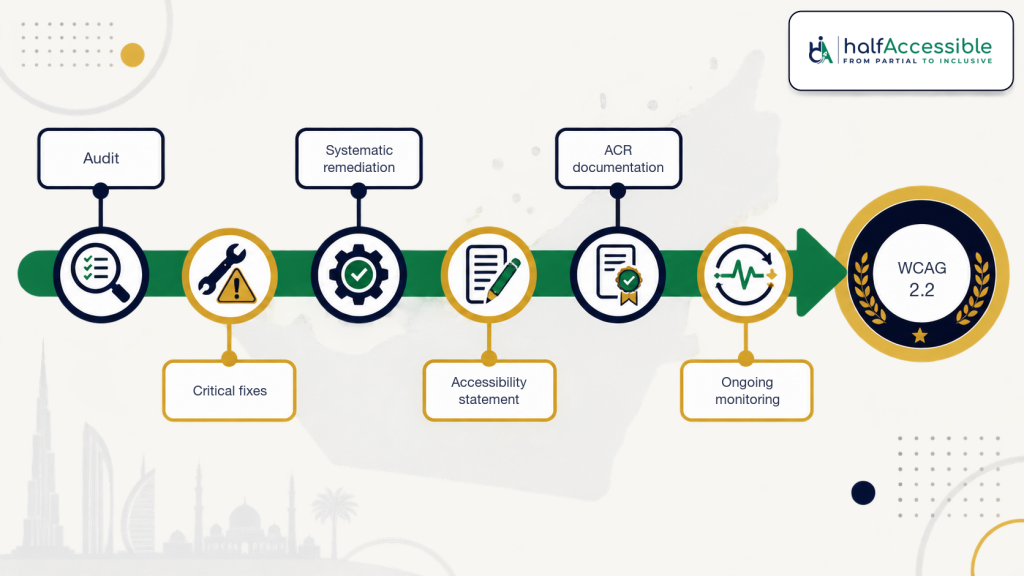
Step 1: Run a professional accessibility audit. Start with an accessibility audit that covers both automated scanning and manual screen reader testing. Automated tools catch 30-40% of issues at best. Manual testing with screen readers — JAWS, NVDA, VoiceOver, and TalkBack — is required to identify the full scope of barriers. The audit produces a prioritized remediation list.
Step 2: Fix critical barriers first. Address issues that block People of Determination from completing key tasks: inaccessible navigation, broken form flows, missing alt text on product images, and keyboard traps. These are the issues most likely to generate formal complaints.
Step 3: Remediate systematically. Build accessibility into your development workflow. Accessibility remediation should address findings from the audit methodically, with developers, designers, and content teams working through issues together.
Step 4: Publish your accessibility statement. The National Policy requires this for government entities, and it is best practice for all organizations. Your statement should declare your compliance status (fully compliant, partially compliant, or working toward compliance), list known issues and your remediation timeline, and provide a contact channel for reporting new barriers.
Step 5: Prepare accessibility conformance documentation. A VPAT or ACR documents your compliance formally and is increasingly required for government procurement. Our VPAT and ACR documentation service produces the conformance records you need.
Step 6: Set up ongoing monitoring. New features, updated content, and third-party integrations can introduce new barriers. Accessibility monitoring and governance keeps you compliant as your platform evolves.
Step 7: Avoid accessibility overlays. Some vendors market overlays as a quick compliance fix. They do not achieve genuine WCAG conformance and will not satisfy UAE regulators or courts. Read our detailed breakdown: Do Accessibility Overlays Protect You From ADA Lawsuits? No.
Step 8: Prepare for WCAG 2.2. TDRA is updating its policy to align with WCAG 2.2. Organizations that move to WCAG 2.2 now will avoid a second remediation cycle when the updated standard is finalized. Key additions in WCAG 2.2 include improved focus indicator requirements (2.4.11 Focus Appearance) and drag-and-drop alternatives (2.5.7).
Not sure where to start? Contact HalfAccessible for a free consultation.
The Bottom Line
The UAE has built one of the most comprehensive digital accessibility frameworks in the MENA region. Five overlapping legal layers, a national policy from TDRA, and criminal law exposure under Article 358 create real accountability for organizations that ignore accessibility.
The technical standard is WCAG 2.1 Level AA — the same benchmark used in the US and EU. Achieving it gets you very close to compliance with all UAE frameworks simultaneously.
The 2024 National Policy has extended requirements to the private sector. If your business operates a website, app, or digital platform serving users in the UAE, compliance is not optional.
HalfAccessible helps organizations achieve and maintain WCAG 2.1 AA compliance and prepare the documentation required for UAE, US, and EU markets. Start with our accessibility audit services or contact us to discuss your compliance position today.
Sources:
- UAE’s Accessibility Laws — Deque
- Digital Accessibility in the UAE: Laws and Compliance — Recite Me
- Website Accessibility in UAE: UAE Disability Act — Skynet Technologies
- National Policy for Digital Accessibility, March 2024 — TDRA / UAE Government
- TDRA Supports Implementation of National Digital Accessibility Policy — TDRA
- Law No. 3 of 2022 Concerning the Rights of Persons with Disabilities in the Emirate of Dubai — Dubai Legislation Portal
- Federal Law No. 29 of 2006 Concerning the Rights of People with Special Needs — UAE Legislation
- United Arab Emirates Accessibility Law — Disability World
- Protecting the Rights of People of Determination — Official UAE Government Portal
- WebAIM Million Report 2026 — WebAIM
Get a Formal UAE Accessibility Audit
This guide covers the UAE’s five-layer accessibility framework. If you need a formal audit mapped to Federal Law No. 29, Dubai Law No. 3, and the TDRA’s National Digital Accessibility Policy, see our UAE Website Accessibility Audit Services.