Short answer: An ADA website filing is a risk signal, not a remediation programme. In late September 2026, independent scanners checked dozens of online stores that had just been named in federal ADA website lawsuits — and most still failed basic automated WCAG checks weeks after the complaint. That gap is what ADA lawsuit remediation has to close: named barriers fixed in code, verified with assistive technology, and kept clean after every theme, app, and campaign change.
This guide is written by accessibility testers who audit and remediate retail sites for a living. It is not legal advice. It explains what the late-September 2026 sued-store scans found, why settlements alone do not stop the next plaintiff, and a practical remediation sequence that matches what HalfAccessible delivers after a demand letter or complaint.
What the Late-September 2026 Scans Actually Showed
Two independent automated studies published in the last week of September 2026 measured stores that had already been sued — not aspirational “best practice” demos.
Thalia Bloom: 60 sued stores, scanned 26–27 September 2026
Thalia Bloom’s sued-store study pulled defendants from CourtListener/RECAP federal dockets filed between 3 August and 25 September 2026, kept defendants that run an online store (skipping large national chains, hospitals, venues, and companies it could not match to a store with confidence), and ran axe-core WCAG 2.0 / 2.1 / 2.2 A and AA rules on each store’s home page plus the first collection and product pages it could reach (159 pages in total).
Key published findings:
- 58 of 60 stores still had at least one automated failure after being sued
- Median 40.5 failures per store (mean 65; highest 306)
- Median 32.5 days between filing and scan
- 39 of 60 had a critical failure (the kind that can stop a shopper outright)
- 50 of 60 had text too faint for low-vision shoppers
- 43 of 60 had an image, link, or button a screen reader cannot name
- Shopify powered 55 of 60; Shopify median was 44 failures
- Courts in the sample: S.D.N.Y. (43), N.D. Ill. (16), N.D. Ind. (1)
Thalia Bloom is explicit about limits that matter for ADA lawsuit remediation planning: automated checks are a floor, three pages are not a whole store, a zero count is not proof of accessibility, and a lawsuit remains an allegation — not a finding of liability.
AccessComply: 54 sued Shopify stores, scanned 21–24 September 2026
AccessComply’s Shopify ADA lawsuit data post scanned up to ten public pages on 54 Shopify stores named in federal website accessibility cases filed from May through September 2026. Updated 25 September 2026, the study reported:
- Median 220 automated issues per store
- 49 of 54 had at least one critical issue
- Most common: low text contrast (46 stores), skipped heading levels (44), tap targets under 24×24 px (40), unnamed links (31), videos without captions (30), images with no text alternative (28)
- Stores sued 60+ days before the scan still had a median of 214 issues; 13 of 17 still had a critical issue
- Median automated “score” of 85.2 / 100 (53 stores with a score) — proving a good score is not a clean store when one theme snippet fails on every page
AccessComply likewise frames the work as research, not legal advice, and notes that automated scans cannot vouch for carts, checkout, or third-party app content. It also says it is rescanning all 54 stores with an improved contrast measurement and will update its figures, so treat the numbers above as the 25 September snapshot.
Together, the two studies say the same operational thing: being sued did not reliably produce a clean storefront in the weeks that followed.
Why “We Got Sued” Is Not the Same as “We Remediated”
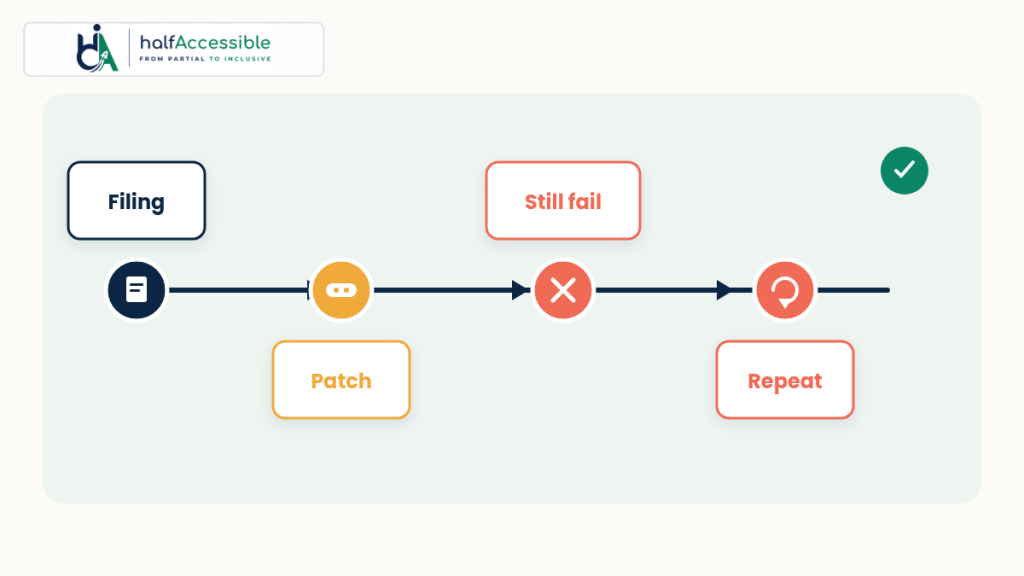
Plaintiffs and serial filers treat litigation history as a watch list. UsableNet’s review of 2025 digital accessibility filings reported that of more than 5,000 digital accessibility lawsuits filed by the end of 2025, 1,427 targeted companies that had already faced an ADA web accessibility claim — and in federal court alone, 46% of cases involved repeat defendants. UsableNet describes the pattern as settlement → limited remediation → new plaintiff → another filing, often within months.
That is why HalfAccessible treats ADA lawsuit remediation as an operating model, not a one-week cleanup. Settlements bind the parties to that case; they do not freeze the site, bind the next plaintiff, or stop marketing from shipping another inaccessible banner the following Monday. For the federal ADA Title III web-and-mobile expectations plaintiffs plead against, start with the DOJ’s guidance on web accessibility and the ADA — then map every alleged barrier to a WCAG criterion you can retest.
National volume context sits in our 2026 ADA website lawsuit statistics. Venue-specific pleading patterns are covered in Minnesota ADA website lawsuits. Platform-specific traps are covered in Is Shopify ADA compliant? and our ecommerce & retail accessibility specialty.
Lesson 1: Preserve Evidence, Then Baseline With Manual Testing
When a demand letter or complaint arrives, rush-to-overlay or silent theme swaps erase the record counsel may need. Preserve the site as it was (screenshots, HTML archives, dated scan exports). Then commission a manual baseline so you know which alleged barriers are real, which are disputed, and which live only in third-party widgets.
Automated counts from Thalia Bloom and AccessComply are useful for backlog sizing. They are not a conformance claim. Walk buy / book / apply journeys with keyboard-only navigation and at least one screen reader. Our methods guides cover manual keyboard accessibility testing, screen reader accessibility testing, automated accessibility testing, and mobile accessibility testing.
HalfAccessible’s Shopify accessibility audit, accessibility audit services, and sample audit report are built for that post-filing baseline.
Lesson 2: Fix the Barriers Plaintiffs Name Most Often — in Theme Code, Not in a Widget
Both late-September studies cluster around the same failure families that show up in shopper complaints:
- Contrast — WCAG 1.4.3 Contrast (Minimum) (Thalia Bloom: 50/60 stores; AccessComply: 46/54)
- Unnamed links and buttons — 2.4.4 Link Purpose and 4.1.2 Name, Role, Value (Thalia Bloom: 43/60 stores with an unnameable image/link/button)
- Missing image text alternatives — 1.1.1 Non-text Content (Thalia Bloom: 32/60; AccessComply: 28/54)
- Small tap targets — WCAG 2.2 2.5.8 Target Size (Minimum) (Thalia Bloom: 27/60; AccessComply: 40/54)
- Uncaptioned video — 1.2.2 Captions (Prerecorded) (AccessComply: 30/54)
- Keyboard-unreachable scroll areas and obscured focus — 2.1.1 Keyboard and WCAG 2.2 2.4.11 Focus Not Obscured (Minimum) (AccessComply: 22/54 and 27/54)
Overlays do not rewrite those failures out of your theme. Our evidence post — Do accessibility overlays prevent ADA lawsuits? — and UsableNet’s 2025 trend piece both underline the same point: widgets appear in complaints; they do not substitute for code remediation. Pair that with the DOJ web guidance when counsel asks what “accessible” means in practice for Title III shoppers.
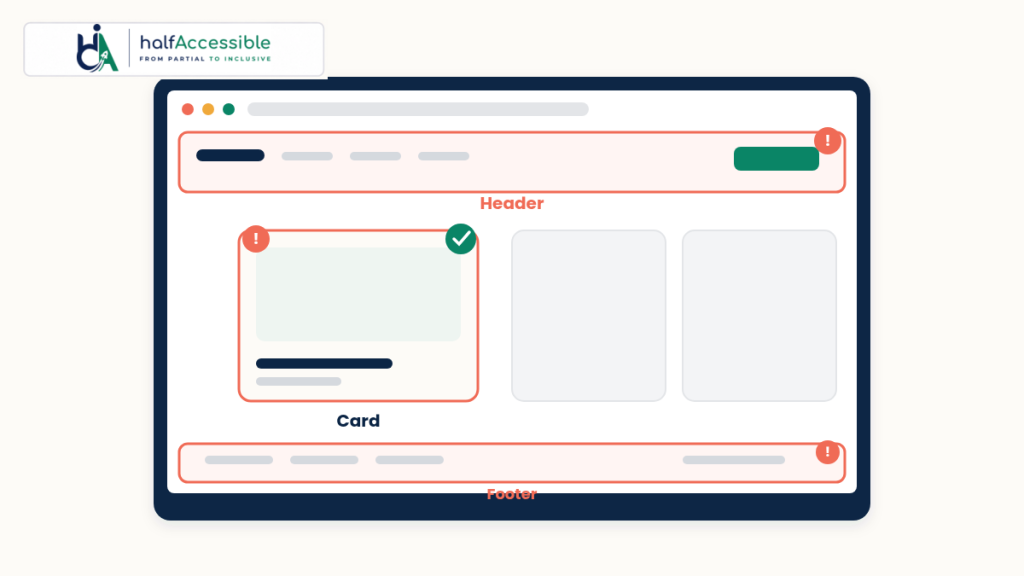
Map each finding to a ticket with the WCAG criterion, the component that owns it (header, product card, cart drawer), and a retest method. That is the difference between “we hired someone” and ADA lawsuit remediation counsel can defend.
Lesson 3: Prioritise Shared Templates Before One-Off Pages
AccessComply’s median score of 85.2 with hundreds of issues is the Shopify story in one number: one inaccessible header icon, sale badge colour, or product-card link name repeats on every page. Fix shared Liquid / theme sections, design tokens, and app embeds first. Then clear product alt text in admin for bestsellers. Then caption brand videos. Then retest the full cart-to-checkout path — including every app on the way — because public-page scanners deliberately skip authenticated flows.
Our accessible Shopify development and accessibility remediation services engagements are sequenced that way on purpose.
Lesson 4: Treat Settlement Deadlines as Programme Milestones, Not Finish Lines
Minnesota-style injunctive pleadings summarised in our Minnesota ADA website lawsuits post often read like an operating model: time-boxed audit, written policy, named owner, vendor WCAG language, staff training, and ongoing automated plus manual testing. That last item is where most failed ADA lawsuit remediation programmes die.
AccessComply’s cohort sued 60+ days earlier did not look markedly cleaner than stores sued the week before. Calendar time after a filing is not remediation. Release discipline is.
Stand up:
- A dated issue register tied to WCAG criteria
- Accessibility monitoring and governance on production
- Pre-release checks in CI where you can (continuous integration accessibility testing glossary)
- Accessibility training workshops for marketers who edit themes and landing pages
- Vendor clauses that name WCAG 2.1 or 2.2 Level AA for any app that touches browse, cart, or checkout
Lesson 5: Aim for WCAG 2.2 AA Engineering Hygiene Even When Pleadings Cite 2.1
Courts and complaints commonly reference WCAG 2.1 Level AA. AccessComply and Thalia Bloom both exercised WCAG 2.2 rules as well — and several of the highest-frequency failures (target size, focus not obscured) are 2.2 criteria. Building to WCAG 2.2 AA generally covers the 2.1 AA set (with 4.1.1 Parsing removed as obsolete) plus those newer mobile and focus criteria. Document against whatever counsel names in the settlement, and keep the engineering target current.
For European shoppers and EAA-covered services, pair this work with our European Accessibility Act guide and the EN 301 549 v4.1.1 update.
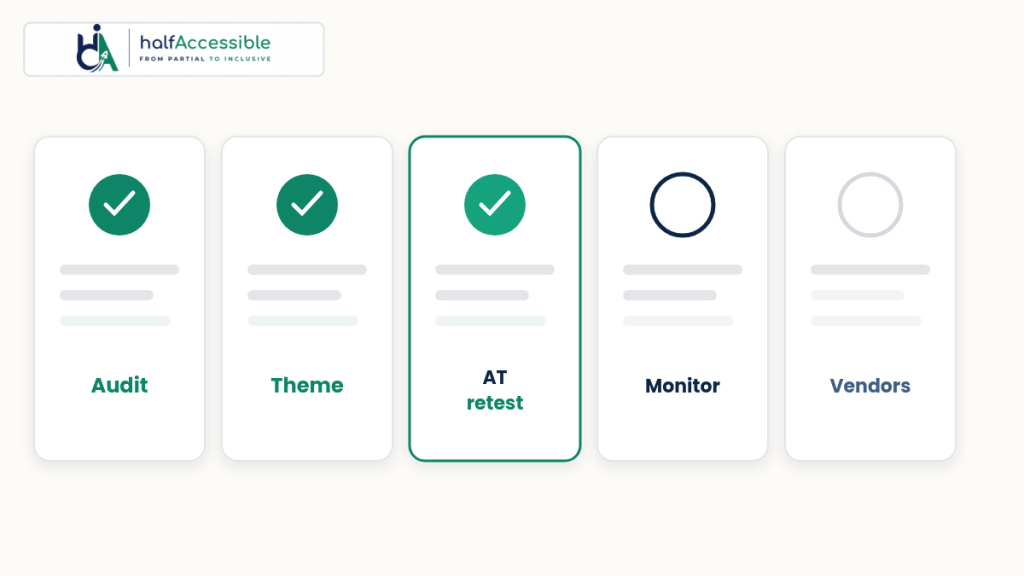
Lesson 6: Retest With People and AT — Then Publish Proof You Can Show Counsel
After code lands:
- Re-run the same automated ruleset used in your baseline so delta is apples-to-apples
- Keyboard-only purchase path
- Screen reader pass on JAWS, NVDA, or VoiceOver for the journeys named in the complaint
- Spot-check mobile tap targets and sticky chrome that obscures focus
- Archive dated before/after evidence
HalfAccessible’s ADA website remediation case study and website accessibility audit and remediation write-ups show what that verification loop looks like in client work — not a scanner badge pasted into a settlement letter.
Lesson 7: Do Not Wait for the Second Filing to Fund the First Fix
UsableNet’s 46% federal repeat-defendant rate is the cost of treating lawsuit one as theatre. The late-September scans show many first-time defendants had not even cleared the automated floor a month later. Budget remediation when the letter arrives — or better, before — so the settlement, if any, describes work already underway rather than work you hope to invent under a court clock.
If you sell through Shopify, start with the platform-specific mistakes in Is Shopify ADA compliant?, the broader ecommerce & retail accessibility playbook, and a scoped Shopify accessibility audit.
Start ADA Lawsuit Remediation Before the Next Plaintiff Does
Late-September 2026 data is blunt: most recently sued stores in those samples still failed automated checks weeks later, and 2025 filing data shows nearly half of federal digital accessibility cases hit repeat defendants. Treat the complaint as a testing brief. Fix shared templates. Retest with real assistive technology. Monitor production. Put WCAG into every app contract.
If you need a prioritised post-filing backlog, book a consultation, request a Shopify accessibility audit, or start accessibility remediation services with IAAP-certified testers who already work the paths plaintiffs document.