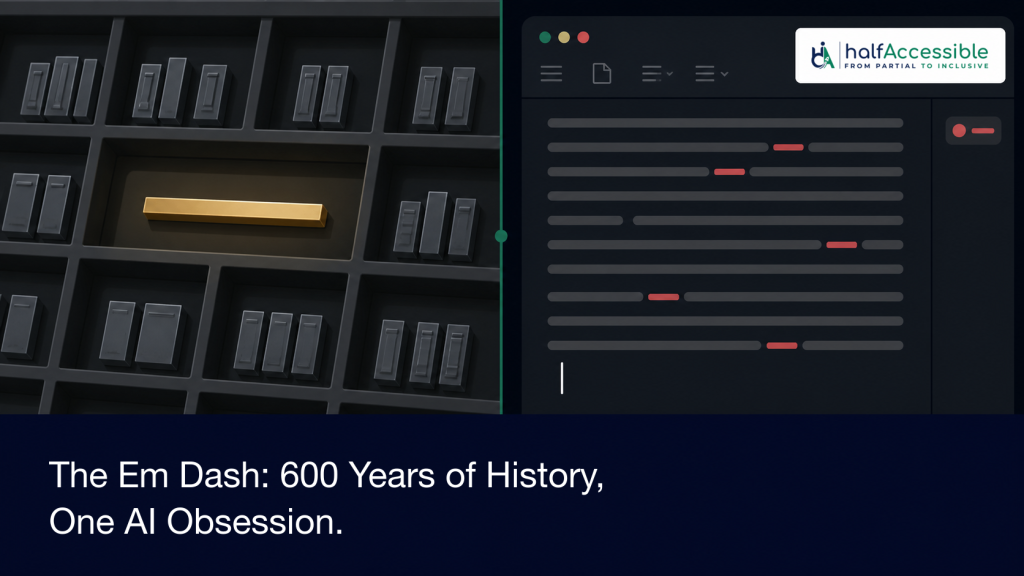
You have probably seen it. A sentence flows along normally, then interrupts itself with a long horizontal mark, and then picks up again.
The dash AI uses is called the em dash (—, Unicode U+2014), the longest of the three English dashes. ChatGPT and other chatbots reach for it far more often than most people do. In a 2026 controlled test, GPT-4.1 produced 10.62 em dashes per 1,000 words, about 3.3 times the 3.23 per 1,000 found in published human essays.
For most of its 450 years in print, the em dash was a quiet tool used by printers and novelists. Then large language models arrived. Suddenly, em dash AI writing was everywhere. Not in literary essays or longform journalism. In everything. Job application emails. Press releases. Social media captions. Customer service replies.
Writers and editors started noticing. Researchers started measuring. And the em dash became the most recognizable visual signal that a piece of text was written by an AI.
This article covers the complete history of the em dash, how to use it correctly, and why it became the punctuation mark that could expose a chatbot. It also covers something most em dash articles miss: how screen readers actually read the em dash, and what really makes AI-written web content hard to use for people with disabilities.
Em Dash AI Writing At A Glance
- 10.62: em dashes per 1,000 words from GPT-4.1 in a 2026 controlled test (Source: Freeburg, The Last Fingerprint (2026))
- 3.3×: more than the 3.23 per 1,000 human baseline in published essays (Source: Freeburg 2026)
- 1.43: em dashes per 1,000 words from OpenAI’s newer GPT-5.4 in the same study (Source: Freeburg 2026)
- Nov 14, 2025: Sam Altman announced ChatGPT can follow a custom instruction to avoid em dashes (opt-in) (Source: TechCrunch)
Choose Your Next Step
Curious about AI writing tells, or shipping AI drafts to the web? Start with a free check, train your team, or talk it through before you spend anything.
Check A Page First (Free tool)
Best for: a quick first look at WCAG issues in AI-drafted pages
Run a free one-page scan on AccessibilityScore.in (powered by axe-core). It is a starting point that complements a manual audit; automated checks miss many barriers screen readers hit.
Run a free accessibility scan (opens in a new tab)
Train Your Content Team
Best for: writers and editors who review AI drafts
Workshops cover accessible headings, link text, alt text and plain language so AI-assisted content stays usable for screen reader and keyboard users.
Free 30-Minute Call
Best for: first conversations, where you stand, and getting a quote
Tell us what you publish with AI and what worries you. We explain where you stand and how a fixed-price audit or training fit.
Book a Free 30-Min Call (opens in a new tab)
$100 Technical Hour
Best for: teams that need technical answers now
A hands-on session for an audit walkthrough, talking with your developer, or reviewing live site issues from AI-drafted pages.
Key Takeaways
- The earliest dashes found in printed English date from the 1580s. A 13th-century Italian mark, the virgula plana, looked like a dash but ended sentences, and historians are not sure it is a true ancestor.
- Its name comes from the em, a typographic unit equal to the width of the capital letter M.
- The em dash has four legitimate uses: parenthetical asides, abrupt breaks in thought, replacing a colon for emphasis, and interrupted dialogue.
- In a 2026 controlled test, GPT-4.1 used 10.62 em dashes per 1,000 words, about 3.3 times a human baseline of 3.23. Rates vary widely by model: Llama produced none and OpenAI’s newer GPT-5.4 only 1.43.
- OpenAI CEO Sam Altman announced a fix on November 14, 2025: ChatGPT now follows a custom instruction to avoid em dashes. It is opt-in, not the default.
- How a screen reader handles the em dash depends on its punctuation setting. NVDA’s default level does not speak it, while higher levels read it as “em dash”. On its own it is rarely an accessibility barrier.
- The bigger accessibility risks in AI-written web content are vague link text, missing heading structure, inaccurate alt text and walls of text, all of which WCAG covers.
- Good alternatives include commas, parentheses, colons, or simply restructuring the sentence.
What Is the Em Dash?
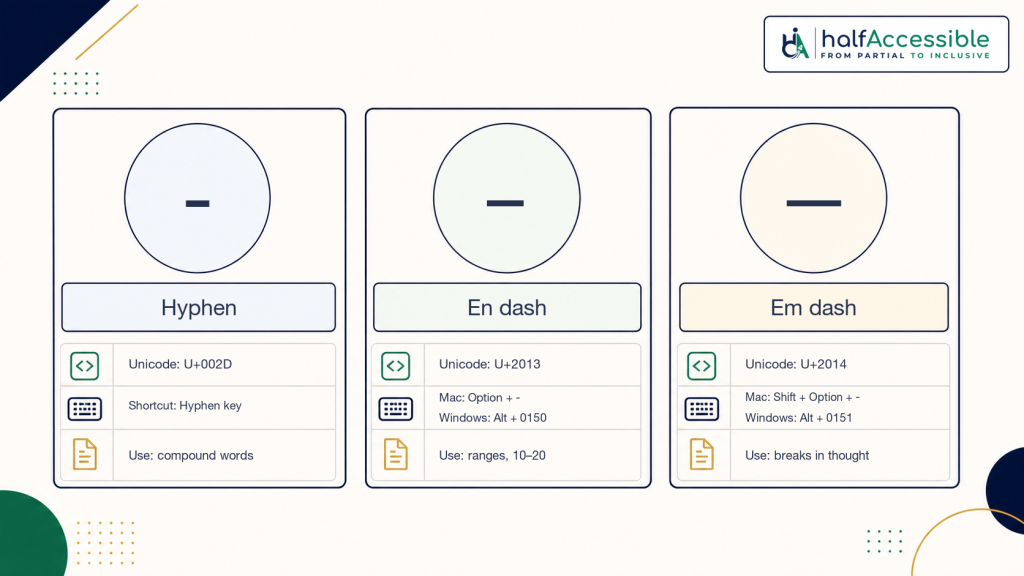
The em dash is the longest of the three dashes used in English typography.
The hyphen (-) is the shortest. It joins compound words and prefixes: well-known, re-enter, up-to-date. The en dash (–) is mid-length. It connects ranges and equal-weight pairs: pages 10–20, London–Paris, 2020–2025. The em dash (—) is the longest. It marks pauses, breaks, and strong asides within a sentence.
On a Mac, type it with Option + Shift + Hyphen. On Windows, use Alt + 0151. On most smartphones, hold down the hyphen key to reveal longer dash options.
Style guides disagree on spacing. The Chicago Manual of Style and MLA close it up (word—word). The AP Stylebook, used by many US newsrooms, puts a space on each side (word — word), and many British publishers use a spaced en dash instead. Pick one style and use it consistently.
When Was the Em Dash Invented? A Short History
The em dash did not begin in a grammar textbook. It began in a print shop.
A possible predecessor appears in the work of Boncompagno da Signa, a Tuscan rhetorician writing in the early 13th century. He proposed a two-mark system: a slash for short pauses and the virgula plana, a flat horizontal stroke, to mark the end of a sentence. That made it closer to a full stop than to a modern dash, and, as the BBC’s history of punctuation notes, it may or may not be the ancestor of the parenthetical dash.
Printing came first. Gutenberg’s movable type arrived in the mid-1450s and fixed most punctuation marks in metal. The dash came later. According to Anne Toner’s Ellipsis in English Literature (Cambridge University Press, 2015), summarised in the history of the dash, the earliest dashes found in printed English appear in letters printed in 1580 and 1585. In 1588, Maurice Kyffin’s translation of Terence’s play Andria used a row of hyphens to show a speaker being cut off. By the 1620s, printed plays by Shakespeare and Ben Jonson used dashes for interruptions and thinking pauses.
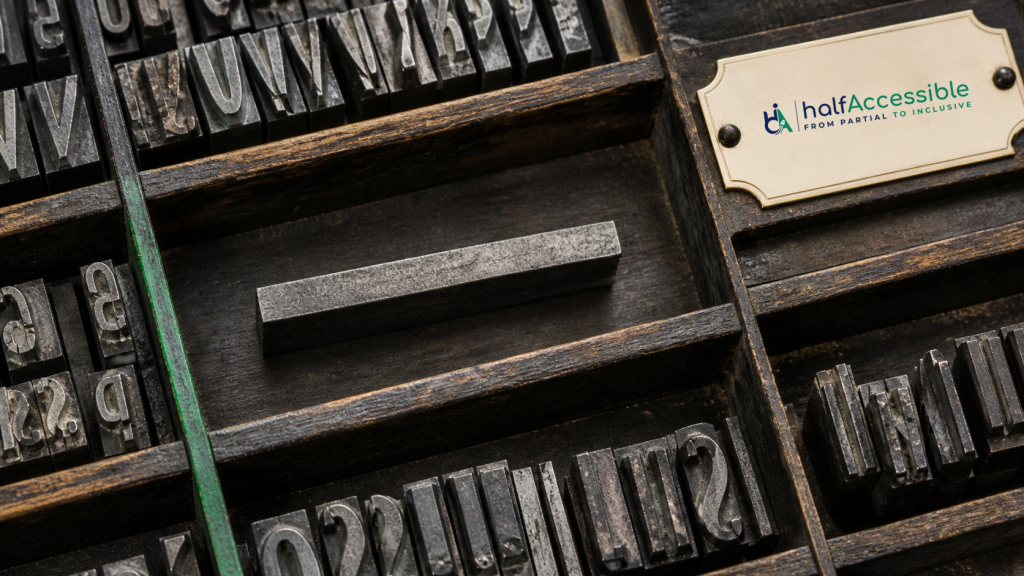
The name comes from the em, a typographic unit equal to the point size of the type (in 12-point type, an em is 12 points). In metal type that was roughly the width of a capital M. An em dash was a piece of type one em wide, set into the line like any other character.
The em dash grew out of printing and drama, not grammar books. Printers and playwrights needed a way to show interruptions and broken-off speech, and the dash did the job.
By the 18th century, the em dash had moved into literary prose. Laurence Sterne’s Tristram Shandy (1759 to 1767) made it a signature of the novel, and British writers used it heavily in novels, letters and essays. By the 19th century, it was a standard part of the English writer’s toolkit. You can read more about its lineage in PublishingState.com’s history of the em dash.
The Writers Who Loved It
The em dash attracted some of the most distinctive literary voices in English.
Emily Dickinson is the most famous example. She used the em dash so obsessively that editors spent decades debating what to do with her manuscripts. Where other writers used commas, periods, or semicolons, Dickinson used dashes. Her poems often carry no other punctuation at all. Thomas H. Johnson’s 1955 scholarly edition was the first to preserve her dashes rather than replace them with standard punctuation.
Henry James used the em dash to pile qualification upon qualification within a single sentence. His prose famously delays its point through successive interrupting clauses, each set off by dashes.
Virginia Woolf used dashes to mirror the movement of thought. Her sentences break and restart the way a mind actually does, without warning and without apology.
Charles Dickens used them in dialogue to show characters cutting each other off mid-sentence, a technique that made his scenes feel theatrical and immediate.
These writers used the em dash purposefully. Each pause or break served a specific effect in a specific sentence. The contrast with AI overuse, where the em dash appears by habit rather than intention, is exactly the problem.
Four Legitimate Uses of the Em Dash
Used well, the em dash is a strong tool. It does things that commas and parentheses cannot quite manage. Here are its four main legitimate applications.
1. A strong parenthetical aside
When you want to add information and parentheses feel too formal while a comma feels too weak, the em dash works well.
Example: “The meeting — which nobody had requested — ran ninety minutes.”
This is more emphatic than a comma pair and less clinical than parentheses.
2. An abrupt break in thought
The em dash signals that a sentence changes direction sharply.
Example: “She was halfway through the sentence when — nothing. She stopped.”
3. Replacing a colon for emphasis
When you build toward a conclusion, the em dash delivers it harder than a colon.
Example: “There was only one acceptable outcome — a full refund.”
4. Interrupted dialogue
In fiction, an em dash at the end of a speech signals that another character cuts in before the sentence is finished.
Example: “I was going to say — ” “You were not going to say anything useful,” Maria replied.
Many editors advise using no more than two em dashes in a sentence, and the AP Stylebook warns against using dashes “when commas would suffice”. More than that and the sentence becomes hard to follow.
Em Dash AI Writing: How ChatGPT Got Addicted
ChatGPT launched in November 2022. Within a year, writers and editors had noticed something unusual: the model used em dashes far more than most human writers do. Em dash AI writing became a recognized pattern that editors and AI detection tools learned to spot.
The main reason is training data. McGill University’s Office for Science and Society notes that more than 60% of the training data for early models such as GPT-3 came from web crawls: journalism, essays, academic writing and long blog posts, the genres where the em dash appears most. Post-training then rewards clear, explanatory answers, and the em dash is a handy way to add an aside or an explanation, so its use gets reinforced. A 2026 paper by E. M. Freeburg, “The Last Fingerprint”, adds a further theory: models trained on markdown-heavy text use the em dash as a structural marker that survives even when headings and bullet points are switched off.
Users noticed. By 2025 the mark had a nickname, the so-called “ChatGPT hyphen”, and editors in publishing and content marketing began treating heavy em dash use as a warning sign. Some AI-text tools now count dash density as one minor input. SlopDetector, for example, says its score only starts to count em dashes above 20 per 1,000 words and treats the mark as “not forensic on its own”.
The em dash became a perceived tell in the same way stock phrases like “delve” did. But perception is not proof. In a piece republished by the Indiana Capital Chronicle in August 2025, cognitive scientist Roger J. Kreuz describes a study where people named excessive em dashes as a sign of chatbot text, yet still identified AI writing only marginally better than chance.
The Data: How Much More Does AI Use the Em Dash?
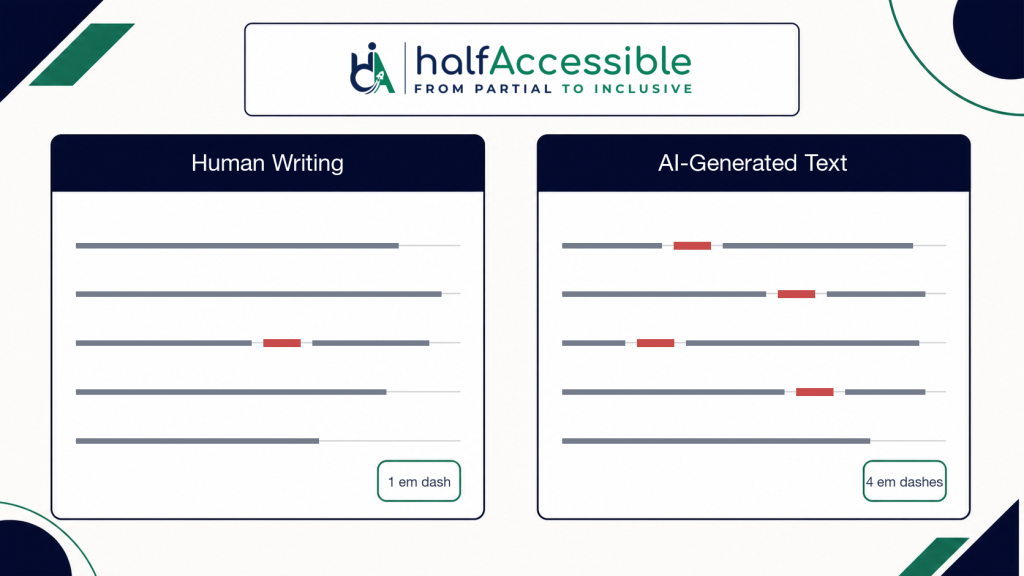
The best controlled numbers come from Freeburg’s 2026 study, which ran twelve models from five providers on matched prompts (about 10,000 words per model per condition) and compared them with eight published human essays (57,232 words). Em dashes per 1,000 words:
| Model or baseline | Em dashes per 1,000 words |
|---|---|
| GPT-4.1 (OpenAI) | 10.62 |
| Claude Opus 4.6 (Anthropic) | 9.09 |
| DeepSeek V3 | 6.95 |
| Gemini 2.5 Pro (Google) | 3.53 |
| GPT-5.4 (OpenAI) | 1.43 |
| Llama 3.1 8B and Llama 3.3 70B (Meta) | 0.00 |
| Human baseline (published essays) | 3.23 average (0.33–17.12 range) |
So the popular “three times” figure is real for GPT-4.1 (10.62 is about 3.3 times 3.23), but it is not true of “AI” in general. Some models use fewer em dashes than people do, and the human range is wide. The study also found that telling models to drop markdown removed headings and bullets but not em dashes, and that even an explicit “no em dashes” instruction did not fully remove them in some models.
Human writers are not em-dash-free either. SlopDetector’s July 2026 analysis counted dashes across 702,939 words of public-domain novels and found about 6.4 dash constructions per 1,000 words overall. Adventures of Huckleberry Finn scored 10.13 per 1,000, almost the same as GPT-4.1. The em dash alone is a weak signal. Combined with other markers, such as stock transitions (“moreover”, “it is worth noting”), words like “delve” and very even sentence lengths, it becomes part of a pattern that is harder to dismiss.
The trend shows up in real publishing too. A pre-registered 2026 study of 69,632 medRxiv preprints found that the share of Discussion sections containing at least one em dash rose from 4.23% before ChatGPT’s release to 11.58% afterwards. The em dash is the most visible of these AI-era patterns simply because it is easy to spot in a quick scan.
AI Em Dash Examples (and How to Rewrite Them)
These are typical of the sentences chatbots produce, with plainer rewrites. They are illustrative examples written for this guide, not quotes from a specific model.
- AI-style: “Accessibility isn’t just a legal requirement — it’s a business opportunity.” Rewrite: “Accessibility is a legal requirement and a business opportunity.”
- AI-style: “Our audit covers everything — from color contrast to keyboard navigation — so nothing slips through.” Rewrite: “Our audit covers everything from color contrast to keyboard navigation.”
- AI-style: “The result? Faster pages — happier users — and more sales.” Rewrite: “The result is faster pages, happier users and more sales.”
- AI-style: “Here’s the thing — most overlays don’t fix the code.” Rewrite: “Most overlays do not fix the underlying code.”
The pattern is the same each time: a dash used as a dramatic pivot where a comma, a period or a plainer sentence would do. If you edit AI drafts, search the text for “—” and ask whether each one earns its place.
OpenAI Acknowledged the Problem
For months, users asked ChatGPT to stop using em dashes. The model acknowledged the request and continued using them anyway. It was a frustrating loop: the AI understood what was being asked but could not reliably follow through.
On November 14, 2025, OpenAI CEO Sam Altman posted on X: “If you tell ChatGPT not to use em-dashes in your custom instructions, it finally does what it’s supposed to do,” calling it a “small-but-happy win.” TechCrunch covered the announcement the same day.
The fix is opt-in. As TechCrunch noted, it does not remove the em dash from ChatGPT’s output by default. Newer models also behave differently: in Freeburg’s early-2026 tests, OpenAI’s GPT-5.4 used 1.43 em dashes per 1,000 words, below the human baseline, while GPT-4.1 still used 9.10 per 1,000 even when told to avoid markdown.
The broader implication is significant. Removing the em dash removes one of the most visible surface signals of AI writing without addressing the deeper stylistic habits that make AI text recognizable. Em dashes were a convenient shortcut for detection. Without them, identifying AI text becomes harder and requires more careful pattern analysis across multiple linguistic signals.
The Accessibility Angle: How Screen Readers Read the Em Dash
Many em dash articles claim screen readers either ignore the em dash or stumble over it. The reality depends on the screen reader and the user’s punctuation setting.
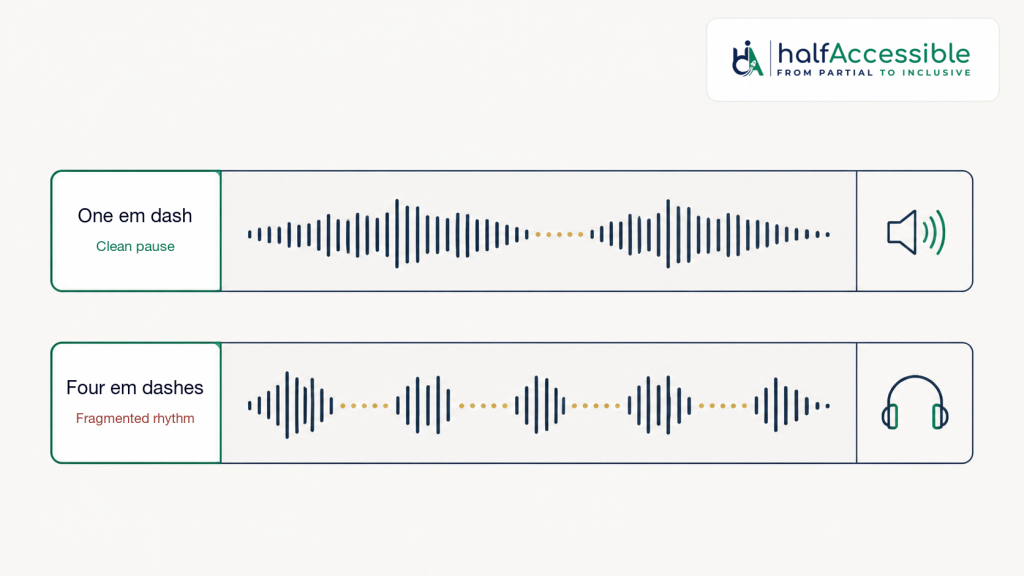
NVDA: NVDA’s English symbol list sets both the em dash and the en dash at the “most” punctuation level. At NVDA’s default level (“some”), the em dash is not spoken; the character is passed to the voice, which may add a slight pause. At “most” or “all”, NVDA reads it aloud as “em dash”.
JAWS and others: Vispero, the company behind JAWS, wrote in “On Dashes, A.I., and Screen Readers” (August 2025) that screen readers by default tend to announce the em dash as “em dash”, and that users can change this in their verbosity settings. When Vispero asked four screen reader users, none found it a problem; the common response was “I’m used to it”. Their advice is to write for readers, not for screen readers.
That does not mean punctuation never matters. Three practical rules help everyone: use the real characters (— and –, or the HTML entities — and –) instead of double hyphens; write “1914 to 1918” when you want a range to be read unambiguously, rather than “1914 dash 1918”; and break up sentences that stack several dashes, because they are harder to follow by ear and by eye.
What actually makes AI-written content inaccessible is rarely the em dash. When we test AI-drafted pages, the problems that block screen reader and keyboard users are usually these:
- Vague link text such as “learn more” or “click here” repeated across a page, which fails WCAG 2.4.4 Link Purpose (In Context) when the surrounding text does not explain the link.
- Fake headings: bold paragraphs styled to look like headings, or skipped heading levels, which break 1.3.1 Info and Relationships and make 2.4.6 Headings and Labels harder to meet.
- Generic or wrong alt text generated for images (“image of a chart”), which fails 1.1.1 Non-text Content when it does not convey the image’s purpose.
- Walls of text with long, even sentences and stacked asides, which are hard to scan, hard to listen to and hard for people with cognitive disabilities.
These are the patterns a manual screen reader accessibility test surfaces and automated scanners often miss.
Publishing AI-Written Content? Check It for Accessibility
If your team uses ChatGPT or other AI tools to draft web pages, product copy or help articles, the em dash is the least of your worries. The real risk is publishing content that screen reader, keyboard and low-vision users cannot use, and that can expose you to ADA, Section 508 or European Accessibility Act complaints. HalfAccessible is founder-led (CPACC, WAS, CPWA, JAWS and DHS Trusted Tester) with 10+ years of accessibility experience. We check real pages with NVDA, JAWS, VoiceOver and TalkBack.
- Quick Audit, $500: manual testing of up to 5 key templates with a top-10 issues report. Start a $500 Quick Audit.
- Complete Audit, $2,000: a full WCAG 2.2 AA audit of up to 25 templates with a re-test. Compare plans on our pricing page or see our accessibility audit services.
- Train your content team: our accessibility training workshops teach writers and editors accessible headings, link text, alt text and plain language, including how to review AI drafts.
- Not sure where to start? Book a free 30-minute call to understand where you stand and get a quote, take the free accessibility needs assessment, or book a $100 one-hour technical consultation when you need an audit walkthrough, developer Q&A or live issue review.
Alternatives to the Em Dash
Whether you are trying to write more naturally, avoid em dash AI writing signals, or improve the experience for screen reader users, here are practical replacements.
Use a comma when the aside is light and the sentence can carry it without extra emphasis. Most parenthetical comments do not need an em dash. A comma pair handles the job cleanly.
Use parentheses when the additional information is supplementary and you want to signal that clearly. Parentheses tell the reader: this is here if you want it, but the main sentence works without it.
Use a colon when you are introducing a conclusion, list, or explanation. The colon is more formal but also unambiguous.
Restructure the sentence so the aside becomes its own sentence. This is often the cleanest option. Two shorter sentences are easier to read than one long one with an interrupting clause.
Use an en dash for ranges, scores, and relationships between equal-weight terms: 2020–2025, London–Paris, win–loss record.
None of these alternatives is inherently better or worse than the em dash. The point is to use each one with a reason, not by default.
The Bottom Line
The em dash is a genuinely useful punctuation mark with more than 400 years of history in English print. It grew out of printing and drama, was adopted by novelists, and belongs in sentences where no other mark will do the same job.
It also became, for a period, the most recognizable signature of AI-generated text. Em dash AI writing is a real and measurable phenomenon. The em dash appeared so often in AI output that it stopped functioning as a stylistic choice and started functioning as a fingerprint.
Good writing is intentional. The em dash belongs in sentences where nothing else will do. If you reach for it as a general-purpose pause or transition, a comma or a period will usually serve better. Your readers, including those using screen readers, will have a cleaner experience.
If you want to understand how your web content performs for people who rely on assistive technology, book a free 30-minute call to talk through where you stand, start a $500 Quick Audit, or book a $100 one-hour technical consultation when you need an audit walkthrough or live review. Explore our accessibility audit services for full WCAG testing with real screen readers.
The em dash is not the villain here. Careless writing is. Knowing the difference between a tool used well and a habit used thoughtlessly is what separates readable content from content that just sounds like it was generated by a machine.