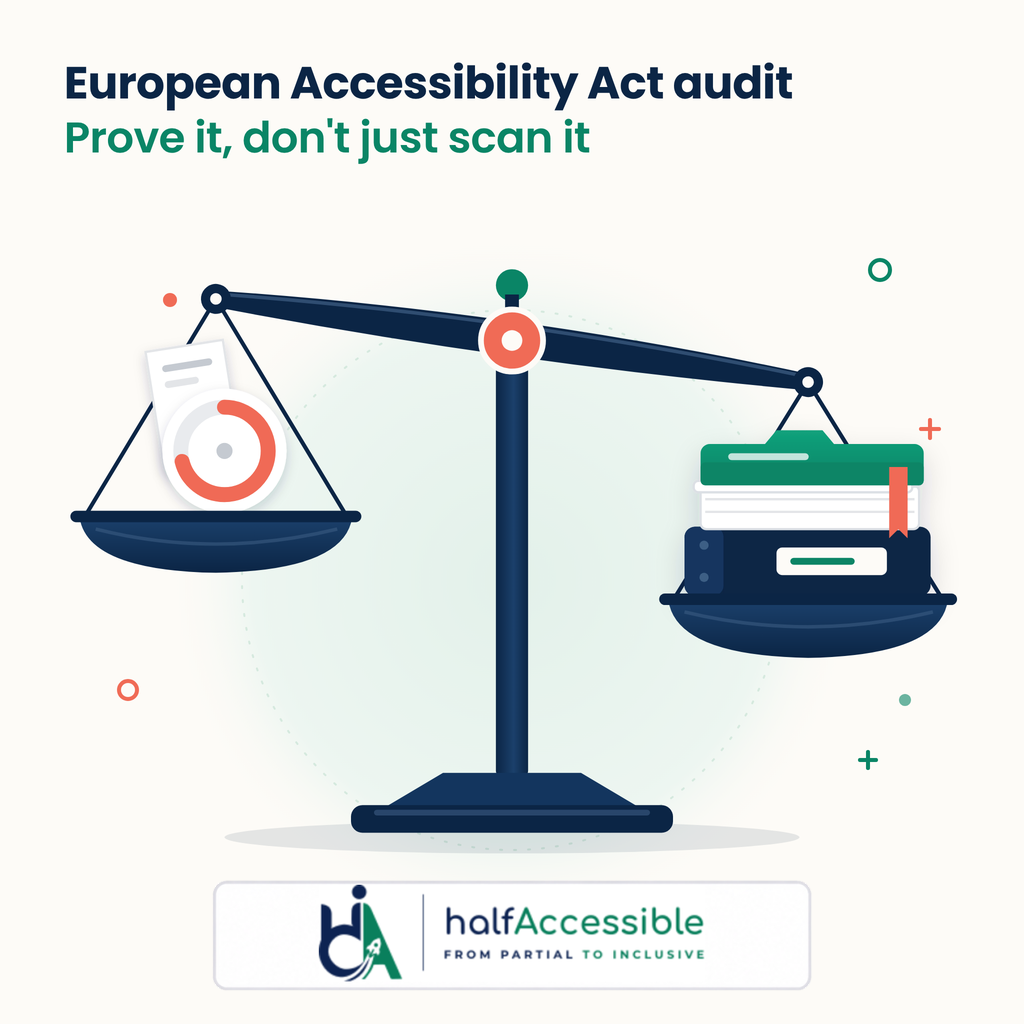
A European Accessibility Act audit has to show two things: that the customer journeys you offer to EU consumers meet the EAA accessibility requirements (in practice, WCAG 2.1 Level AA through EN 301 549), and that you hold the paperwork the law asks for: your service accessibility information, any disproportionate burden assessment, and a record of how you fix non-conformities. Regulators in Sweden and Germany are already checking live sites, and in June 2026 a French court ordered Carrefour to make its online store fully accessible even though it was reported to be 71% conformant. A scanner score will not survive that kind of scrutiny. A scoped manual audit with documented evidence will.
This guide is written by IAAP-certified accessibility testers who audit EU-facing stores, SaaS products and service platforms. It is not legal advice. It explains what an EAA audit should cover, what enforcement looks like in 2026, and how to scope one without paying for work you do not need.
Why EAA Audits Became Urgent in 2026
The European Accessibility Act (Directive (EU) 2019/882) applies to covered services provided to consumers after 28 June 2025, including e-commerce, consumer banking, e-books, electronic communications and parts of passenger transport. For the first year, many teams treated it as a future problem. That changed in 2026:
- Courts are ordering fixes. On 4 June 2026 the Tribunal judiciaire de Caen ordered Carrefour France to provide e-commerce services that meet French accessibility requirements, with a penalty of €500 per day starting six months after the order. The case was brought by the disability associations apiDV and Droit Pluriel, not by a regulator. According to France 3, Carrefour had made 71% of its content accessible, and the associations’ position was that the law requires full conformance, not 70%.
- Regulators are checking named sites. Sweden’s Post and Telecom Authority (PTS) began supervising e-commerce services in October 2025, focusing on the home page, a product page and the search function, plus whether information about how the service works is provided accessibly. By March 2026 it had opened 28 cases, including H&M, IKEA, Systembolaget and Boozt.
- Complaints are piling up. Germany’s joint market surveillance authority, the MLBF, said on 1 June 2026 that it was working through almost 700 reports, including possible non-conformities and disproportionate burden claims made by businesses.
- Most large stores still fail. In March 2026 the Dutch regulator ACM reported that at 61% of the roughly 100 largest Dutch webshops and telecom and energy sites it checked, people using assistive technology could not place an order, and another 33% had serious problems.
The pattern is clear. Enforcement starts with the journeys a customer actually uses, and it asks for proof. If you need the wider legal background first, read our European Accessibility Act guide and European Accessibility Act compliance overview.
Does Your Business Need an EAA Audit?
Start with scope, because the directive is narrower than “every website” and wider than “EU companies only”.
| Question | Why it matters | Source |
|---|---|---|
| Do you offer a covered service to consumers in the EU? | E-commerce, consumer banking, e-books, electronic communications and passenger transport websites and apps are covered. A “service provider” includes anyone who offers the service to consumers in the EU, so non-EU sellers are in scope. | Articles 2 and 3 |
| Are you a microenterprise providing services? | Service businesses with fewer than 10 employees and annual turnover or balance sheet not above €2 million are exempt from the service accessibility requirements. | Articles 3(23) and 4(5) |
| Is the content yours? | Third-party content you neither fund, develop nor control is excluded, and so are pre-recorded video and office files published before 28 June 2025 and true archives. Your checkout widget, reviews plugin or chat tool usually still counts if you chose and configured it. | Article 2(4) |
| Are you relying on an exception? | If you claim a disproportionate burden, you must document the assessment, keep it for five years, renew it at least every five years and tell the relevant authority. | Article 14 |
If you sell to EU consumers from the US, UK, India or anywhere else and you are not a microenterprise, assume you need an audit of your consumer-facing journeys.
What a Credible European Accessibility Act Audit Covers
The EAA sets functional requirements in Annex I. The practical benchmark for websites and apps is EN 301 549, the European ICT accessibility standard, which incorporates WCAG. The version in force today, EN 301 549 v3.2.1 (cited in the Official Journal under the Web Accessibility Directive), maps to WCAG 2.1 Level AA. No harmonised standard has yet been cited under the EAA itself. The newer v4.1.1, the first version written with the EAA in mind, moves to WCAG 2.2 and is expected to be cited in the Official Journal (currently forecast for 16 December 2026; see our EN 301 549 v4.1.1 guide). Once that happens, Article 15 gives a presumption of conformity to anyone who meets it, so a good audit tests against WCAG 2.1 AA today and flags the WCAG 2.2 additions now, so you are not caught out at the switch.
A credible audit covers:
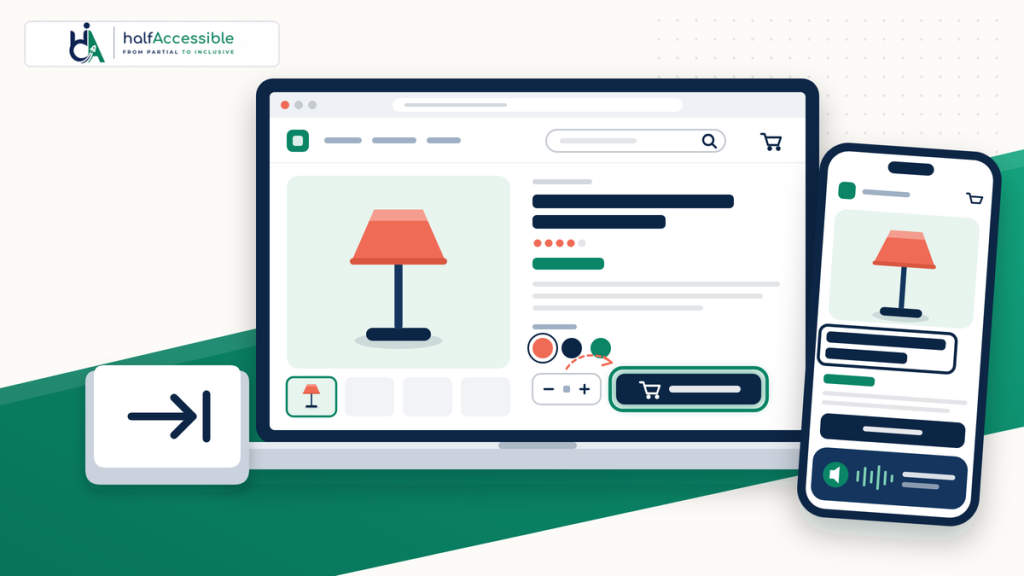
- The journeys regulators test first. Home page, search, category and product pages, cart, checkout, account sign-up and login, and customer support or contact. PTS has said publicly it starts with the home page, a product page and search.
- Every channel you offer. The EAA covers websites and mobile device-based services, so a native app that sells or books is in scope alongside the site.
- Manual testing with assistive technology. Keyboard-only use, screen readers (JAWS and NVDA on Windows, VoiceOver on iOS and macOS, TalkBack on Android), zoom and reflow, and colour contrast. Automated tools find only part of the problems.
- Service information under Annex V. Article 13(2) requires service providers to publish information explaining how the service meets the accessibility requirements, in an accessible format, and keep it for as long as the service runs. An audit should check that this information exists, is accurate and is itself accessible.
- Third-party components. Payment providers, cookie banners, chat widgets, review tools and embedded booking engines. If you control or configure them, test them.
- Exceptions you plan to rely on. If any requirement would impose a disproportionate burden, the audit evidence is what supports (or undermines) the Article 14 assessment.
The Evidence File Regulators and Courts Will Ask For
Article 13(5) says service providers must give a competent authority, on reasoned request, all the information needed to demonstrate conformity. In practice, that means an evidence file. Use this checklist:
- A dated audit report naming the standard (EN 301 549 / WCAG 2.1 AA, with WCAG 2.2 gaps noted), the journeys, platforms, browsers and assistive technologies tested
- Each issue mapped to a WCAG success criterion, with location, severity and fix guidance
- A remediation log showing what was fixed and when, and a re-test confirming it
- Your published service accessibility information (Annex V), usually in your terms and conditions or an accessibility statement, plus a working feedback or contact route
- Any disproportionate burden assessment (Article 14), with the Annex VI criteria considered, the date and the renewal date
- A record of notifying the authority if a service is not compliant (Article 13(4)) or if you rely on an exception (Article 14(8))
- A monitoring plan for releases, content updates and new third-party tools (Article 13(3) requires procedures so the service stays compliant)
The Carrefour case shows why the remediation log matters as much as the report: a partial conformance figure was not treated as compliance. What you can show is a clear plan, real fixes and a re-test.
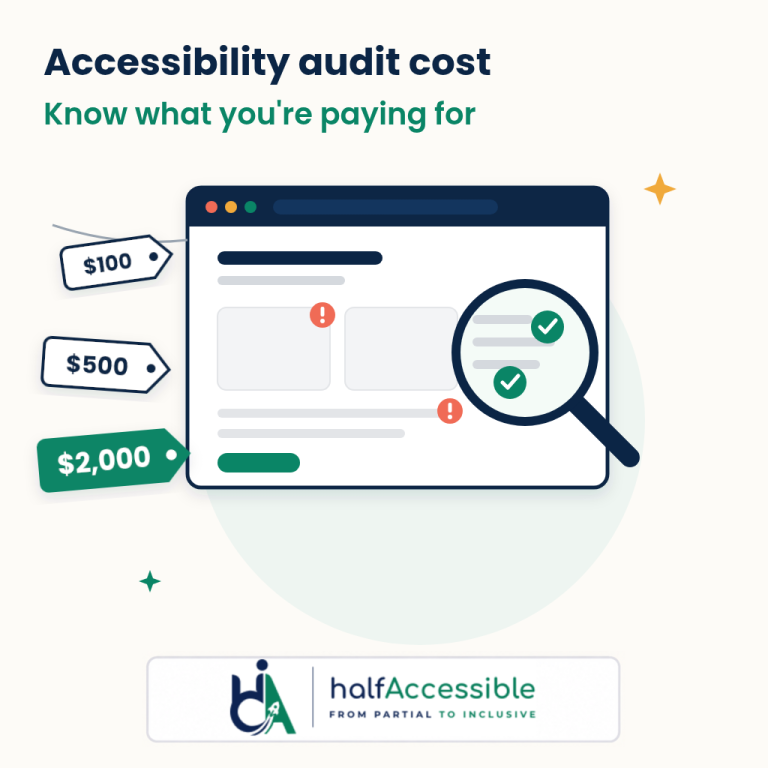
If you sell into the EU and do not have this file yet, start a $500 Quick Audit of your key templates, or book a $100 consultation and we will tell you which journeys and documents your EAA audit needs.
Common Mistakes That Make an EAA Audit Worthless
- Relying on an overlay or a scanner score. An automated score is not evidence of conformance, and an overlay widget does not change the underlying code. Our post on accessibility overlays and lawsuits explains why.
- Testing the marketing site but not the store or app. Enforcement so far has focused on buying journeys.
- Ignoring the language and market. If you sell in German, French or Swedish, test the localised journeys that customers in those countries use.
- Claiming a disproportionate burden without paperwork. The directive’s recitals say lack of priority, time or knowledge are not legitimate reasons, and the assessment must be documented.
- Treating the audit as a one-off. Every release can add new barriers. Plan accessibility monitoring and governance or a periodic re-audit.
How to Scope and Budget Your EAA Audit
Scope by unique templates and journeys, not by page count. A 5,000-product store may have six templates; a banking app may have dozens of flows.
| Your situation | Sensible starting point | HalfAccessible option |
|---|---|---|
| Not sure if or how the EAA applies | A one-hour scoping call and action plan | $100 consultation |
| Small EU-facing site or a first look before budgeting | Up to 5 templates, top issues mapped to WCAG | $500 Quick Audit |
| Online store or service selling to EU consumers | Up to 25 templates or key flows, full manual testing, re-test and statement draft | $2,000 Complete Audit (pricing) |
| Shopify store | Storefront, product pages, cart and checkout | $2,000 Shopify Accessibility Audit |
| Multiple countries, apps, banking or SaaS products | Custom scope mapped to EAA and EN 301 549 | EU accessibility compliance audit |
For a breakdown of what each price level buys and what most quotes leave out, see accessibility audit cost in 2026. If your store runs on WordPress or WooCommerce, the WordPress accessibility audit is built for that stack, and our eCommerce and retail accessibility team handles marketplaces and custom storefronts. SaaS vendors selling to EU businesses and consumers can pair the audit with a VPAT / ACR through our SaaS and B2B software accessibility practice. Agencies can resell the work through our white-label accessibility audits.
Get an EAA Audit You Can Defend
A European Accessibility Act audit is only useful if it would stand up to a regulator’s request or an association’s lawyer. That means real journeys, real assistive technology, a clear fix list and a re-test, not a scanner export.
HalfAccessible’s IAAP-certified testers audit EU-facing stores, SaaS products and service platforms against EN 301 549 and WCAG 2.1 and 2.2 AA, and our accessibility remediation and development teams for WordPress, Shopify and React fix what we find. Prices are fixed and public: $100 consultation, $500 Quick Audit, $2,000 Complete Audit and the $2,000 Shopify Accessibility Audit.
Request an EU accessibility compliance audit, start a $500 Quick Audit, book a consultation, or see our pricing and sample audit report.