If you sell software, apps or websites to US state and local governments, public schools or public universities, ADA Title II now reaches your product: the DOJ rule makes those buyers responsible for WCAG 2.1 Level AA on the web content and mobile apps they provide “directly or through contractual, licensing, or other arrangements”, so the requirement arrives in your RFPs, renewals and contract clauses. The first compliance date is April 26, 2027, a federal lawsuit could bring it forward, and buyers signing contracts now are already asking vendors for evidence.
This guide is for founders, product leaders and sales or compliance leads at SaaS, EdTech and GovTech companies, and for agencies that build or run public-sector websites. It explains what the rule says about vendors, which dates apply, what buyers are starting to ask for and what to have ready. If you work for the public entity itself, our DOJ Title II deadline guide is written for you. This is not legal advice.
What the Title II Rule Says About Vendor Products
Title II of the ADA covers state and local governments: their agencies, public schools, community colleges and public universities, courts, elections offices, public hospitals and similar bodies. In April 2024 the Department of Justice added a web and mobile rule, now at 28 CFR Part 35, Subpart H, that adopts WCAG 2.1 Level AA as the technical standard.
Three parts of the rule matter to vendors.
- Vendor products are in scope. Section 35.200 requires a public entity to make sure its web content and mobile apps meet WCAG 2.1 Level AA when it provides or makes them available “directly or through contractual, licensing, or other arrangements” (28 CFR 35.200 on eCFR). A licensed portal, booking tool or learning platform counts.
- The third-party exception does not cover you. The rule exempts content posted by a third party, “unless the third party is posting due to contractual, licensing, or other arrangements with the public entity” (28 CFR 35.201). A member of the public writing on a town message board is exempt. A contracted vendor is not.
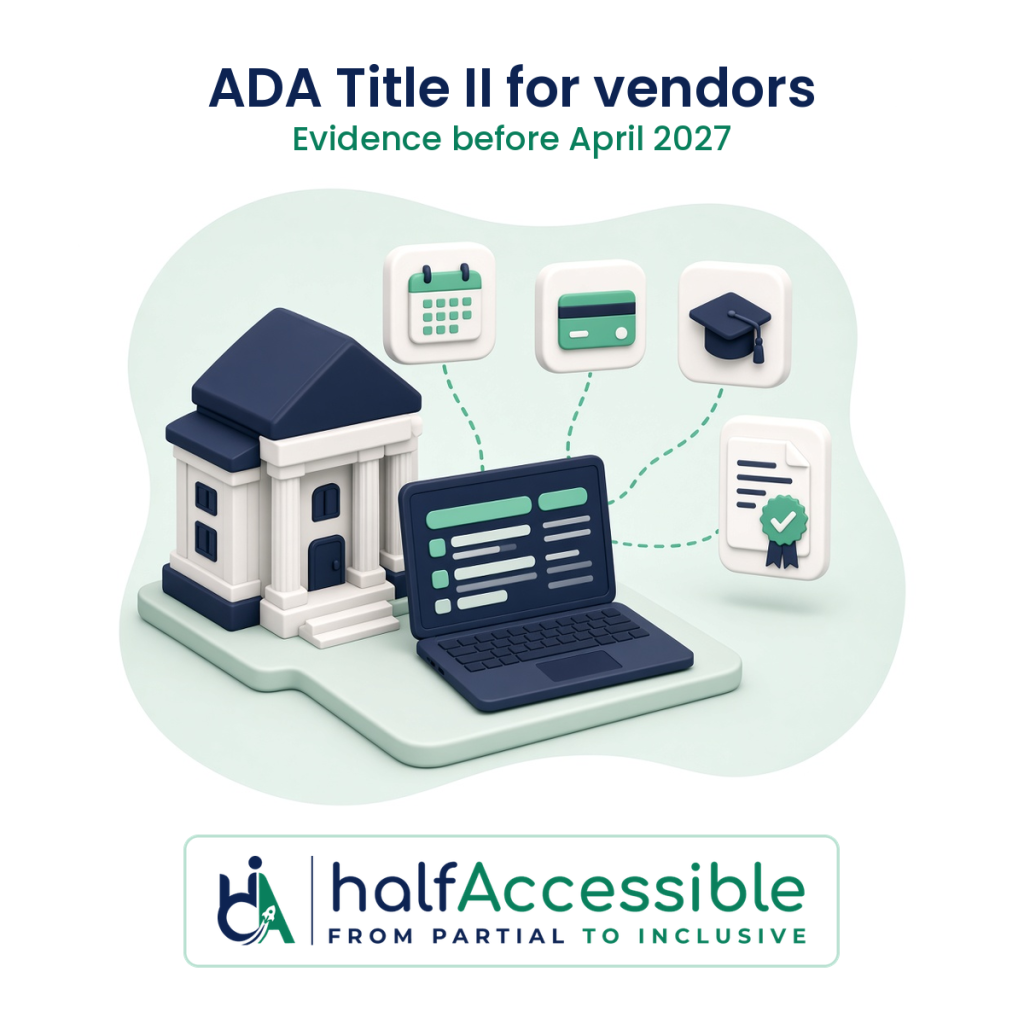
- ADA.gov names the tools buyers use. The DOJ fact sheet says content “developed by an outside technology company, like calendars, scheduling tools, maps, reservations systems, and payment systems” would usually need to meet WCAG 2.1 Level AA, and so would content a company posts while it designs, manages or updates a government website (ADA.gov fact sheet).
The legal duty sits with the public entity, not with you. That is exactly why it reaches you through procurement: a county or a university cannot meet its deadline on a product it licenses unless that product conforms, so it asks you to prove it.
The Dates, and Why They Could Move
The DOJ extended the original deadlines by one year in an interim final rule published on April 20, 2026 (91 FR 20902, Federal Register). Only the dates changed. The standard, the scope and the exceptions did not.
| Public entity | Compliance date now | Date before the April 2026 extension |
|---|---|---|
| Total population of 50,000 or more | April 26, 2027 | April 24, 2026 |
| Total population under 50,000 | April 26, 2028 | April 26, 2027 |
| Special district governments | April 26, 2028 | April 26, 2027 |
Three things make it risky to treat April 2027 as a comfortable gap.
- The extension is being challenged in court. The National Federation of the Blind sued the Department of Justice on May 21, 2026 in the US District Court for the District of Maryland (National Federation of the Blind v. Department of Justice, No. 1:26-cv-02007). The case was still open on the court docket when we checked on October 20, 2026. If the extension were set aside, the earlier dates in the right-hand column could apply again, and one of them has already passed.
- The DOJ expects to enforce the new dates. The interim rule says the Department “will consider issuing an NPRM” on the substance of the rule, and that if it does not, it “fully anticipates implementing the regulation at the new deadline”. No proposed or final rule changing that had appeared in the Federal Register as of October 20, 2026.
- The existing duty never paused. The same interim rule states that, regardless of the compliance dates, covered entities “have an ongoing obligation” to make services offered through web content and mobile apps accessible under Title II. It also notes that Title II gives people a private right of action. Your public-sector customers can be sued today, and they know it.
There is also a contract-length point. A three-year agreement signed this autumn will still be running in April 2027 and April 2028, so the buyer has to judge your product against WCAG 2.1 AA now, not at the deadline.
How ADA Title II Vendor Requirements Show Up in Your Deals
Most vendors will never read 28 CFR Part 35. They will meet the rule as questions in a security-and-accessibility review, a new clause in a renewal, or a scoring line in an RFP. Public guidance already shows what those look like.
The DOJ’s own list of contract practices. ADA.gov’s first-steps guide for public entities tells them to review vendor contracts and lists practices some entities found helpful (ADA.gov first steps, Action Step 10):
- asking vendors for detailed information about the accessibility of their product before signing
- a warranty that the product complies with stated technical standards and accessibility laws
- language that stops vendors from disclaiming those warranties
- indemnification for any breach of the accessibility warranties
- testing vendor products and publishing the results for other entities
Expect some version of each of these in public-sector paperwork over the next year.
States are writing it into procurement. Two published examples:
- Idaho. The Division of Purchasing says that starting April 1, 2026, vendors providing digital products or services on behalf of the State of Idaho must meet WCAG 2.1 AA, with the requirements taking full effect on April 24, 2027. Bidders complete a Vendor Accessibility Assessment form (Idaho Division of Purchasing). The state’s procurement FAQ says vendors may be asked for an Accessibility Conformance Report (ACR), that products with gaps are not automatically ruled out, and that agencies should weigh the severity of the issues, whether the vendor has a clear remediation plan and the timeline for fixes (Idaho ITS procurement FAQ, PDF).
- Texas. The Department of Information Resources says DIR contracts require compliance with Texas Government Code 2054, TAC 206, TAC 213 and WCAG 2.1 AA, and that vendors must submit accessibility documentation with solicitation responses and when agencies and universities ask for updates (Texas DIR procurement and vendor resources).
Notice what the Idaho FAQ rewards: an honest ACR plus a credible fix plan. It also tells agencies to review ACRs carefully and use other evaluation methods to check them, so a document with nothing behind it is a weak position.
Which Vendors Are Most Exposed
Going by the examples ADA.gov gives and the entities Title II covers, these vendors should expect questions first:
- EdTech and learning platforms licensed by public school districts, community colleges and public universities, including student portals, career and admissions tools, and course or assessment software.
- Payments, permits and billing: fee payment, utility billing, licensing and permit applications.
- Scheduling and reservations: appointment booking, facility and parks reservations, event calendars.
- Maps and public information tools: GIS viewers, service request and 311-style reporting apps.
- Agencies and web vendors that design, manage or update government websites, since ADA.gov says content they post usually has to meet WCAG 2.1 AA.
- Mobile apps a public entity offers through a vendor, because the rule covers apps as well as web content.
If public users sign in to your product to apply, pay, book, learn or report something, assume it is in scope.
What to Have Ready Before Your Next Public-Sector Renewal
You don’t need to wait for an RFP to start. These are the items buyers are most likely to ask for, in the order that makes them credible.
- A list of the journeys public users actually touch. Sign-up and login, the core task (apply, pay, book, submit an assignment), notifications, documents your product generates, and account settings. These are the journeys a buyer will test.
- Testing against the right standard. Title II names WCAG 2.1 Level AA. Many teams test to WCAG 2.2 AA because some private buyers ask for it, and W3C states that content conforming to WCAG 2.2 also conforms to WCAG 2.1 (WCAG 2.2). Make sure your report still shows results against the 2.1 criteria your public buyers will check.
- Manual testing, not only a scan. Automated tools catch code-level problems quickly but cannot confirm keyboard access, screen reader output or whether a whole workflow works. A free single-page scan on AccessibilityScore.in, our WCAG accessibility score checker, is a sensible first check of a public page; signed-in screens and full journeys need manual testing with keyboards and screen readers before you make any claim to a buyer.
- An honest ACR. An Accessibility Conformance Report on the VPAT WCAG edition, with remarks that match the test results. Our VPAT for SaaS guide explains how to write one that procurement teams trust.
- A dated remediation plan. For anything marked Partially Supports or Does Not Support, list the fix and a realistic date. Idaho’s FAQ shows that a clear plan and timeline are part of how gaps get judged.
- Contract language you can stand behind. Read warranty and indemnification clauses against your actual test results before you sign them, and agree fix timelines you can meet.
- A re-test routine. Re-test the journeys in scope after major releases and update the ACR when results change, so the evidence still matches the product at renewal.
Mistakes That Cost Vendors Public-Sector Deals
- Sending an ACR built from a scan export. Buyers are being told to check ACRs with their own testing. Claims that a manual test would disprove damage trust more than an honest “Partially Supports”.
- Testing only the marketing site. The public uses your application, not your homepage. Login, forms, data tables, uploads and payment steps are where most serious barriers sit.
- Forgetting documents and mobile. PDFs your product generates for users, and the mobile app, are part of what the buyer provides to the public.
- Promising “fully compliant” in a warranty. If your testing says otherwise, a warranty or indemnity clause turns that gap into contract risk.
- Treating an overlay widget as the fix. It does not change your application code, and it gives an evaluator nothing to verify. Our guide on accessibility overlays and ADA lawsuits covers why.
How HalfAccessible Helps Vendors Selling to the Public Sector
- Proof from EdTech: Interstride, a career and immigration platform for international students, worked with us on two audit rounds: November 2025, then a February 2026 re-test of earlier findings plus newly shipped features. Findings were mapped to WCAG 2.2 after NVDA, JAWS, VoiceOver and keyboard-only testing, and both engagements were rated 5.0 out of 5 on Upwork. The full write-up is in our EdTech accessibility audit case study.
- Who tests: audits are led and reviewed by Mohammad Shadab Saifi (IAAP CPACC, WAS and CPWA, DHS Section 508 Trusted Tester), with manual testing in NVDA, JAWS and VoiceOver plus keyboard-only checks. Certification details are on the International Association of Accessibility Professionals site.
- Audit, fixes and paperwork from one team: manual ADA and Section 508 accessibility audits, accessibility remediation, re-testing and VPAT and ACR documentation, so your findings, fixes and claims stay consistent.
Sector pages with more detail: SaaS and B2B software accessibility, Education and EdTech accessibility and Government and public sector accessibility.
Next Step: Get Ahead of the Questions in Your Next Renewal
You don’t have to buy anything today to get a clearer picture.
- Run a quick first check: scan a public page on AccessibilityScore.in to see common code-level issues with issue-level guidance, then plan manual testing for your signed-in journeys.
- Learn what evidence holds up: read our VPAT for SaaS guide, then our guide to buying a SaaS accessibility audit for procurement, and use our checklist for choosing an accessibility audit company.
- Talk it through: book a free 30-minute call to work out which of your products and journeys a public buyer will look at, or book the $100 one-hour technical consultation if you already have an RFP question, a draft ACR or findings to review with your developers.
- Compare options: see pricing ($500 Quick Audit, $2,000 Complete Audit), the sample audit report and our case studies.