The European Accessibility Act (EAA) has been enforceable since June 28, 2025.
That is not a warning date. It is not a soft launch. National laws now carry real penalties, and enforcement has started: in France, disability associations took four major grocery retailers to court in November 2025 over inaccessible online shopping, and market surveillance authorities across the EU can order fixes and impose fines.
European Accessibility Act compliance is now a legal requirement for many private companies that sell covered products or services to consumers in the EU. This includes businesses based outside Europe. If your website or app delivers a covered service, such as online shopping, consumer banking, passenger transport booking or e-books, to consumers in the EU, this law applies to you.
This guide covers everything you need to know: who must comply, what the technical standard requires, how fines are structured across EU member states, what happened in the first months of enforcement, and how to build an action plan that gets you compliant fast.
Need a fast answer for your own site? Our $500 Quick Audit tests your key journeys against EN 301 549 and WCAG 2.1/2.2 AA, or you can request a free accessibility needs assessment and we reply within 2 business days.
Key Takeaways
- The EAA has applied since June 28, 2025 to covered products placed on the market and services provided to consumers after that date. Transitional rules (Art. 32) let service contracts agreed before then run until they expire, but no later than June 28, 2030, and let services keep using products already in use until that date.
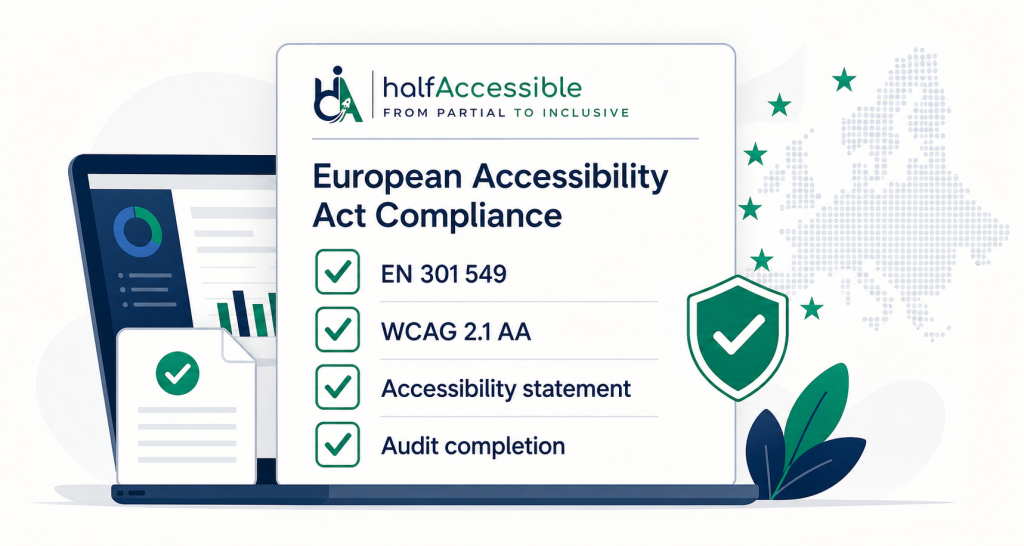
- The practical technical benchmark is EN 301 549. Version 3.2.1 incorporates WCAG 2.1 Level AA; version 4.1.1 (September 2026) moves to WCAG 2.2. No version has been cited in the Official Journal under the EAA yet.
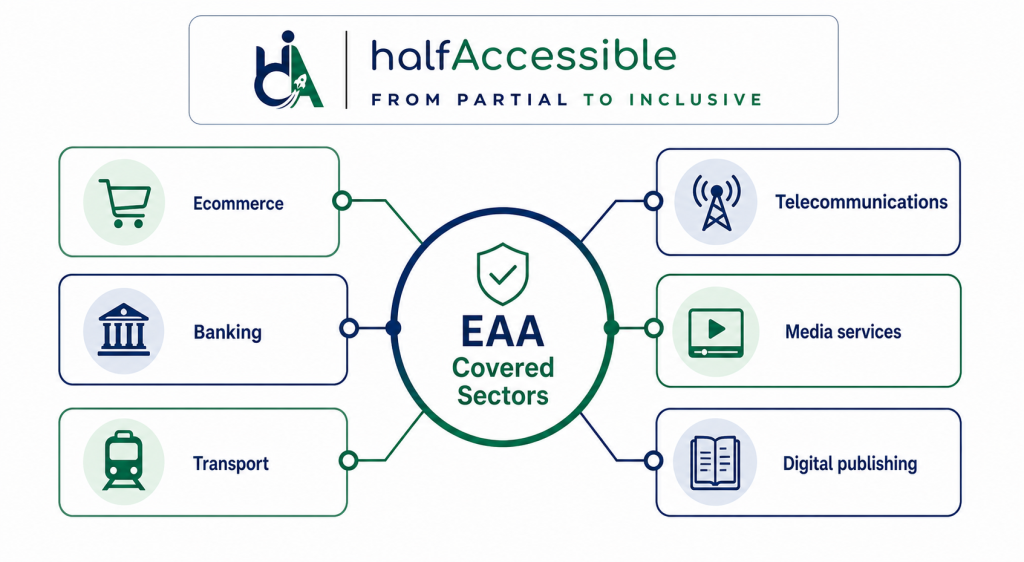
- The EAA covers listed products and services offered to consumers, including ecommerce, consumer banking, passenger transport, electronic communications, e-books and services that give access to audiovisual media.
- Non-EU businesses serving EU customers must also comply.
- The only exemption is microenterprises providing services: fewer than 10 employees and under €2 million annual turnover. Product manufacturers must comply regardless of size.
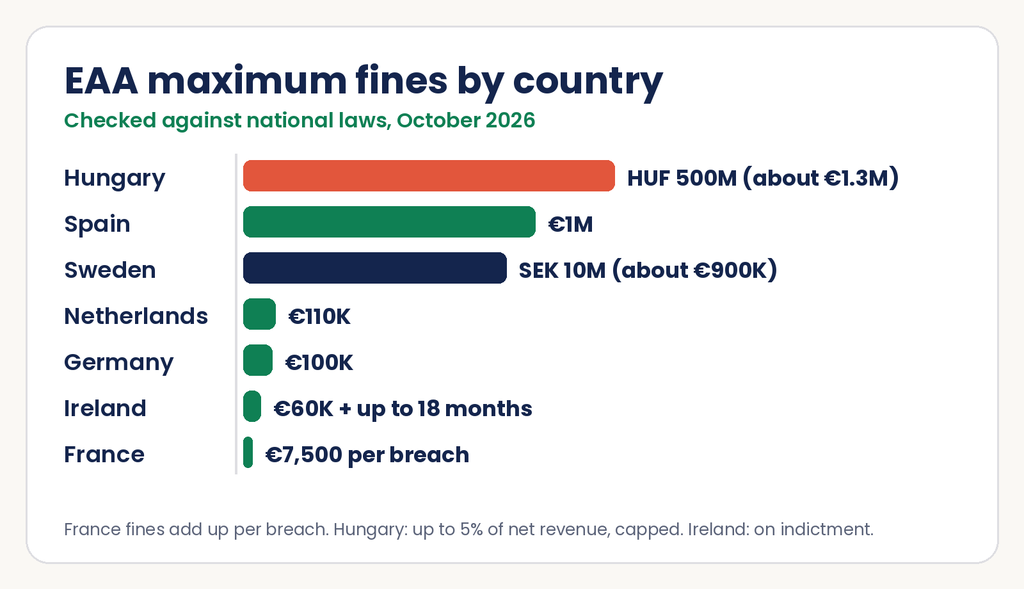
- Fines are set nationally: up to €1,000,000 in Spain, SEK 10 million in Sweden, HUF 500 million (or 5% of net revenue) in Hungary and €100,000 in Germany. Some countries can add periodic penalty payments until a breach is fixed.
- Enforcement has started. In France, disability associations sent formal notices to four grocery retailers in July 2025 and took them to court in November 2025.
- Service providers must publish information on how their service meets the accessibility requirements (Art. 13 and Annex V), usually as an accessibility statement.
- An accessibility audit followed by remediation is the fastest path to compliance.
What Is the European Accessibility Act?
The European Accessibility Act is an EU Directive (2019/882) that sets harmonized accessibility requirements across all 27 EU member states. Its goal is to remove the patchwork of national accessibility laws and replace them with a single standard that applies across the bloc.
The key word is “harmonized.” Before the EAA, companies operating across Europe had to navigate different rules in different countries. Germany had one standard, France had another, and Spain had a third. The EAA ends that fragmentation.
The EAA covers both physical and digital products and services. For digital compliance, the standard is EN 301 549, which maps to WCAG 2.1 Level AA.
The law was adopted in 2019, member states had to transpose it into national law by June 28, 2022, and it has applied since June 28, 2025. The transitional rules in Art. 32 are narrower than many guides suggest. Service contracts agreed before June 28, 2025 can continue unchanged until they expire, but no longer than June 28, 2030, and services can keep using products that were already lawfully in use until that date. Self-service terminals already in use can stay in service until the end of their economic life, up to 20 years. France’s DGCCRF has stated that a website or mobile app is not a “product” for this rule, so an existing online shop cannot use it to delay compliance (DGCCRF guidance). A new service offered to consumers today must comply from the start.
Who Must Comply with the EAA?
This is where many businesses get confused. The EAA is not just for government agencies or large corporations. It applies to private companies of almost any size.
You must comply if you:
- Sell or provide covered products or services to customers in any EU member state
- Provide a covered service to consumers through a website or mobile app, such as an online shop, a banking app or a ticket booking site
- Provide ecommerce, consumer banking, passenger transport, electronic communications, e-book or audiovisual media access services in the EU
- Are based outside the EU but serve EU customers
The scope is intentionally broad. A company headquartered in the US, India, or Australia that sells to German or French customers must meet EAA requirements.
The only exemption that applies to most small businesses is the microenterprise rule for service providers: fewer than 10 employees AND annual turnover or balance sheet under €2 million. If you are a service-based micro-business below both thresholds, you are exempt.
This exemption does NOT apply to product manufacturers. A hardware company with 8 employees still must comply.
What Digital Products and Services Does It Cover?
The EAA’s digital scope covers more than just websites. Here is what falls under the law:
Websites and mobile apps for covered sectors are the most common compliance concern. If your website takes payments, delivers services, or provides content to EU users, it is in scope.
Ecommerce platforms must have accessible product listings, checkout flows, cart updates, payment forms, error messages, and order confirmations. This includes embedded third-party payment tools like Stripe or PayPal.
Consumer banking services including online banking, payment and account services, consumer credit, e-money and certain investment services must be accessible. Insurance is not on the EAA list of services.
Transport services including airline booking sites, rail ticketing, real-time travel information, and transport apps are covered.
Telecommunications services including broadband, VoIP, and associated apps are in scope.
E-books and digital publishing platforms must provide accessible reading experiences.
Services providing access to audiovisual media, such as the websites, apps and electronic programme guides of streaming and TV services, fall under the EAA.
If your business falls into any of these categories, European Accessibility Act compliance is not optional. Our European Accessibility Act guide includes a 2026 EAA compliance checklist and explains how an EAA audit works.
What Is EN 301 549 and How Does It Relate to WCAG?
EN 301 549 is the European harmonized standard for ICT (Information and Communications Technology) accessibility. It is the official technical benchmark for EAA compliance.
No version of EN 301 549 has yet been cited in the Official Journal under the EAA itself, so in practice the reference is EN 301 549 v3.2.1, the version cited under the EU Web Accessibility Directive. Its web chapter incorporates WCAG 2.1 Level A and Level AA success criteria in full. A newer version, EN 301 549 v4.1.1, was published in September 2026 and moves the web requirements to WCAG 2.2, but it still has to be cited in the EU Official Journal before it replaces v3.2.1 for that purpose. Our EN 301 549 v4.1.1 guide covers what changes and how to prepare. For now, this means:
- If your website meets WCAG 2.1 Level AA, you meet the web-related requirements of EN 301 549.
- If you have a WCAG 2.1 AA audit report and conformance documentation, you have the evidence base for EAA compliance.
However, EN 301 549 goes further than WCAG in some areas. It includes requirements for hardware accessibility, software running on devices, ATMs, ticketing kiosks, and real-time communication tools. For most web and mobile teams, WCAG 2.1 AA is the practical target.
WCAG 2.2 is not yet mandated by the EAA, but adopting it is wise. It adds important criteria including a rule that focused elements must not be hidden behind sticky headers or banners (WCAG 2.4.11 Focus Not Obscured) and drag-and-drop alternatives (WCAG 2.5.7).
EAA Enforcement Has Started: Real Examples from 2025 and 2026
The first months of EAA enforcement made clear that regulators are not bluffing.
France saw the first major court action. On July 7, 2025, the disability associations ApiDV and Droit Pluriel, supported by the legal collective Intérêt à Agir, sent formal notices (mises en demeure) to four large grocery retailers: Auchan, Carrefour, E.Leclerc and Picard Surgelés. In November 2025 they summoned all four before the French courts in urgent summary proceedings (référé), arguing that the online grocery sites and apps could not be used on equal terms by blind and partially sighted shoppers. One retailer’s own accessibility statement claimed only 32% of France’s RGAA criteria at the time of the notice, and 50% after an August 2025 audit (Intérêt à Agir). Separately, France’s consumer protection authority, the DGCCRF, can order businesses to comply and back those orders with penalty payments (DGCCRF).
Germany‘s national EAA law, the Barrierefreiheitsstärkungsgesetz (BFSG), has applied in full since June 28, 2025. Market surveillance authorities check services by sampling, first ask a business to fix a non-conformity, and can then fine it or prohibit the service. Consumers and recognised associations can ask the authority to act and go to the administrative courts if it refuses (Bundesfachstelle Barrierefreiheit). German lawyers also warn that competitors may send private warning letters (Abmahnungen) under competition law.
Norway shows how quickly a daily fine starts once a deadline is missed, although this case falls under its own universal design rules for ICT rather than the EAA. Its regulator, Uu-tilsynet, found 119 errors against WCAG 2.1 on the HelsaMi patient portal run by Helseplattformen AS. Six errors were still open on December 19, 2025, so a daily fine of NOK 50,000 started on December 20, set to rise by 10% a month from February 2026. The last errors were fixed by December 23, so the fine ran for two days (Uu-tilsynet).
The pattern is clear. The first actions target core consumer journeys such as finding products, adding them to a cart, checking out and logging in, tested by people who use assistive technology. Those are the journeys a $500 Quick Audit checks first, and the EU accessibility compliance audit covers in full.
EAA Fines by Country: What You Actually Risk
The EAA requires member states to set penalties that are “effective, proportionate, and dissuasive” (Art. 30), together with remedial action to bring the product or service into line. Each country set its own fine structure. Here is a summary of key markets, checked against the national laws in October 2026:
Germany: Up to €100,000 for the more serious breaches and up to €10,000 for others (BFSG § 37). Private warning letters can add legal costs.
France: Breaches of the consumer code accessibility rules are fifth-class offences, with fines of up to €7,500 per breach for a company, added up for each breach found. The DGCCRF can also issue compliance orders with penalty payments.
Spain: Tiered fines from €301 for minor infringements up to €1,000,000 for very serious ones, under the General Law on the rights of persons with disabilities (Royal Legislative Decree 1/2013), which Law 11/2023 applies to the EAA.
Hungary: For larger, non-SME businesses, up to 5% of annual net revenue, capped at HUF 500 million (about €1.3 million). Most fines are far lower and follow a warning and a deadline to fix.
Sweden: A sanction fee from SEK 10,000 up to SEK 10 million (about €900,000) under Act 2023:254.
Netherlands: Administrative fines up to the fifth-category amount in the Dutch Criminal Code, which is €110,000 from January 1, 2026.
Ireland: On conviction on indictment, a fine of up to €60,000, up to 18 months in prison, or both (S.I. No. 636/2023).
Periodic penalty payments are also possible in some countries. France’s DGCCRF can attach them to compliance orders, and the Norway example above shows a daily fine starting the day after a missed deadline.
Each member state enforces its own national law, so a service offered in several EU countries can be checked by the authorities in each of them, under different penalty scales.
EAA vs ADA vs Section 508: How They Compare
If you are already managing ADA compliance for your US audience, understanding how the EAA fits in is important.
ADA (Americans with Disabilities Act): A US civil rights law. For websites, the DOJ’s 2024 Title II rule requires WCAG 2.1 Level AA for state and local governments, with compliance dates of April 26, 2027 or April 26, 2028 after the April 2026 interim final rule (see our DOJ Title II deadline guide). Title III has no web regulation for private businesses, but WCAG 2.1 AA is the benchmark most often used in lawsuits and settlements.
Section 508: Applies to the ICT that US federal agencies develop, buy, maintain or use, which is why vendors selling to them are asked for a VPAT. The 2017 Refresh, in effect since January 18, 2018, incorporates WCAG 2.0 Level A and AA by reference.
EAA: Covers listed products and services offered to consumers across all 27 EU member states, including by non-EU businesses. It sets functional accessibility requirements (Annex I); EN 301 549, whose v3.2.1 maps to WCAG 2.1 Level AA, is the practical benchmark until a standard is cited under the EAA.
The practical implication for most businesses: WCAG 2.1 Level AA is the shared technical baseline across all three frameworks. Achieving WCAG 2.1 AA gets you very close to compliance with all three, though the documentation requirements (VPAT for US contracts, accessibility statement for EAA) differ.
For a full breakdown of how these frameworks interact, read our guide: Which Accessibility Framework Actually Matters?
What Your Website Actually Needs to Meet EAA Standards
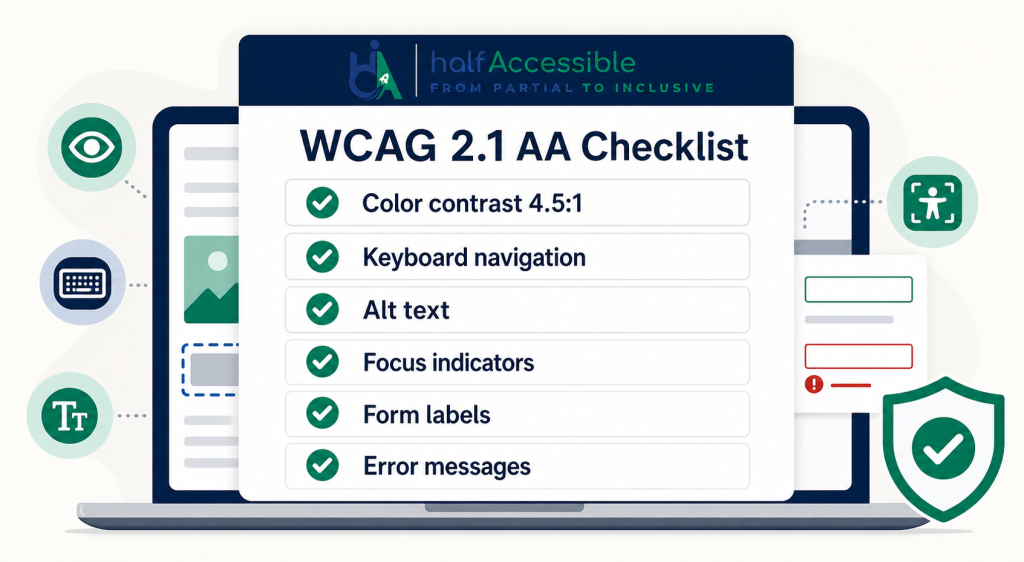
Achieving European Accessibility Act compliance at the WCAG 2.1 AA level means addressing issues across four categories: perceivable, operable, understandable, and robust content.
Here are the most critical requirements most websites fail on:
Color contrast is the single most common failure. Normal text needs a contrast ratio of at least 4.5:1 against its background. Large text (18pt or 14pt bold and above) needs 3:1. The 2026 WebAIM Million report found low-contrast text on 83.9% of the top one million home pages.
Alternative text for images is required for all meaningful images. Decorative images should have empty alt attributes (alt=””). Product images, infographics, and buttons with icons need descriptive alt text that conveys the same information a sighted user would get.
Keyboard accessibility means every function on the site must work without a mouse. Forms, menus, modals, carousels, and checkout steps must all be navigable using Tab, Enter, Space, and arrow keys.
Focus indicators must be visible. When a keyboard user tabs through the page, a clear visual indicator must show which element has focus. Removing the default browser outline without providing a replacement is a WCAG violation.
Form labels must be programmatically associated with their inputs. Placeholder text alone does not qualify. Every input needs a <label> element that stays visible and is announced by screen readers.
Error messages must be specific and actionable. “Invalid entry” fails. “Please enter a valid email address, for example name@example.com” passes.
Page titles must be unique and descriptive. Every page on your site should have a title that identifies both the page content and the site name.
Language attributes must be set on the <html> element so screen readers use the correct pronunciation.
Video and audio content must include captions (for pre-recorded video), audio descriptions (where video content conveys information not available in the audio), and transcripts.
ARIA use must be correct. Incorrect ARIA is worse than no ARIA. Use native HTML elements first and add ARIA only where native semantics are insufficient.
These requirements apply equally to your checkout pages, product listings, customer account areas, and any third-party embedded tools your site uses.
The EAA Accessibility Statement: What to Include
Under Art. 13(2) and Annex V, service providers must make information on how their service meets the accessibility requirements publicly available, in written and oral format and in an accessible way, for as long as the service is offered. Annex V asks for a general description of the service, the explanations needed to understand how it works, and a description of how it meets the accessibility requirements. Most businesses publish this as an accessibility statement page and keep it up to date.
A practical EAA accessibility statement covers these five elements:
1. Compliance status. Declare whether your site is fully compliant, partially compliant, or not yet compliant with EN 301 549 / WCAG 2.1 AA. Be honest. Partially compliant with a remediation timeline is far better legally than claiming full compliance when you are not.
2. Known inaccessible content. List what is not yet accessible and explain why. Acceptable reasons include: the content is exempt (archived), the content is third-party and outside your control, or remediation is in progress with a stated timeline.
3. Remediation timeline. If you have known issues, state when they will be fixed. This shows good faith and reduces regulatory risk.
4. Contact information. Provide a way for users to report accessibility issues and request accessible alternatives. This should be a working email or contact form, not a generic catch-all address.
5. Standard and version. Name the standard you tested against (for example EN 301 549 v3.2.1 / WCAG 2.1 Level AA, or WCAG 2.2 AA if you already test to it), the version of the product or service tested, and the date of the most recent assessment.
Do not confuse this with France’s public-sector rules, where the regulator ARCOM can fine public bodies up to €25,000 for a missing accessibility statement and related declarations, and up to €50,000 for an inaccessible site. Private businesses under the EAA fall under the consumer code penalties above. Our $2,000 Complete Audit (see audit pricing) includes an accessibility statement draft.
Your EAA Compliance Action Plan
Here is a practical step-by-step plan to achieve European Accessibility Act compliance.
Step 1: Run an accessibility audit. Start with a professional accessibility audit that covers both automated scanning and manual testing. Automated tools miss many issues: when the UK Government Digital Service tested 13 automated checkers on a page with 142 deliberate barriers, the best fully detected 40% and the worst 13% (GDS tool audit). Manual testing by accessibility experts, including testing with screen readers like JAWS, NVDA, and VoiceOver, is required to catch the rest. The audit gives you a full picture of your compliance gaps and a prioritized remediation list. The fastest start is our $500 Quick Audit (up to 5 templates, top-10 issues report); the $2,000 Complete Audit covers up to 25 templates or key flows with a full manual audit and a re-test of fixes. See a sample audit report.
Step 2: Fix critical issues first. Not all failures carry equal risk. Start with issues that block users from completing key tasks: inaccessible checkout, broken form submission, missing alt text on product images, and keyboard traps. These are also the issues regulators are targeting first.
Step 3: Remediate systematically. Work through your audit findings methodically. Accessibility remediation should be part of your development workflow, not a one-time fix. Build accessibility requirements into your design system, component library, and QA process.
Step 4: Test with real users. Involve people who use assistive technologies in your testing process. Screen reader users and keyboard-only users will identify issues that automated tools and sighted testers miss.
Step 5: Publish your accessibility statement. Once you have completed your audit and begun remediation, publish your accessibility statement. Update it as you fix issues.
Step 6: Set up ongoing monitoring. Accessibility is not a one-time project. New pages, new features, and third-party updates can introduce new barriers. Accessibility monitoring and governance keeps you compliant as your site evolves.
Step 7: Document your conformance. Consider producing a VPAT or ACR (Accessibility Conformance Report) to document your compliance status formally. This is especially valuable if you sell to enterprise customers or government entities who require procurement documentation. See our VPAT and ACR documentation service.
If you are an ecommerce business, our eCommerce accessibility specialty page covers the specific requirements for product listings, cart flows, and checkout steps.
Not sure where to start? Request a free accessibility needs assessment (we reply within 2 business days) or book a $100 consultation to talk through your EAA scope.
How Much Does an EAA Compliance Audit Cost?
Our EAA compliance audits use fixed packages, benchmarked to EN 301 549 and WCAG 2.1/2.2 AA:
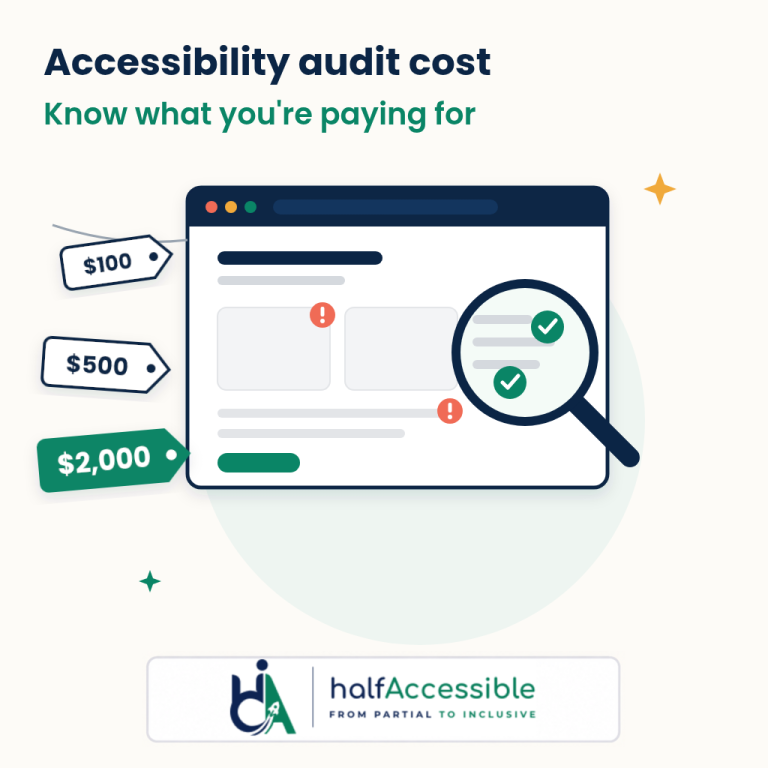
- $100 consultation: one hour to confirm whether the EAA covers your service and what to test first (book a consultation).
- $500 Quick Audit: up to 5 representative templates with a top-10 issues report (start a Quick Audit).
- $2,000 Complete Audit: up to 25 templates or key flows, full manual testing with JAWS, NVDA, VoiceOver and keyboard, a re-test of fixes, an accessibility statement draft and 90-day support (compare packages).
For larger or multi-country services, our EU accessibility compliance audit scopes every covered journey, and our European Accessibility Act guide walks through the 2026 EAA checklist step by step.
The Bottom Line
European Accessibility Act compliance is live. Enforcement has started. French disability associations have already taken major retailers to court, and national authorities can order fixes and impose fines.
The standard is WCAG 2.1 Level AA via EN 301 549. If you offer a covered service to EU consumers through a website or app, you are in scope. The microenterprise exemption is narrow, and only limited transitional rules run to 2030, so waiting carries real legal and reputational risk.
The fastest path forward is a professional accessibility audit to identify your gaps, followed by systematic remediation, an accessibility statement, and ongoing monitoring.
HalfAccessible helps businesses of all sizes achieve and maintain EAA compliance. Start with a $500 Quick Audit, compare packages on our audit pricing page, see our accessibility audit services, or request a free needs assessment.
Get an EU Accessibility Audit
For a full audit benchmarked to EN 301 549 and WCAG 2.1/2.2 AA, see our EU Accessibility Audit Services page, or start a $500 Quick Audit to get started.