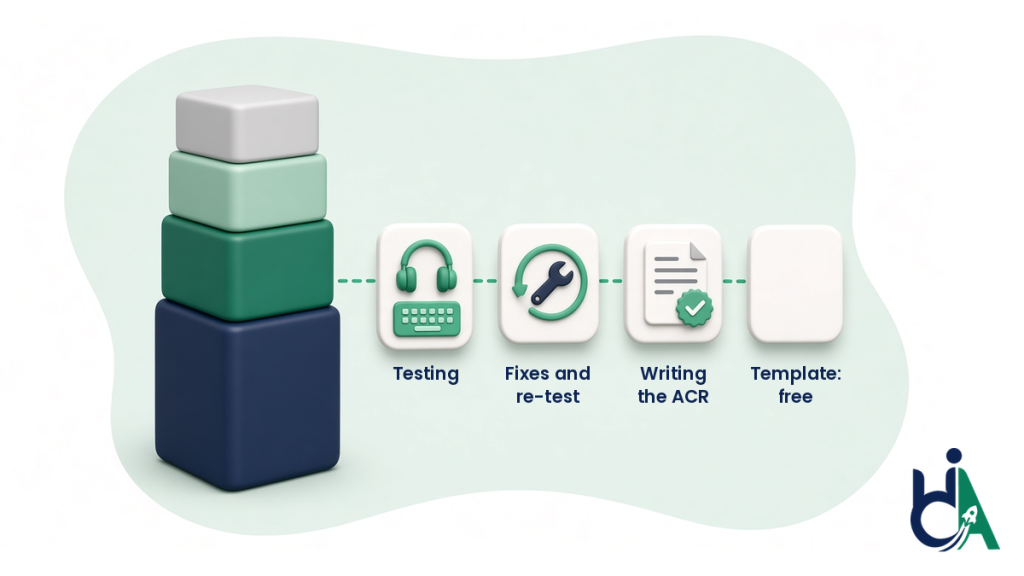
The VPAT template itself costs nothing, so the real VPAT cost is the price of testing your product properly and writing up the results: for most teams that means an accessibility audit plus a documentation fee, and often fixes and a re-test before the report goes to a buyer. A published rate card from one US provider shows the documentation part at a few hundred dollars per edition on top of the audit, which tells you where the money really goes.
This guide is for founders, product managers and sales or compliance leads whose buyer has just asked, “Can you send us your VPAT?” It explains what you are actually paying for, what moves the price, what a good quote should include, the red flags that make a cheap VPAT expensive, and how we price this work at HalfAccessible. This is not legal advice.
The Template Is Free. The Testing Is What You Pay For
The Information Technology Industry Council (ITI) publishes the VPAT® “free of charge”, and you don’t need to be an ITI member to use it (ITI VPAT). ITI asks you to test your product against each section of the template and record the results. Once it is filled in for a specific product, the document is called an Accessibility Conformance Report (ACR).
Three points from the official sources shape what you should be willing to pay for:
- There is nothing to certify. ITI states that it does not review or approve VPATs, that “there is no VPAT certification”, and that there is no pass or fail scale (ITI VPAT FAQ). Any quote that sells a “certified VPAT” is selling something that does not exist.
- For federal buyers the ACR is not optional. Section508.gov says that while the VPAT template is not required, “it is not voluntary to complete an ACR if you wish the government to consider purchasing your product” (Section508.gov ACR and VPAT FAQ).
- Buyers are told to check your claims. Section508.gov advises purchasers to “conduct independent conformance validation testing” to verify what vendors claim in ACRs whenever possible (Understanding Vendor Claims in ACRs), and the federal Technology Accessibility Playbook tells agencies to “require independent expert reviews of vendor conformance claims” before contract award (Play 8).
So the honest answer to “how much does a VPAT cost?” is: whatever it costs to produce test results that will survive a buyer checking them.
What a VPAT Costs: A Published Rate Card and How We Price It
Few providers publish VPAT prices. One that does is Accessible.org, whose pricing page (updated July 25, 2026) lists the ACR service on top of the audit it is based on (Accessible.org pricing):
| VPAT 2.5Rev edition | Published fee (Accessible.org) | Charged on top of |
|---|---|---|
| WCAG | $350 | The audit |
| Section 508 | $550 | The audit |
| EU (EN 301 549) | $650 | The audit |
| INT (all three standards) | $950 | The audit |
The same page says most of its audits cost between $1,250 and $2,750. Different providers price differently, but the pattern is the useful part: writing up the report is the smaller cost, and the testing underneath it is the larger one.
At HalfAccessible, VPAT and ACR documentation is quoted together with the audit it is based on, because the price depends on product size, the edition and how many user flows need testing. Most requests are scoped and quoted within 1 to 2 business days (VPAT quote request). The audit packages underneath have fixed published prices (pricing):
- $500 Quick Audit: up to 5 page templates, automated and manual spot checks and a top-10 issues report. Useful as a first look, not enough evidence for a full ACR.
- $2,000 Complete Audit: up to 25 page templates or key user flows, full manual testing with JAWS, NVDA, VoiceOver and keyboard, a severity-ranked report and a re-test of fixed issues. This is the usual base for an ACR on a web product.
- Enterprise Program (custom quote): several products, VPAT/ACR creation, remediation sprints and ongoing monitoring.
If you are comparing audit prices more broadly, our accessibility audit cost guide breaks those down.
Seven Things That Move the Price of a VPAT
- The edition your buyer needs. ITI publishes four editions of VPAT 2.5Rev: 508, EU, WCAG and INT. Each covers different standards, and they even contain different WCAG versions: WCAG 2.0 in the 508 edition, WCAG 2.1 in the EU edition and WCAG 2.2 in the WCAG and INT editions (ITI VPAT). An INT report covers the most ground, so it costs the most to test and write. Buy the edition your buyers actually name.
- What your product includes. Section508.gov notes that software has to be reported against the WCAG 2.0 tables and the Revised 508 software chapter, and support documentation against a separate chapter. A product with documentation, hardware and a mobile app can use one ACR that covers all of it, or separate ones (Section508.gov FAQ). Every extra platform (iOS, Android, desktop, PDFs your product generates) adds testing time.
- How many journeys and user roles are in scope. Sign-up, login, the core task, settings, billing, admin screens and each role that sees a different interface all need testing. Complex components such as data tables, editors, drag-and-drop and live updates take longer than static pages.
- Whether you already have recent audit results. If a manual audit of the current version exists, the ACR can be written from it. If not, the testing has to happen first.
- Whether you fix before you publish. An ACR written before remediation documents your failures for the buyer to read. Many teams fix the worst issues first and have them re-tested, which adds remediation and re-test cost but produces a stronger report.
- Extra documents a buyer asks for. Federal guidance tells agencies to require a Supplemental Accessibility Report describing the evaluation methods used, and points to an Issue Detail Supplement that explains the severity and user impact of known issues (Section508.gov: Request Accessibility Information). If your solicitation asks for these, budget for them.
- Your deadline and update cycle. Rush timelines cost more everywhere. And an ACR is not a one-off purchase: Section508.gov says an updated ACR may be required every time your product changes (Section508.gov FAQ), so plan the cost of re-testing after major releases.
What a Credible VPAT Quote Should Include
Before you compare prices, make sure each quote describes the same work. A quote you can rely on names:
- The product and version being tested, and the platforms (web, iOS, Android, desktop, documents).
- The VPAT edition (508, EU, WCAG or INT) and the standard behind it, for example WCAG 2.2 Level AA.
- The scope: the user journeys, roles and components that will be tested, written down, not “a representative sample” with no list.
- The evaluation methods: manual keyboard and screen reader testing (for example NVDA, JAWS and VoiceOver) plus automated checks. ITI’s template has a field for these, and federal buyers ask for them.
- What you receive: the ACR with a conformance level and remarks for every criterion, and the findings report the remarks are based on.
- Whether fixes are re-tested before the ACR is written, and what a re-test costs.
- Who does the testing and what qualifications they hold.
- Timeline and update terms: delivery date, and the price of updating the ACR after a release.
- A fixed price in writing before work starts.
If two quotes differ a lot, the difference usually sits in one of these lines: one covers the signed-in application and the other only the marketing site, or one includes manual testing and the other does not.
Red Flags That Make a Cheap VPAT Expensive
A low price is only a saving if the buyer accepts the report. Walk away, or ask hard questions, when you see:
- “VPAT certification” or a “compliance certificate”. ITI says no such certification exists.
- Every criterion marked “Supports” with no remarks. Experienced reviewers read this as untested, and it invites the independent checks federal guidance tells buyers to run.
- Evaluation methods that list only an automated scanner. Scans find many code-level issues, but they cannot confirm keyboard access, screen reader output or whether a full workflow can be completed.
- “Not Evaluated” across large parts of the report. Section508.gov says a “not evaluated” note “does not provide any assurance of accessibility” (Understanding Vendor Claims in ACRs).
- A report filled in from a questionnaire your team answered, with no testing by the provider.
- Claims that an overlay widget makes the product conform. An overlay does not change your source code, and it gives an evaluator nothing to verify.
The cost of a rejected ACR is not the fee you paid. It is the deal that stalls while you test properly, usually against the buyer’s deadline.
Do You Need a Third-Party VPAT, or Can You Write Your Own?
You can write your own. ITI says the product owner “will likely have the most accurate information” and that a third-party review is not required, with one caveat: if you are responding to a government or other solicitation, follow its instructions, which “may require a third party audit or review” (ITI VPAT FAQ). Section508.gov also offers a free ACR Editor for building reports (ACR Editor).
Doing it yourself is not free, though. Someone on your team needs to know WCAG and the Section 508 or EN 301 549 requirements well, test with a keyboard and screen readers, and write remarks a reviewer will accept. Teams usually bring in an outside tester when:
- the solicitation asks for independent testing,
- nobody in-house has done manual assistive technology testing before,
- a large deal depends on the report and you want it right the first time, or
- you need the findings and fixes as well as the document.
How to Keep VPAT Costs Down Without Weakening the ACR
- Ask the buyer which edition and standard they want before you request quotes. Paying for INT when your buyers only name WCAG 2.1 AA adds cost without adding value.
- Fix the obvious issues first. A free single-page scan on AccessibilityScore.in, our WCAG accessibility score checker, shows common code-level problems on a public page with issue-level guidance. It is a starting point, not evidence for an ACR: the signed-in journeys still need manual testing.
- Scope by journeys, not pages. List the tasks your customers actually perform, so the provider tests what the buyer will check instead of padding the page count.
- Reuse a recent audit of the same version instead of paying for testing twice.
- Agree the update price up front. Updating an existing ACR after a release usually costs less than starting again, because the baseline already exists.
Our VPAT for SaaS guide explains how to write remarks buyers trust, and our SaaS accessibility audit guide covers what to test in a SaaS product. Selling to US federal agencies? Read our guide to Section 508 testing.
How HalfAccessible Prices and Delivers a VPAT
- Proof from real ACR work: for Happeo, a social intranet platform, we delivered a tested ACR for its web application in 7 days (April 16 to 23), with every conformance claim backed by manual NVDA, VoiceOver and keyboard testing against WCAG 2.2, and the engagement was rated 5.0 out of 5 on Upwork. The full write-up is in our Happeo VPAT case study. For a longer audit, fix and document path, our SaaS accessibility audit and VPAT case study ran the audit, code-level remediation and the VPAT/ACR as three consecutive contracts over about six weeks.
- Who tests: VPAT and ACR work is led by Mohammad Shadab Saifi (IAAP CPACC, WAS and CPWA, DHS Section 508 Trusted Tester), with manual testing in NVDA, JAWS and VoiceOver plus keyboard-only checks. Certification details are on the International Association of Accessibility Professionals site.
- One team for testing, fixes and the report: VPAT and ACR documentation on ITI’s VPAT 2.5Rev template in the edition you need, accessibility remediation if you want gaps closed first, and a re-test before the ACR is written.
- Transparent prices: a free 30-minute call, a $100 one-hour technical consultation, a $500 Quick Audit and a $2,000 Complete Audit, with the VPAT quoted alongside the audit after scoping. You can see how our findings are written in the sample audit report.
Next Step: Get a Fixed VPAT Quote Before Your Buyer’s Deadline
If a buyer, RFP or security review is waiting on your ACR, the fastest way to a firm number is a short scoping conversation.
- Request a quote: send a VPAT quote request with your product URL, the edition or standard your buyer named and your deadline. Most requests are scoped and quoted within 1 to 2 business days.
- Talk it through first: book a free 30-minute call to work out which edition, platforms and journeys you need, or book the $100 one-hour technical consultation to review an existing ACR or a competing quote with your developers.
- Compare options: see pricing ($500 Quick Audit, $2,000 Complete Audit), our VPAT and ACR documentation service and our case studies.