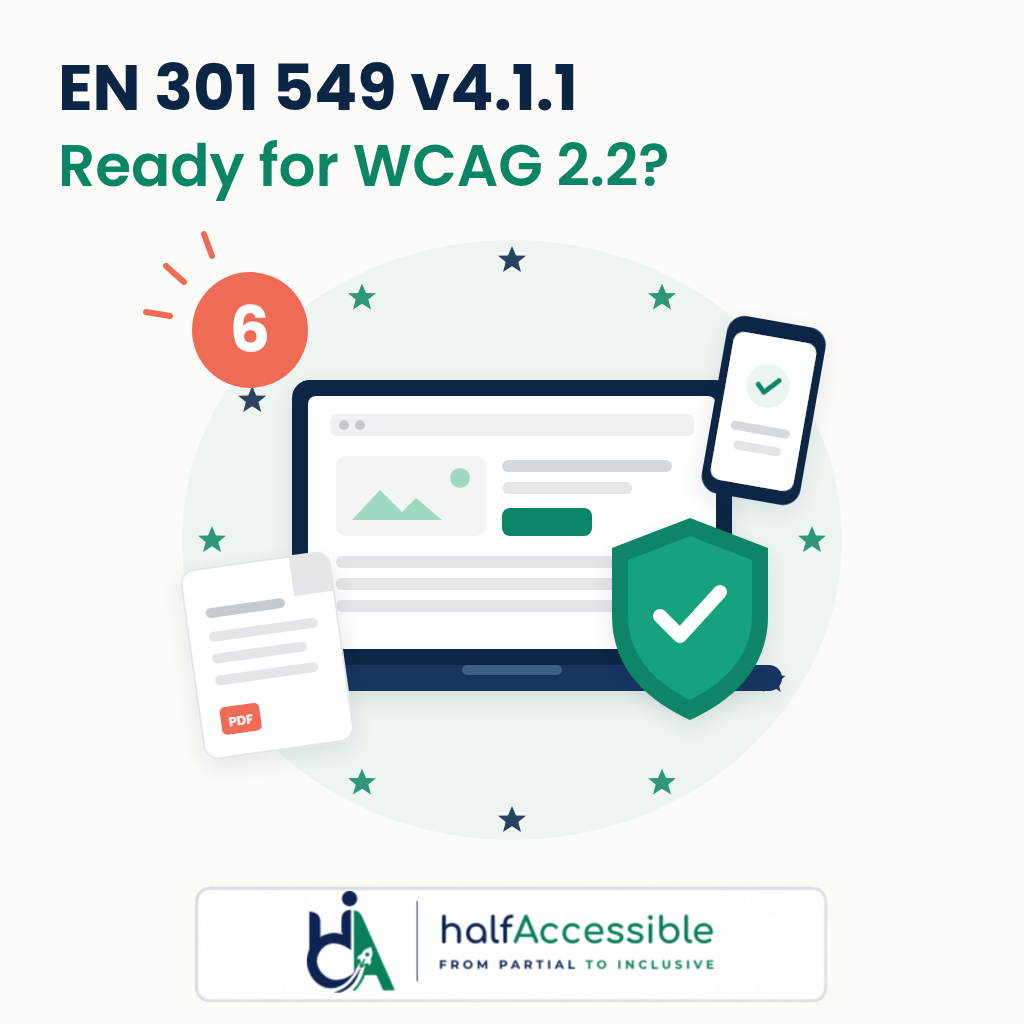
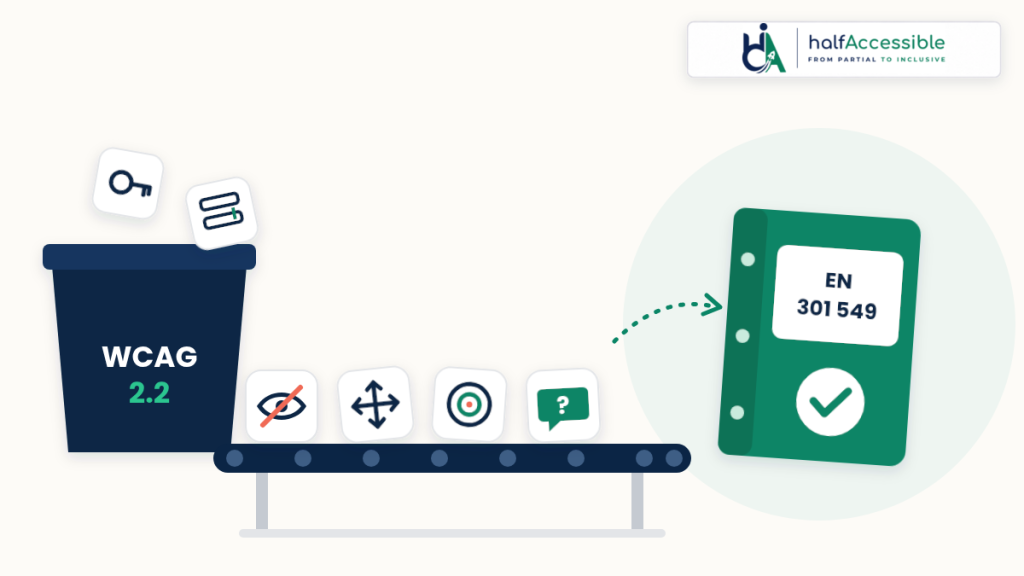
EN 301 549 v4.1.1 is the September 2026 update to Europe’s harmonised ICT accessibility standard. It moves the web, document and software baseline from WCAG 2.1 to WCAG 2.2 Level AA, revises real-time text requirements, and adds mapping annexes for the European Accessibility Act (EAA) and the Web Accessibility Directive. It is published, but it is not yet the Official Journal citation that confers presumption of conformity — so teams should prepare now without pretending the legal safe harbour has already flipped.
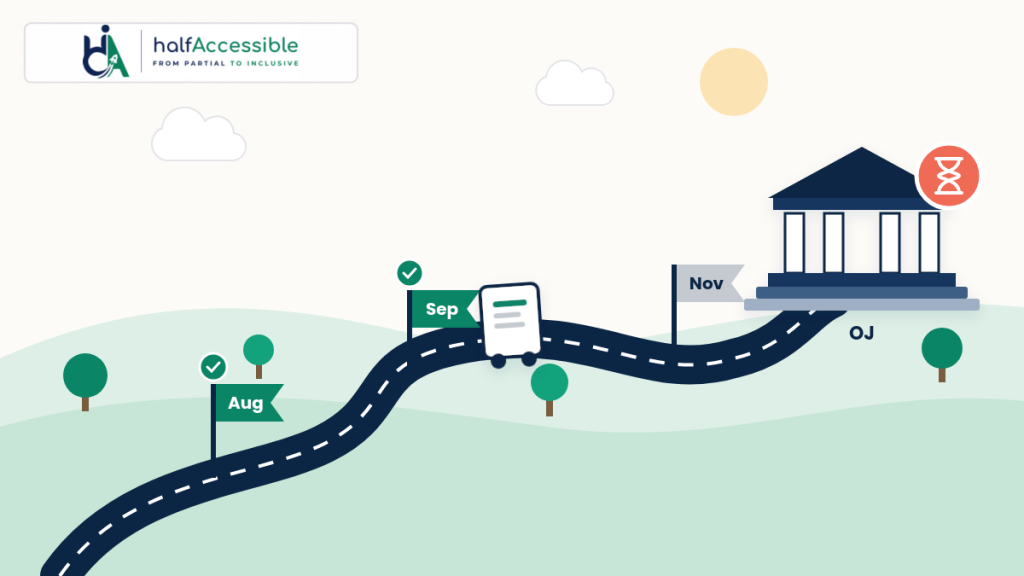
That timeline became concrete in early September 2026. According to the ETSI work-item record, EN 301 549 V4.1.1 was published on 2 September 2026. The official ETSI PDF records adoption on 24 August 2026, with national announcement by 30 November 2026 and endorsement by 31 May 2027. AccessibleEU and Ireland’s National Disability Authority both stress the same point: until the European Commission cites the new version in the Official Journal of the European Union, EN 301 549 v3.2.1 (2021) remains the cited reference for presumption of conformity.
This guide is written by accessibility testers who audit websites, apps, documents and ICT products for EU-facing organisations. It is not legal advice. It covers what changed in EN 301 549 v4.1.1, the six WCAG 2.2 Level A/AA criteria that dominate gap analyses, and a practical readiness plan.
What EN 301 549 Is — and Why Version Numbers Matter
EN 301 549 is the European technical standard for accessibility requirements for ICT products and services. It is broader than WCAG alone: it covers web content, non-web documents, software, hardware and related ICT services. Public-sector rules under the Web Accessibility Directive (Directive (EU) 2016/2102) and private-sector obligations under the European Accessibility Act (Directive (EU) 2019/882) both point to it as the technical reference for demonstrating conformity.
For who the EAA covers, see our European Accessibility Act guide and European Accessibility Act compliance article. For how EN 301 549 sits next to ADA, Section 508 and VPAT work, see which accessibility framework actually matters.
Version numbers matter because presumption of conformity attaches to the version cited in the Official Journal, not the newest ETSI PDF. Until citation exists, quote AccessibleEU: prepare for WCAG 2.2, but do not claim EN 301 549 v4.1.1 is already the legal reference.
What Officially Changed in EN 301 549 v4.1.1
The ETSI/CEN/CENELEC PDF lists the significant changes since EN 301 549 V3.2.1 (March 2021). The ones that matter for most digital teams are:
- Clauses 9, 10 and 11 now align with WCAG 2.2 for web pages, non-web documents and software.
- Clause 6.2 Real-Time Text (RTT) is significantly revised and extended to include total conversation (voice, real-time text and video together).
- A new Annex ZA maps the standard to the Web Accessibility Directive.
- A new Annex ZB maps the standard to the essential requirements of the European Accessibility Act.
- A new clause A.2 supports evaluating specific ICT products and services against those EAA essential requirements.
AccessibleEU adds that the update adds six new WCAG 2.2 requirements, removes obsolete WCAG 4.1.1 Parsing, and expects sites and documents to better respect users’ accessibility preferences. Deque’s technical summary warns that WCAG 2.2 AA alone is not full EN 301 549 — especially if Clause 6 applies.
| Layer | What v4.1.1 changes | Who feels it first |
|---|---|---|
| Web (clause 9) | WCAG 2.2 Level AA baseline | Sites, portals, ecommerce, SaaS web apps |
| Non-web documents (clause 10) | WCAG 2.2 alignment | PDFs, manuals, statements, invoices |
| Software (clause 11) | WCAG 2.2 alignment | Desktop clients, some embedded UIs |
| Real-time communication (clause 6) | Expanded RTT / total conversation | Telecom, contact centres, messaging, video |
| Legal mapping (ZA / ZB, A.2) | Clearer EAA and WAD paths | Compliance, legal, procurement |
Timeline: Publication Is Not Official Journal Citation
Keep these dates distinct when you brief executives:
- 24 August 2026: EN adopted (ETSI PDF).
- 2 September 2026: EN published (ETSI work-item milestone).
- 30 November 2026: latest announcement date (doa) in the ETSI PDF.
- 31 May 2027 / 31 May 2028: national endorsement (dop/e) and withdrawal of conflicting standards (dow).
- Official Journal citation: still pending. The NDA currently expects 16 December 2026, in line with ETSI’s current project schedule; earlier forecasts, including Deque’s, pointed to around 30 November 2026. Treat these as targets, not decisions — watch the Official Journal.
Until citation happens, V3.2.1 remains the cited presumption-of-conformity reference. That does not mean you should wait. The technical text is public, and the EAA has already been in force for in-scope products and services since 28 June 2025, as the NDA notes.
The 6 Must-Fix WCAG 2.2 Level A/AA Changes
WCAG 2.2, a W3C Recommendation since 5 October 2023, adds nine success criteria versus WCAG 2.1. Six are Level A or AA — the ones EN 301 549 v4.1.1 pulls into the practical target for web, documents and software. Details below follow W3C’s “What’s New in WCAG 2.2” page and the WCAG 2.2 Recommendation itself.
1. 2.4.11 Focus Not Obscured (Minimum) — Level AA
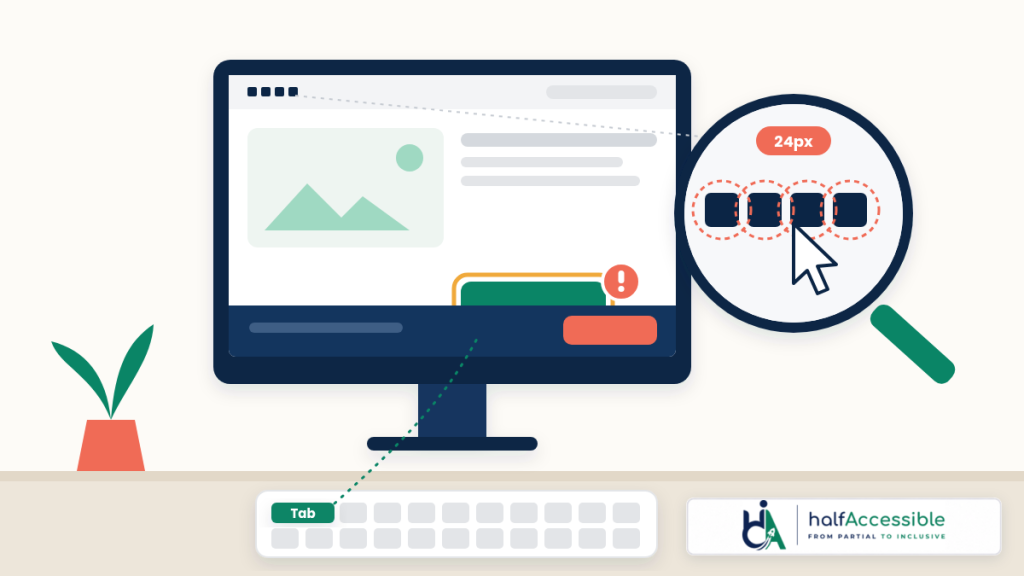
A focused control must not be entirely hidden by author-created content such as sticky headers, cookie banners or chat bubbles.
Where it fails: fixed “Book a demo” bars and chat widgets covering the focused control.
How to fix it: keep focused items visible, shrink or dismiss overlays during keyboard use, and include sticky UI in every keyboard pass. See our manual keyboard accessibility testing guide.
2. 2.5.7 Dragging Movements — Level AA
If a feature requires dragging, provide a single-pointer alternative unless dragging is essential.
Where it fails: kanban boards, drag-only sliders, crop tools, and reorder lists with no up/down controls.
How to fix it: add buttons or steppers that achieve the same result. Keep drag if you want — just don’t make it the only path.
3. 2.5.8 Target Size (Minimum) — Level AA
Pointer targets must be at least 24 by 24 CSS pixels, with documented exceptions for spacing, equivalent controls, inline text, user-agent defaults and essential presentations.
Where it fails: icon-only toolbars, packed social icons, pagination chevrons and mobile filter chips.
How to fix it: enlarge hit areas in the design system, or space undersized targets so their 24-pixel circles do not intersect.
4. 3.2.6 Consistent Help — Level A
Help mechanisms that appear on multiple pages — contact details, forms, self-help or chat — must occur in the same relative order unless the user initiates a change.
Where it fails: help links that jump from header to footer between templates.
How to fix it: put support entry points in one relative place in your templates and keep that order stable.
5. 3.3.7 Redundant Entry — Level A
Information already entered in the same process should be auto-populated or available to select, with limited exceptions for security or essential re-entry.
Where it fails: multi-step checkouts that force users to retype name, address or email.
How to fix it: persist earlier answers, offer select-from-previous controls, and avoid resetting forms on back steps.
6. 3.3.8 Accessible Authentication (Minimum) — Level AA
Do not require a cognitive function test — remembering a password or solving a puzzle — unless an alternative method, an assistive mechanism (password-manager / paste support), or an allowed exception is available.
Where it fails: login walls that block paste, CAPTCHA-only challenges, and “type the code” steps with no other path.
How to fix it: allow paste and password managers, offer magic-link or passkey options, and provide an accessible alternative whenever a cognitive test remains.
Beyond WCAG: Documents, Preferences and Real-Time Communication
If your EN 301 549 v4.1.1 programme stops at the six web criteria, you will under-scope.
Documents. Clause 10 alignment with WCAG 2.2 means PDFs and Office-style files need tagged structure, reading order and the new 2.2 criteria where they apply. AccessibleEU specifically recommends reviewing digital documents. See our PDF accessibility guide, document accessibility testing, and PDF document remediation.
User preferences. AccessibleEU notes websites and documents should better respect users’ accessibility preferences. Treat OS/browser settings (contrast, reduced motion, text size) as test conditions; confirm exact clauses in the ETSI text.
Real-time communication. If you ship calling, messaging, contact-centre or video products, Clause 6 matters. The ETSI PDF says RTT requirements in clause 6.2 were significantly revised and extended to include total conversation. Web-only retailers can usually park this; communications vendors cannot.
Mobile apps. Pair web remediation with mobile accessibility testing when an app is in scope for the EAA or public-sector WAD obligations.
A Practical EN 301 549 v4.1.1 Readiness Plan
- Confirm legal scope with counsel. EAA, WAD, both, or neither — this article cannot answer that for you.
- Inventory ICT in scope. Web properties, apps, customer PDFs, portals, and any real-time communication products.
- Run a WCAG 2.2 Level AA gap analysis on critical journeys, including sticky UI, authentication and multi-step forms. Scans help; they do not replace keyboard and screen reader testing.
- Expand to documents and software where clauses 10 and 11 apply.
- Fix the design system first. Target size, focus visibility, dragging alternatives and consistent help are component-level problems.
- Update procurement language. Ask vendors for EN 301 549 / WCAG 2.2 evidence. The NDA points procurement teams to TR 101 551 V2.1.1 (2026-02) on accessibility award criteria.
- Refresh VPAT / ACR drafts carefully. State which EN version and WCAG edition you evaluated, and do not claim Official Journal presumption before citation. See VPAT/ACR documentation.
- Train, remediate and re-test. Use accessibility training workshops, accessibility remediation, an accessibility audit, or an EU accessibility compliance audit. See our sample audit report.
How This Fits US ADA Work (Without Mixing the Rules)
US private-sector website risk still runs mainly through ADA Title III litigation, not EN 301 549. Moving to WCAG 2.2 helps on both sides of the Atlantic, but EAA presumption of conformity is an EU mechanism. Keep the evidence packs separate even when the engineering work overlaps.
The standard also travels beyond the EU. Australia adopts it as AS EN 301 549, and the Australian Human Rights Commission says its requirements should be met for digital products, using WCAG 2.2 where the standard still references 2.1 (see our Australia website accessibility audit). In practice, public bodies and the SaaS vendors that sell to them are usually the first to be asked for EN 301 549 evidence; our government and public sector and SaaS accessibility pages cover what those buyers expect.
Start Your EN 301 549 v4.1.1 Gap Analysis
EN 301 549 v4.1.1 is adopted and published; the six WCAG 2.2 Level A/AA criteria are public; the EAA mapping annexes are in the text; and Official Journal citation is the next formal step. Teams that inventory scope, fix design-system issues, and evidence WCAG 2.2 AA now will spend far less time firefighting later.
If you want a prioritised backlog mapped to EN 301 549 and WCAG 2.2, book an EU accessibility compliance audit or book a consultation to scope audit, remediation, PDF work and VPAT/ACR documentation.