Accessibility Audit Services

HalfAccessible delivers manual accessibility audit services for websites, web applications, mobile apps, SaaS platforms, PDFs, and enterprise software — combining automated scanning with hands-on testing by CPWA-, CPACC-, and WAS-certified specialists. Every audit is benchmarked against WCAG 2.2 AA, ADA Title II/III expectations, Section 508, the European Accessibility Act (EAA), and EN 301 549, and delivered as a developer-ready report your team can act on within days, not months.

Quick Answer

Accessibility Service Summary

Quick Answer

An accessibility audit is a structured evaluation of a website, application, or digital document to identify barriers that prevent people with disabilities from accessing digital content. A complete accessibility audit combines automated tools, manual keyboard testing, screen reader testing, mobile accessibility testing, and expert review against WCAG 2.2 success criteria to produce prioritized remediation guidance. According to the WebAIM Million report, an annual review of the top one million website home pages, the large majority contain detectable WCAG failures — which is why automated scans alone are never treated as a complete audit.

In Simple Terms

Think of an accessibility audit like a building safety inspection for your website or product. Instead of checking exits and alarms, it checks whether people using keyboards, screen readers, zoom, voice control, or other assistive technologies can understand content, navigate interfaces, complete forms, and finish important tasks.

Key Takeaways

  • WCAG 2.2 AA audit coverage
  • Manual and automated testing
  • Screen reader and keyboard validation
  • Developer-ready reports with remediation guidance
  • Optional retesting and procurement support
8+ Years of Accessibility Experience
CPWA, CPACC and WAS Certified Specialists
Manual + Automated Testing
Screen Reader Testing
Developer-Friendly Reports
Global Accessibility Consulting
Why Audits Matter

Why Accessibility Audits Matter

An audit shows how real users experience your digital product, not just what automated tools can detect.

Find barriers before users do

Accessibility barriers can stop customers from buying products, patients from accessing care, students from completing courses, and employees from using internal systems. An audit identifies those barriers before they become user complaints, procurement blockers, or legal risks.

Improve usability for everyone

The same improvements that help disabled users often improve the experience for everyone. Better form labels, clearer focus states, stronger contrast, consistent headings, readable error messages, and predictable navigation all make digital products easier to use.

Prepare for compliance requirements

Organizations use audits to understand gaps against WCAG 2.2, ADA expectations, Section 508, EN 301 549, PDF/UA, and other accessibility obligations. The audit gives teams a documented baseline and a prioritized plan.

Support enterprise procurement

Enterprise and government buyers increasingly ask for accessibility evidence before purchase. Audit findings, remediation plans, VPAT support, and retest results help product teams answer procurement questions with confidence.

Reduce long-term remediation costs

Finding accessibility issues early is usually cheaper than fixing them after launch. Audits help teams prioritize root causes, update reusable components, and avoid repeating the same issues across pages and releases.

Build accessibility into future releases

A good audit does more than list defects. It shows patterns your design, development, QA, and content teams can use to prevent similar accessibility issues in future work.

Audit Scope

What We Audit

We audit public websites, authenticated applications, SaaS platforms, mobile apps, documents, and design systems.

Websites

Corporate websites, marketing sites, government websites, university websites, healthcare websites, ecommerce journeys, landing pages, blogs, resource libraries, and multilingual content experiences.

Web Applications

Customer portals, admin dashboards, CRMs, internal software, enterprise workflows, complex forms, authenticated user journeys, data tables, reports, notifications, and role-based interfaces.

SaaS Products

B2B platforms, cloud software, analytics dashboards, AI applications, product onboarding flows, account settings, billing workflows, and feature-rich application screens.

Mobile Applications

Native iOS, native Android, hybrid applications, progressive web apps, orientation changes, touch targets, gestures, screen reader flows, zoom behavior, and mobile form interactions.

Digital Documents

PDFs, Word documents, PowerPoint files, forms, reports, policy documents, financial statements, healthcare documents, education resources, and procurement documentation.

Design Systems

Reusable components, UI libraries, pattern libraries, design tokens, Figma components, interaction patterns, and documentation that affects many pages or product screens.

Public-facing teams

Marketing, ecommerce, healthcare, government, education, nonprofit, and service organizations use accessibility audits to make essential public content available to more people.

Product and SaaS teams

Product teams use audits to validate complex workflows, reduce accessibility debt, improve component libraries, and prepare for enterprise accessibility reviews.

Procurement and compliance teams

Legal, compliance, procurement, and sales teams use audit evidence to answer buyer questions, support VPAT work, and document remediation commitments.

Website Accessibility Audits

Evaluate public websites against WCAG 2.2 AA using manual testing, automated scanning, keyboard-only navigation, and assistive technologies.

Web Application Accessibility Audits

Review authenticated user journeys, dashboards, complex forms, data tables, notifications, custom widgets, and enterprise workflows.

Mobile Accessibility Audits

Test native and hybrid applications using VoiceOver, TalkBack, keyboard alternatives, zoom, orientation changes, touch target review, and gesture accessibility checks.

PDF Accessibility Audits

Assess PDFs for PDF/UA support, semantic tagging, reading order, alternative text, bookmarks, form fields, headings, tables, and screen reader compatibility.

Accessibility Design Reviews

Identify accessibility issues in Figma files, design systems, and component specs before development begins, reducing rework and improving handoff quality.

VPAT And Procurement Reviews

Evaluate products and prepare accessibility documentation that supports enterprise and government procurement conversations.

Issues We Identify

Accessibility Issues We Identify

Each issue is mapped to user impact, WCAG criteria, severity, affected users, and practical remediation guidance.

Missing Alternative Text

Missing or inaccurate alternative text prevents screen reader users from understanding meaningful images, icons, charts, infographics, product photos, and linked graphics. In an audit, we identify images that need concise alternatives, images that should be marked decorative, and complex visuals that need longer explanations. We map findings to the relevant WCAG criteria and recommend practical fixes, such as better alt text, adjacent explanations, captions, or revised content patterns.

Keyboard Accessibility

Many users navigate with a keyboard, switch device, voice control, or assistive technology that relies on keyboard behavior. We test focus order, skip links, menus, modals, tabs, accordions, custom widgets, carousels, date pickers, and form flows without a mouse. We identify keyboard traps, missing focus indicators, unexpected focus movement, unreachable controls, and interactions that require pointer-only input.

Color Contrast

Low contrast can make text, buttons, icons, form controls, charts, and graphical objects difficult or impossible to perceive. We evaluate contrast for normal text, large text, UI components, focus indicators, disabled states, links, error messages, and data visualizations. Findings include exact locations, severity, recommended color adjustments, and notes where design tokens or component styles should be updated.

Forms

Forms often block users when labels, instructions, required indicators, validation messages, autocomplete attributes, grouping, and error handling are not accessible. We test forms with keyboard navigation and screen readers to confirm that users can understand each field, complete inputs, recover from errors, and submit successfully. We also review password fields, payment flows, search forms, filters, file uploads, and multi-step workflows.

Headings And Structure

Headings, lists, landmarks, tables, and reading order help assistive technology users understand a page quickly. We identify skipped heading levels, visual headings that are not semantic headings, incorrect lists, missing landmarks, confusing page regions, table header problems, and reading-order mismatches. These findings improve navigation for screen reader users and make content easier for search engines and AI systems to summarize.

Images And Media

Accessible media requires more than basic alt text. We review decorative image handling, informative image alternatives, captions, transcripts, audio descriptions, video player controls, autoplay behavior, and media keyboard support. For complex images such as charts or diagrams, we recommend alternatives that communicate the same information without overwhelming users.

Interactive Components

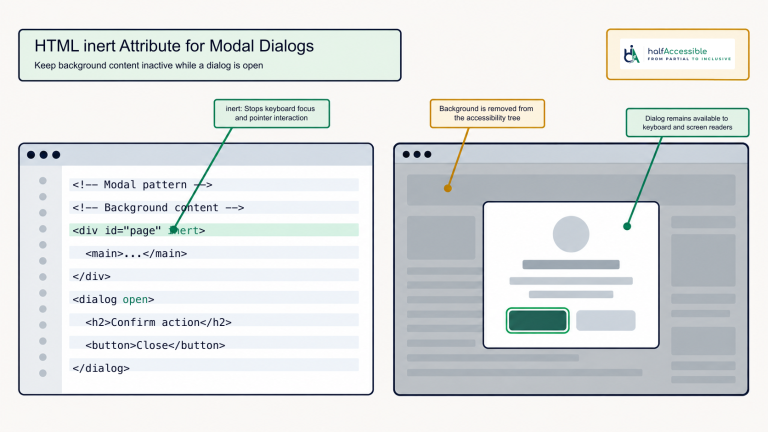
Dialogs, tabs, accordions, menus, carousels, date pickers, comboboxes, tooltips, drawers, and custom controls need correct semantics and predictable keyboard behavior. We test names, roles, states, focus management, escape behavior, announcements, and screen reader output. Findings include examples that help developers fix components at the source instead of patching each page one by one.

Tables

Data tables need programmatic relationships between headers and cells so users can understand rows, columns, totals, and comparisons. We review simple tables, complex tables, responsive tables, sortable tables, data grids, and financial or analytical reports. Recommendations may include header associations, captions, summaries, simpler table structures, or alternate layouts for small screens.

Dynamic Content

Modern applications often update content without refreshing the page. We test status messages, ARIA live regions, notifications, loading indicators, validation updates, filters, search results, and single-page app transitions. The audit identifies when important changes are not announced, when updates are too noisy, and when users lose context after interactions.

Authentication

Login, MFA, password reset, account creation, security prompts, and session timeout flows must be accessible because they control access to the entire product. We test labels, instructions, error recovery, one-time codes, password rules, captcha alternatives, focus order, timeout warnings, and accessible authentication patterns so users can sign in without unnecessary barriers.

Decision Support

How To Choose The Right Accessibility Service

Feature Automated Testing Manual Testing
Speed Fast (minutes) Slower (days)
Cost Low Higher, but more accurate
Manual WCAG Review No Yes
Keyboard Navigation Limited Complete
Screen Reader Compatibility No Yes
Logical Reading Order No Yes
Meaningful Alternative Text No Yes
Form Usability Partial Yes
Overall User Experience No Yes

Helpful Statistics

  • 1 in 6 people The World Health Organization estimates that roughly 1 in 6 people globally live with a significant disability — a substantial share of any organization's customers, patients, students, or employees. WHO Disability Fact Sheet →
  • WCAG is the international technical baseline. WCAG is the international technical baseline. Many regulations and procurement processes reference WCAG directly or indirectly when defining accessibility requirements. W3C WCAG →
  • 56.1 errors per page The WebAIM Million report has found detectable WCAG failures on the large majority of home pages tested every year since the study began — most commonly low-contrast text, missing alternative text, empty links, and missing form labels. WebAIM Million →

Choose This Service If You Need

  • ADA accessibility risk review
  • WCAG 2.2 AA readiness
  • Enterprise procurement support
  • Accessibility lawsuit prevention
  • Better UX for keyboard and screen reader users
  • A developer-ready remediation roadmap
Audit Methodology

Our Accessibility Audit Process

A structured process gives your team clear findings, clear priorities, and a practical path to remediation.

Standards And Technologies

Standards, Assistive Technologies, And Platforms We Support

NVDA JAWS VoiceOver TalkBack Keyboard-only navigation Browser zoom Voice Control Switch Control Axe ARC Toolkit WAVE Accessibility Insights Chrome DevTools Safari Firefox React Next.js Angular Vue WordPress Drupal Shopify Magento WooCommerce Laravel ASP.NET Java Flutter React Native
Deliverables

What You Receive After The Audit

Executive Summary

A clear summary of audit scope, key risks, priority themes, and recommended next steps for stakeholders.

Accessibility Score

A practical status snapshot that helps teams understand current accessibility maturity and remediation priorities.

Detailed Issue Report

Issue-by-issue findings with screenshots, affected URLs or screens, severity ratings, WCAG references, and reproduction steps.

Developer Recommendations

Practical remediation guidance, code-level notes, component recommendations, and examples your developers can act on.

Accessibility Roadmap

A prioritized path that separates urgent blockers, high-impact component fixes, content improvements, and longer-term governance work.

Optional Retest Report

Validation evidence after remediation, showing which issues were fixed and what remains open.

Healthcare

Accessibility audits for patient portals, provider websites, medical forms, telehealth journeys, and healthcare documents.

Government

Audits for public services, citizen portals, forms, documents, procurement requirements, and Section 508 alignment.

Banking

Audits for financial journeys, statements, account dashboards, authentication flows, reports, and high-risk transactional experiences.

SaaS

Audits for B2B products, dashboards, analytics, onboarding, admin settings, and enterprise procurement readiness.

Education

Audits for university websites, LMS experiences, EdTech platforms, digital documents, admissions journeys, and student services.

Retail

Audits for ecommerce product pages, carts, checkout, filters, account flows, promotions, and customer support journeys.

Certified Accessibility Expertise

HalfAccessible brings CPWA, CPACC, and WAS accessibility expertise to audits, remediation support, documentation, and product guidance.

Developer-Friendly Reporting

Reports are written for action. Developers receive clear reproduction steps, expected behavior, affected users, WCAG mapping, and remediation guidance.

Enterprise Experience

We support teams preparing for procurement, compliance reviews, product launches, design system improvements, and accessibility governance.

Practical Turnaround

Audit scope is tailored to your product and priorities so your team receives useful findings without unnecessary reporting overhead.

Checklist

Accessibility Audit Checklist

  • Page title is unique and descriptive
  • Headings follow a logical structure
  • Landmarks identify major page regions
  • Keyboard users can reach every interactive element
  • Focus order matches the visual and logical order
  • Visible focus indicators are clear
  • No keyboard traps are present
  • Links have meaningful accessible names
  • Buttons have meaningful accessible names
  • Images have appropriate alternative text
  • Decorative images are ignored by assistive technology
  • Text meets contrast requirements
  • UI components meet non-text contrast requirements
  • Forms have labels and instructions
  • Required fields are programmatically identified
  • Errors are described in text
  • Error messages are associated with fields
  • Autocomplete attributes are used where appropriate
  • Dialogs manage focus correctly
  • Menus, tabs, and accordions expose state
  • Tables include appropriate headers
  • Dynamic updates are announced when needed
  • Media includes captions or transcripts
  • PDFs include tags and reading order
  • Mobile screens support zoom and orientation
  • Touch targets are large enough
  • Authentication flows are accessible
  • Reports include WCAG references and remediation guidance

Ready to Make Your Digital Products Accessible?

Whether you're launching a new website, responding to a demand letter, preparing for enterprise procurement, or improving an existing platform, our certified specialists will identify every real accessibility barrier — not just what automated scanners catch — and hand your team a prioritized, developer-ready roadmap. Most audits are scoped and quoted within 1–2 business days.

Request an Accessibility Audit
Accessibility Audit FAQs

Frequently Asked Questions

Answers to common questions about accessibility audits, manual testing, screen readers, WCAG, remediation, procurement support, and retesting.

What is an accessibility audit?

An accessibility audit is a structured review of a website, application, mobile app, or document to identify barriers for people with disabilities. It combines automated scanning, manual WCAG review, keyboard testing, screen reader testing, and expert analysis.

How long does an accessibility audit take?

Timeline depends on scope. A small marketing website may take a few days, while an enterprise SaaS product, authenticated application, or large document set may take several weeks. We confirm scope and timeline before starting.

How much does an accessibility audit cost?

Audit cost depends on page count, workflows, technology stack, document volume, and reporting needs. HalfAccessible scopes audits before work begins so you know the estimated effort and priorities.

Do you manually test every page?

We manually test representative pages, templates, components, and critical user journeys based on the approved scope. For large sites, this usually includes key templates and high-risk workflows rather than every URL.

Do you use screen readers?

Yes. We test with screen readers such as NVDA, JAWS, VoiceOver, and TalkBack when relevant to the platform and scope.

Can automated tools find every accessibility issue?

No. Automated tools are useful for detecting many code-level issues, but they cannot reliably determine logical reading order, meaningful alternative text, keyboard usability, screen reader compatibility, or overall user experience.

Which WCAG version do you test against?

We typically test against WCAG 2.2 AA unless your organization needs a different target such as WCAG 2.1, Section 508, EN 301 549, or PDF/UA.

Do you provide remediation?

Yes. HalfAccessible can provide remediation guidance, developer support, and direct code fixes depending on your technology stack and project needs.

Can you retest fixes?

Yes. Retesting verifies that accessibility fixes resolve the original barriers and do not introduce new issues in affected flows.

Do you support enterprise procurement?

Yes. We support audit evidence, remediation roadmaps, VPAT and ACR preparation, accessibility documentation, and buyer-facing accessibility conversations.

Do you audit mobile apps?

Yes. We audit iOS, Android, hybrid, and progressive web applications using mobile screen readers, zoom, orientation checks, touch target review, and mobile interaction testing.

Can you audit password-protected applications?

Yes. We can audit authenticated applications, portals, dashboards, CRMs, admin systems, and SaaS products when test credentials and representative workflows are provided.

Do you test PDFs?

Yes. We audit PDFs for tagging, reading order, headings, tables, links, forms, alternative text, bookmarks, metadata, and screen reader compatibility.

Which browsers do you test?

Browser coverage depends on scope, but commonly includes Chrome, Safari, Firefox, and relevant mobile browsers.

Which assistive technologies do you use?

Depending on scope, we use NVDA, JAWS, VoiceOver, TalkBack, keyboard-only navigation, browser zoom, voice control, and platform accessibility features.

What does the audit report include?

Reports include issue descriptions, affected locations, expected and actual results, user impact, severity, WCAG references, screenshots, reproduction steps, and remediation recommendations.

Do you include code examples?

Where useful, we include code examples or implementation notes so developers understand how to fix the issue in context.

Can you audit React, Angular, Vue, or Next.js apps?

Yes. We audit modern JavaScript applications, including React, Next.js, Angular, Vue, and other component-driven frameworks.

Can you audit WordPress, Shopify, or Drupal sites?

Yes. We audit WordPress, Shopify, Drupal, WooCommerce, Magento, and other CMS or ecommerce platforms.

Do you audit design systems?

Yes. Auditing design systems and reusable components is one of the best ways to reduce repeated accessibility issues across products.

Do you review Figma designs?

Yes. Accessibility design reviews can identify issues before development, including contrast, focus behavior, form patterns, component states, headings, and interaction design.

Will an audit make my site compliant?

An audit identifies barriers and provides a remediation roadmap. Compliance improves when the identified issues are fixed, validated, and supported by ongoing governance.

Can you help prioritize issues?

Yes. Findings are prioritized by severity, user impact, compliance risk, frequency, and remediation complexity so teams know where to start.

Can you work with our developers?

Yes. We can join walkthrough calls, answer developer questions, review fixes, and help teams address accessibility issues at the component level.

Do you provide VPAT support after an audit?

Yes. Audit findings can support VPAT or ACR preparation, especially for SaaS products and organizations selling to enterprise or government buyers.

Do you audit documents separately from websites?

Yes. Documents often require a dedicated audit because PDF/UA, tagging, reading order, and document structure are different from web page testing.

How do we start?

Send us the URL, application type, representative workflows, target standard, and any deadlines. We will recommend an audit scope and next steps.

What is the difference between an accessibility audit and an accessibility scan?

An accessibility scan is an automated tool checking code for detectable errors, usually in seconds. An accessibility audit includes that scan plus manual keyboard testing, screen reader testing, and expert human review — because issues like logical reading order, meaningful alternative text, and real usability can’t be reliably detected by software alone.

How often should we run an accessibility audit?

Most organizations audit annually at minimum, and after any major redesign, feature launch, or CMS/platform migration. Regulated industries (healthcare, government, banking) or teams with frequent releases often pair a full annual audit with ongoing monitoring in between.

Do accessibility audits help with AI search visibility?

Yes, indirectly. Fixes like semantic headings, descriptive link text, proper landmark structure, and logical reading order are the same signals that help AI search tools and language models parse and summarize your content accurately. Sites that pass accessibility checks are often easier for AI crawlers to extract correctly.

What happens if we don't fix the issues found in an audit?

Unresolved barriers keep blocking real users, increase legal and procurement risk, and compound as more pages and features get built on the same inaccessible patterns. We provide a prioritized roadmap specifically so teams can tackle urgent blockers first without needing to fix everything at once.